The Catholic View of ‘Having It All’
COMMENTARY: As Pope St. John Paul II suggests: Where women need to be in the workforce or feel called to it, the world should help them out in a way that honors them back for the gift they give society.
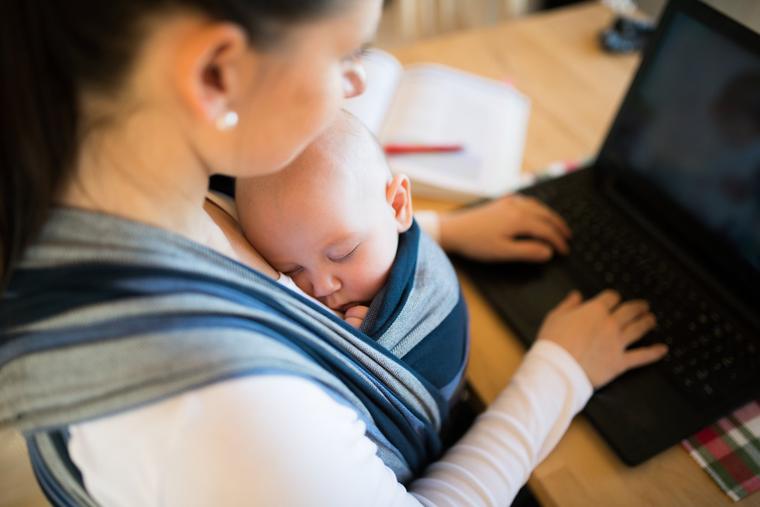
Apparently, I am “having it all” — or so says The Wall Street Journal, which interviewed me for a piece about how conservative women are “juggling work and family on their own terms.”
A few weeks ago, I was interviewed for the piece, which, at the time, seemed like it would be comparative: Why are women who tend to self-identify as being “on the right” more successful at balancing marriage and motherhood with work, as compared to women who might self-identify as being on the left?
My answer was fairly simple: When you lean on your faith or a more traditional ideology — and you have more traditional beliefs — family comes first, no matter what.
Our culture often downplays parenthood, and, more specifically, motherhood, as a valuable pursuit, and if you’re raised in, and believe, that family is, above anything else, your priority as a human and not just as a worker, it helps you to better set your priorities, both in choosing a spouse and in ordering your life.
“The public message you hear in the culture is ‘Your life is over if you have a baby and you’ll never accomplish anything,’” I told the WSJ. “But what I always heard from fellow conservatives was to pursue a vocation and have a family, because that’s one of the greatest things you can do to contribute to the future.”
The truth is, that’s often what I heard from fellow Catholics, because as Catholics, we are given an incredible gift: the understanding that each of us is not simply a child of God, but an idea of God, made in his image, and given inherent dignity. When you feel called to a vocation, it sets the tone for how you will order your life and you structure your relationships, and that’s how you set your priorities.
In any case, that’s family. Everything else just fits in around family.
Unfortunately, most of what I told the WSJ ended up on the cutting-room floor, and while that’s perfectly fine, the WSJ piece ultimately inspired a conversation among Catholics and self-identified conservatives as to what it truly means to “have it all” and whether balancing work and home life is really what “having it all” really means.
Even the women most adept at “balancing” are really making a trade-off: The amount of time spent with children shifts for those working, in say, the Trump White House, even if it is just a temporary assignment, and many women, like me, are privileged to be able to work from home — but even I need a village to raise my family.
To be clear, women can work, though it’s clear from almost every study that children benefit greatly from having their mother as their primary caretaker in their early years. Pope St. John Paul II made as much clear in his groundbreaking 1988 apostolic letter Mulieris Dignitatem, on the dignity and vocation of women, and his 1995 “Letter to Women.”
“Thank you, women who work!” the Pope said in his 1995 letter. “You are present and active in every area of life — social, economic, cultural, artistic and political. In this way, you make an indispensable contribution.”
He went on to say that it isn’t just that women can work, but that women in the workplace use their unique talents as mothers to shape culture and policy, adding that our gifts, which come to us by virtue of being women, are as necessary in public life as in private life.
He also noted, of course, that women are uniquely torn between the call of their vocations in the world and their need to care for their own families. As Catholicism recognizes, women are not the same as men; they can never be the same as men, and such differences don’t make us lesser. The world, he said, should not reject women in the workplace for those reasons, but should adapt to help women address the gravitational pull of their families, even as they address the problems of the world.
“The growing presence of women in social, economic and political life at the local, national and international levels is thus a very positive development,” St. John Paul II noted in his “Women: Teachers of Peace” message, also released in 1995. “Women have a full right to become actively involved in all areas of public life, and this right must be affirmed and guaranteed, also, where necessary, through appropriate legislation.”
What happens, though, in real life? Well, things get messy. Kids don’t always come along on our schedule. Work is sometimes less about following a calling and more about simply keeping a roof over our heads and food on the table.
It’s a privilege to be able to balance work and family life, because that means some of the basic needs are met and one parent doesn’t have to work a 60-hour-a-week job (or jobs!) just to afford groceries.
The world is changing, though, to meet St. John Paul II’s vision: Remote work is now more popular than ever, and women who feel the pull to a working vocation can find ways to follow it while structuring their lives with their family at the forefront, which is, as we know, where the family should be.
I am different than a lot of the women mentioned in the article. My high-powered days are, at least I think, mostly behind me. I’ve worked in politics and in the news business, and it was hard to juggle wanting to be present at work with wanting to be present at home. I’m now home more often (though my kids, now a bit older, aren’t), and money isn’t as tight. But even when things looked different than they do now, the Catholic model of the family still provided the best road to balance.
The most important foundation to a good family is a good marriage, and a good marriage looks like a good partnership. The more communication and support that exists between spouses, with an understanding that each person has a unique role, the more both spouses can follow their call from God, no matter what that call is. A good marriage is also open to children and those related joys and sacrifices.
Catholics also understand that while you might be able to “have it all,” you can’t actually have it all at the same time: That is, there are seasons to life, and priorities don’t just shift based on who is in a family, but what season the family is in. When kids are younger, they take up more time and energy, and the work isn’t always engaging or mentally stimulating. When they’re older, the work does get more involved, on a mental and intellectual level, even if older kids are more capable of, say, putting pants on independently (though, to be fair, we still haven’t mastered that one).
God’s plan for our lives is immense. The One who scattered the stars also authored our purposes on earth, and that’s daunting — but we don’t have to do it all at once, and we don’t have to do it alone. Catholic spouses lean on each other, whether that’s in deciding who washes the dishes and changes the diapers, or who provides the health insurance with the steady employment.
We are getting each other to heaven, and part of that involves getting the kids to school on time.
Because children are a gift, not a burden.
Too often in the modern world, we hear about how children will ruin our life, not enrich it. That the sacrifice made by mothers for their children — whether mental, financial or otherwise — is a subversion of a woman’s identity and purpose, rather than the puzzle piece that completes it.
As mothers, our love for our children is all-consuming, but it’s also this incredible superpower. It rewards us with color in our lives and shapes our priorities in a way that honors God and our families. Yes, motherhood is a sacrifice, but there’s only one true way to shape the future, and that is by “leaning in” — to use a corporate phrase — to our own maternal nature because that maternal nature is exactly what St. John Paul II was referring to when he said that women are positioned to benefit the culture in a unique way.
Even women who don’t have biological children are called to lean in to their maternal nature. They are mothers of the Church, mothers of invention, mothers to the world. Spiritual mothers. Theological mothers. And we don’t get to leave that behind just because we like our jobs.
That idea alone is enough to keep a Catholic woman grounded, even when she sees an opportunity to make a difference in the wider world. And the wider world should respond in kind, as St. John Paul II suggests: Where women need to be in the workforce or feel called to it, the world should help them out in a way that honors them back for the gift they give society. Remote and part-time work options, as well as expanded paid parental leave and more reasonably priced maternal care, are all necessary to help all women, not just the lucky ones like me, get this balance.
And I am lucky. A lot of my life fell into place in God’s time, and it worked out. I’m lucky to have a supportive Catholic husband, a great network of caregivers and educators who are there when I can’t be, and a fulfilling job. But putting faith first helps even when the road is long and the world is hard. You can’t always have it all, but you can have God, and that’s the key to everything else.
- Keywords:
- catholic families
- holiness and motherhood
- working mother
- feminine genius
- pope st. john paul ii