Pope Leo XIV Will Visit France Amid Its First Assembly on the ‘Catechumen Boom’
A provincial ecclesial assembly studying France’s surge in adult catechumens has already drawn interest across Europe and the U.S., a hot topic that Leo may address during his September visit.
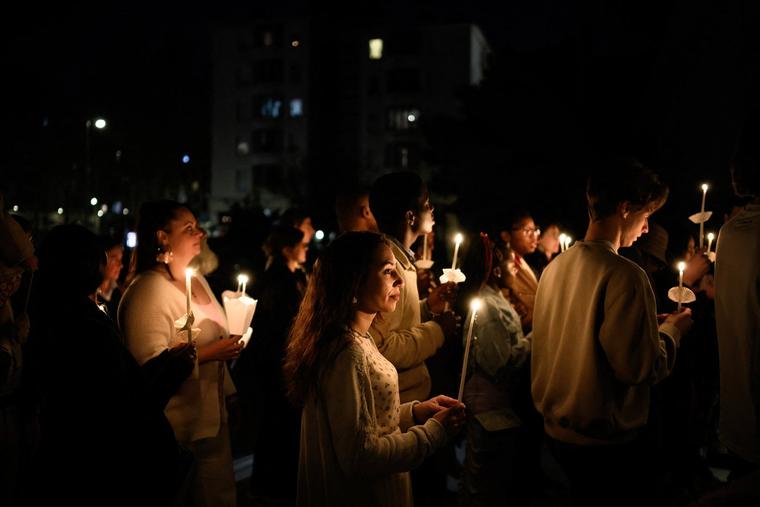
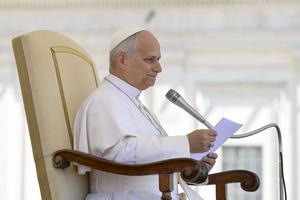
Pope Leo XIV’s visit to France, scheduled for Sept. 25-28, comes at what appears to be a time of grace for a national Church still recovering from decades marked by scandal and decline. It coincides, in fact, with a major institutional overhaul designed to address the new challenges posed by the surge in the number of catechumens in the country since 2022.
Last year, the bishops of Île-de-France — the region encompassing the greater Paris area — announced that they would hold a provincial assembly dedicated to this issue. It is only the seventh such council held within the Church since Vatican II and the first ever devoted specifically to the wave of new converts.The number of people entering the Catholic Church has been on the rise over the last decade, with more than 13,000 people baptized across France this Easter, a 28% increase compared to 2025. Increases ranging from 10% to 30% have been recorded over the past four years.
The deliberations, based on parish consultations over the past few months, are in full swing this summer, with the first working session set to open on Oct. 10, shortly after the Pope’s visit to France. The process is expected to conclude in the summerof 2027, when a final text is voted on and sent to the province’s bishops.
The Pontiff’s remarks during his upcoming visit to France are expected to directly inform the delegates’ discussions, which will already be drawing on tens of thousands of testimonies from the flock.
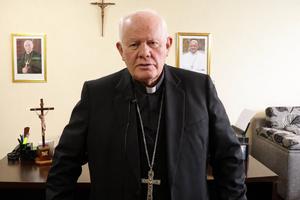
For Father Maximilien de la Martinière, the assembly’s secretary general, the topic of the catechumenate and neophytes could very well be among the subjects addressed by the Pope during his visit — all the more so, as he mentioned in an interview with the Register, since the council has generated considerable interest, including abroad. Rome has reportedly already requested access to the instrumentum laboris, the council’s working document.
Converts’ Counterintuitive Profiles
If this large-scale consultation is of interest to the French episcopate — and others beyond it — it is because it offers rare and detailed information on who these catechumens really are, at a time when a renewal of the Catholic faith is being observed almost everywhere in the West. The sheer scale of the initiative itself lends it significant weight and authority: Nearly 45,000 people participated in the small-group sessions organized throughout the province as part of this consultation, producing approximately 850,000 words of testimonies — “more than the length of the Bible,” commented Father de la Martinière — an unusual volume for this type of internal Church initiative.
What it has revealed so far runs counter to certain preconceived assumptions about the identity of these converts, starting with the one that tends to associate them with a mere political reaction linked to concerns about national identity and immigration.
The survey’s findings, indeed, complicate such a narrative. “Motivation based on identity,” the French priest said, “is virtually absent among the catechumens interviewed by the assembly, who very rarely mentioned a search for their roots.”
“Perhaps they have looked more toward heaven than at their feet in searching for their roots,” he said. “They seem to be asking themselves more the question, ‘Where do I want to go?’ than ‘Where do I come from?’”
Additionally, contrary to what the assembly itself had anticipated, social media is not the main gateway to the Church either. The consultation concluded that the influence of social media was “fairly minimal,” according to the assembly’s secretary general, while a study conducted by the French Bishops’ Conference last Easter revealed that social media ranked only eighth among the factors cited by respondents. What tops the list, in fact, is human experience — whether it be a profound spiritual experience, a bereavement, a trial, or, more simply, a testimony or a faith-focused encounter. “It’s often friends who bring other friends to the faith,” Father de la Martinière said.
He specifically mentioned the recent story of a young woman who, inspired by her own grandmother’s example of faith, had called a parish to ask where to start. “All of this is concrete; it’s feedback from the field, and it’s worth more than any theory.”
New Convert Anxiety
Two fears recur constantly in the testimonies gathered during the consultation, expressed in almost identical terms from one parish to another: “Do I have the right to pray?” “Do I have the right to enter?” and “Will people think I’m an idiot?”
For many newcomers, Father de la Martinière explained, the Church remains an unknown territory — a world where they think they need to know a secret password to enter.
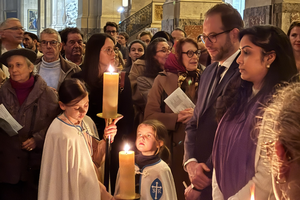
The most telling example, he said, is that of a 16-year-old boy who showed up alone at the back of a parish church last winter and spontaneously asked to be baptized. When asked if he knew what baptism was, he admitted he had no idea — adding that people on social media had told him that was the right answer to be welcomed. “He’s asking to be baptized, but what he’s really asking for is to be loved.”
The findings of the consultation highlighted the problem that parishes often send a contradictory message to newcomers. “We tell them, ‘You have to find your place,’” Father de la Martinière explained. “And at the same time, we do nothing to actually make room for them.”
The single most sensitive subject to emerge, he said, was the welcoming and long-term accompaniment of people in what he called “borderline” situations — those divorced and remarried, but mostly homosexual people. “The challenge is to find the most appropriate way to accompany them along the way, with love and truth at the same time,” he said. “That’s what the Church has been trying to do for a thousand years.”
Getting people through the door, the secretary general argued, may not even be the assembly’s most difficult challenge. “The after-baptism period can be the riskiest. People get lost precisely because we’ve maybe focused too much on the idea that once baptism is done, that’s it; our work is finished — and not enough on bringing them into the community, a dimension we probably need to develop more.” The accompaniment itself, he added, is long — often a year and a half — “and there can be failures,” he admitted. “It’s not all rosy.”
The instrumentum laboris’ findings will not automatically become policy. The province’s 12 bishops, not the delegates who will vote on the assembly’s final text, will ultimately decide what gets promulgated.
France as a Laboratory
The assembly’s reach already extends well past Île-de-France. Father de la Martinière said he has fielded spontaneous outreach from other provinces in France and from bishops’ conferences or religious communities from Poland, the Czech Republic and the United States, while Belgium and Switzerland already sent observers to the council — evidence, he believes, that Paris is seen as something of a laboratory, a model slightly ahead of everyone else.
This points to the paradox of this historical phenomenon, witnessing a resurgence of faith following a period that, in many respects, should have driven people away from the Church. “Against all expectations, we are witnessing this resurgence, this collective revival, which I find very providential,” Father de la Martinière said. According to him, the Church in France is also “aided by the anxiety-inducing and depressing climate that prevails in the contemporary world.”
These reflections already resonate with the theme of Pope Leo XIV’s visit to France: “So That the World May Have Life.” Judging by the strong mobilization already taking place in French dioceses in anticipation of his visit, this is an exhortation that many in the country seem to need to hear — further proof, according to Father de la Martinière, of a vitality that many believed had vanished forever.
- Keywords:
- 'pope leo xiv'
- france
- converts to catholicism