Are the US Ambassador and Vatican News Both Wrong About the Pope’s Status as a Head of State?
ANALYSIS: There is much to unpack in the recent back-and-forth between U.S. Ambassador Brian Burch and the Vatican’s editorial director.
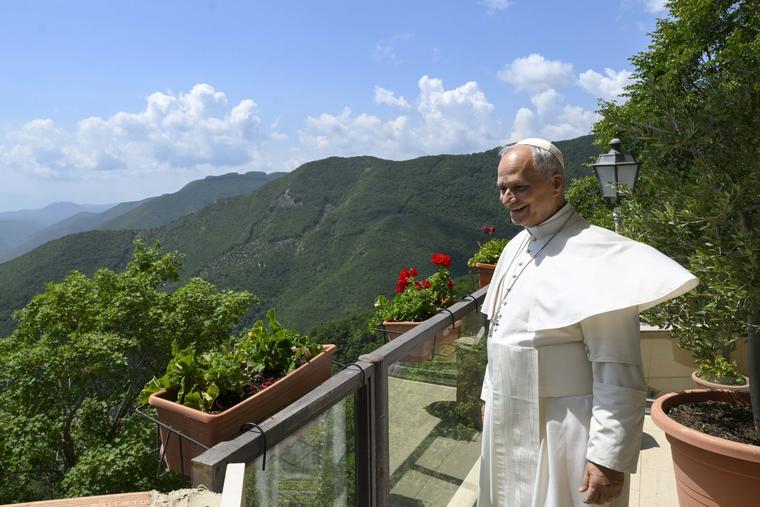
In a rare occurrence this past week, official Vatican media weighed in on a controversy surrounding some recent remarks by U.S. Ambassador Brian Burch, America’s diplomatic representative to the Holy See.
Vatican media sought to reiterate, “The Pope always speaks as a shepherd.”
That was the title of an editorial by Andrea Tornielli, the editorial director of Vatican Media, which appeared to be a direct response to an interview Burch had given to The New York Times.
Published a few days before Tornielli’s editorial but conducted in June, the Times’ interview with Burch quoted the ambassador as saying that the Pope’s opinion, when he speaks as head of state, is equal to that of other heads of state.
There’s a lot to unpack, both in Burch’s remarks and in Tornielli’s editorial.
Tornielli explains that the fact that the bishop of Rome is also sovereign of Vatican City State does not mean he acts or speaks as a political leader when intervening on issues that concern humanity.
Tornielli notes that the existence of Vatican City State serves to guarantee full independence for Peter’s successor in the exercise of his spiritual mission, but this does not mean that the pope has both political and religious functions.
To support this argument, Tornielli recalls that Paul VI, at the United Nations on Oct. 4, 1965, emphasized that the pope had “no temporal power nor ambition to compete” with the leaders of nations. Prior to his election to the pontificate, then-Cardinal Giovanni Battista Montini argued in 1962 that after the end of the Papal States, the papacy could better develop its mission as a teacher and witness to the Gospel.
In short, “any exaltation or exaggeration of the role of the pontiff as head of state is misleading” because it “diverts attention from his one true mission as universal pastor,” who, when he speaks in defense of life, peace and disarmament, or calls for moving beyond the concept of just war, or gives attention to the poor and religious freedom, simply proclaims the Gospel.
In The New York Times, Burch emphasized that the pope, as head of state, should be considered on par with other heads of states. He noted that the Holy See “has not said nor will it definitively declare” whether the conflict between Israel, the United States and Iran is a just war, that the pope would do so in his capacity as head of state, and that the doctrine of just war requires that governments decide; the pope cannot have enough information to define it.
Now, the U.S. ambassador’s statements have limitations.
For one thing, the just-war tradition of thinking has very clear criteria, developed over literally thousands of years, and Leo told journalists during his flight to Spain on June 6 that the Iran conflict doesn’t meet them.
“I believe this has already been made very clear,” Leo said, adding that “in Iran, the criteria for a just war are not present.”
“The theory of the just war dates back to centuries when it was impossible to imagine the weapons and the destructive capacity available to humanity today,” Leo also said.
In his recent encyclical letter, Magnifica Humanitas, the Pope said just-war theory is “outdated” largely because of modern weapons’ destructive power, following a path that started with John XXIII’s encyclical Pacem In Terris.
Preventive war, in the end, can never be a just war.
That the pope’s opinion, as head of state, is separable from that of a religious leader is true up to a point.
The pope cannot be defined as a head of state like all the others because, especially when he speaks diplomatically, he is the Holy See. He does not represent the Holy See; he is the Holy See. According to canon law, the pope, the Holy See and the Secretariat of State are synonymous.
So the question isn’t whether the pope is a head of state. The issue is the international representation of the Holy See.
This international representation continued even during the period when, following Italy’s invasion of the Papal States, Pope Clement VII went into self-exile in Castel Sant’Angelo and the Holy See was left without a state.
In those years, however, diplomatic relations multiplied. Leo XIII was even invited to the 1899 Hague Peace Conference, and he did not attend solely because of Italian opposition — which did not want to recognize the Holy See’s sovereignty — but sent a message containing, among other things, the seeds of many of the reforms initiated by the era of multilateralism.
It is therefore striking that the Vatican News article focuses only on the pope’s role as pastor.
The pope is a pastor, and the pope proclaims the Gospel. But the Gospel is also proclaimed diplomatically, through an enormous diplomatic network (184 bilateral relations) and also by defending life, the family and rights in international forums.
The pope never speaks only as a pastor, because otherwise the speech the pope gives to the diplomatic corps accredited to the Holy See, the speech to the diplomatic corps and to civil society that constitutes the first appointment of every apostolic journey, or even the speech Pope Leo gave before the Spanish Cortes during his trip to Spain, would be meaningless.
But all this is missing from the Vatican News editorial, which is primarily eager to eliminate the possibility of considering the pope a head of state like any other. He isn’t, but he’s not simply a pastor either.
This nuance, likely considered obvious and implicit, isn’t found in the text, thus giving the impression that Leo XIV intends to exercise only that role, creating a short circuit in the perception of the pope’s diplomacy.
Thus, both the interview that sparked the controversy and the response lack some key elements essential for better understanding the context. The U.S. ambassador’s remarks aren’t surprising since the Trump administration has always used this distinction between head of state and spiritual leader to try to separate the Pope’s words from the government’s actions.
It’s surprising that Vatican News didn’t emphasize the diplomatic work but rather sought to demonstrate that the pope is merely a functional head of state, devoid of temporal power.
It has been said that the Vatican News article was requested by Leo XIV himself, or at least by higher-ups, and that the Pope wanted to read and approve it first. If true, then three conclusions can be drawn.
Burch’s interview would have been almost uninteresting without this response from the Vatican because, beyond the American linguistic narrative, Burch uses U.S. terminology and is essentially addressing an American audience.
If the Pope asked for a response, it’s because he cares about perceptions in the U.S.
Indeed, if you think about it, he also gave his first interview for a book by an American journalist, Elise Allen, published in Spanish for a Peruvian audience, to clarify his position on certain past situations.
Leo XIV doesn’t want to give the impression that he’s prioritizing the United States in his thoughts, but U.S. public opinion is taking it that way.
Second, there is a substantial difficulty in defining the Holy See as it is.
The pope’s sovereignty over Vatican City State seems to obscure the fact that the Holy See has international sovereignty independent of territory, as if the Holy See’s presence in the international arena needs to be justified, rather than reaffirmed. These are new times, in which it is difficult to explain the meaning of the pope’s diplomacy.
But not everything can be reduced to a pastoral understanding. Otherwise, the pope becomes — and truly in this case — one spiritual leader among many. But the pope has never been one spiritual leader among many. And the Holy See, precisely in this sense, has been the third party remembered for peace since time immemorial.
Moreover, Montini wasn’t the only one who spoke of the providential nature of the loss of the Papal States. Benedict XVI, speaking in Germany, also spoke of the providential nature of the secular trends that allowed for a de-worldly Church.
That doesn’t mean, however, defending the loss of sovereignty. It means emphasizing that, if sovereignty becomes merely a structure, it loses sight of its original motivations.
The third conclusion concerns communication.
Why should Vatican Media respond to an ambassador’s statements, even indirectly? Why is there a need to clarify an ambassador’s statements?
This is an important issue because it concerns the very dignity of the Holy See and the way it interacts with the world.
Once upon a time, such a comment as Burch’s would simply have been ignored, an internal protest launched, or the ambassador summoned for an explanation.
The fact that everything is now being exposed in the media is indeed evidence of a modernization of the Holy See.
- Keywords:
- papal history
- papal diplomacy