Why Pope Leo Quoted Tolkien’s Gandalf
COMMENTARY: Anyone who sees the world through the Eucharist, as Tolkien and Pope Leo do, will judge AI not by its power but by its service to the human person.
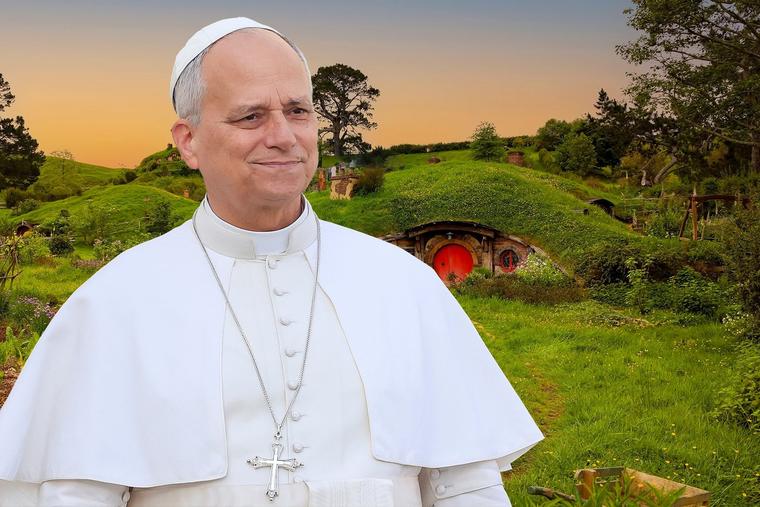
There has been much discussion of Pope Leo XIV’s first encyclical, Magnifica Humanitas, which tackles the dangers and challenges of new technology, especially artificial intelligence. This is the latest in a series of papal documents addressing contemporary social issues that began with Pope Leo XIII’s groundbreaking 1891 encyclical Rerum Novarum.
It is no surprise, therefore, that Leo XIV’s new encyclical should be full of quotes from recent popes. What is a surprise is that there’s also a quote from a wise old wizard from J.R.R. Tolkien’s The Lord of the Rings. In the midst of quotes from Leo XIII, Pius XI, Pius XII, John XXIII, Paul VI, John Paul II, Benedict XVI and Francis, there are the following words of wisdom from Gandalf, spoken to his young hobbit companion Frodo as they discuss the growing shadow of evil in Middle-earth:
It is not our part to master all the tides of the world, but to do what is in us for the succour of those years wherein we are set, uprooting the evil in the fields that we know, so that those who live after may have clean earth to till.
Pope Leo follows these words with the lesson that we should learn from them: “The civilization of love will not arise from a single or spectacular gesture, but from the sum total of small and steadfast acts of fidelity that serve as a bulwark against dehumanization.”
Much could and should be said about the many other lessons that the Holy Father seeks to teach in his first encyclical but let’s concentrate on Gandalf’s words and the Pope’s response to them.
Essentially, Gandalf is saying that localism is the only effective response to globalism. None of us, as individuals, as mere pint-sized hobbits in a world of great and largely dark powers, can defeat the power of global corporations and the invasive technology that they are trying to impose upon us. “It is not our part to master all the tides of the world.”
On the other hand, we are called “to do what is in us for the succour of those years wherein we are set.” We are only called to attend to the times in which we live and to work to make the world in which we find ourselves a better place by loving and serving those around us. It is pointless worrying about how evil our own time is and equally pointless to vainly wish that things were different.
“I wish it need not have happened in my time,” Frodo complains to Gandalf.
“So do I,” Gandalf replies, “and so do all who live to see such times. But that is not for them to decide. All we have to decide is what to do with the time that is given us.”
No, we cannot choose the time in which we are born. We might wish to have lived, as Frodo does, in more peaceful and virtuous times, unravaged by war and wickedness, but that is not for us to decide. What we do need to decide is what to do with the time that is given us in the times in which we find ourselves. In the words that Pope Leo quotes, Gandalf tells us that we cannot stop all the wars and all the wickedness, we cannot “master all the tides of the world,” but we can decide to fight wickedness where we find it in our own small sphere of influence, “uprooting the evil in the fields that we know, so that those who live after may have clean earth to till.”
Our calling, our responsibility, is to be good and faithful stewards of the good things we’ve been given and to be good and faithful servants of the Lord our God and of those who are our neighbors in the Shire in which we live, and of those who will be born after us.
But what, we might ask, does a wise and wizened old wizard in a fantasy story by Tolkien have to do with the Lord our God? And, for that matter, what has The Lord of the Rings to do with the Lord our God?
Tolkien, a lifelong and devout Catholic, answered the latter question when he stated unequivocally that “The Lord of the Rings is, of course, a fundamentally religious and Catholic work.” As for Gandalf, he declares as he faces the demonic Balrog that he is “a servant of the Secret Fire.” Elsewhere, Tolkien reveals that the Secret Fire is the Holy Spirit, which makes Gandalf a servant of the One True God. Gandalf hints as much when he tells Frodo that Bilbo’s finding of the Ring was part of God’s Providence:
There was more than one power at work, Frodo…. [T]here was something else at work, beyond any design of the Ring-maker. I can put it no plainer than by saying that Bilbo was meant to find the Ring, and not by its maker. In which case, you were meant to have it. And that may be an encouraging thought.
And this brings us back to Pope Leo’s commentary upon Gandalf’s wisdom: “The civilization of love will not arise from a single or spectacular gesture, but from the sum total of small and steadfast acts of fidelity that serve as a bulwark against dehumanization.” We are called to fight the power of sin, the power of the Ring, in the way that Frodo does. He is small. He is humble. He’s a mere hobbit of the Shire. He is not one of the high and mighty ones, nor does he wish to be. Yet he triumphs over evil by “the sum total of small and steadfast acts of fidelity.”
Pope Leo is right. The civilization of love is built not on the spectacular gestures of those in power but on the exaltation of the humble.
But the humble cannot defeat evil on their own. They need help. They need the help of neighbors. They need the fellowship of friends as Frodo does. But they also need the help of God. They need the supernatural assistance which theologians call grace. This crucial reality is emphasized by Pope Leo in Magnifica Humanitas through his insistence on the importance of the Eucharist:
The spirituality that we need is a Eucharistic spirituality, that is, a spirituality of ecclesial unity in love. The Incarnation and the Paschal Mystery reveal God entering into our human condition and transforming it through the gift of himself. This gift remains present and active in the Eucharist…. [T]he Church — nourished by the Eucharist — is called to make visible a different paradigm [from new technologies], one that preserves human connections, gives a voice to the invisible and ensures that processes are aimed at respecting people’s dignity.
Again, there are parallels between The Lord of the Rings and the teaching of the Holy Father. Tolkien’s deep love for the Blessed Sacrament finds expression in the form of lembas, the elvish waybread, which sustains Frodo and Sam as they enter into the valley of death known as Mordor. Lembas has the power to feed the will and is the only thing that Frodo and Sam have to eat during their time in the lifeless desert of Mordor. We are told that “lembas” means “life-bread” or the “bread of life,” connecting the “magic” bread which feeds the hobbits with the miraculous Bread of Life with which Christ feeds all those who are in communion with him.
As for Tolkien himself, his own love for the Eucharist was made manifest in his description of the Blessed Sacrament as “the one great thing to love on earth”:
Out of the darkness of my life, so much frustrated, I put before you the one great thing to love on earth: the Blessed Sacrament. … There you will find romance, glory, honour, fidelity, and the true way of all your loves on earth, and more than that: Death: by the divine paradox, that which ends life, and demands the surrender of all, and yet by the taste (or foretaste) of which alone can what you seek in your earthly relationships (love, faithfulness, joy) be maintained, or take on that complexion of reality, of eternal endurance, which every man’s heart desires.
We’ll let these words of Tolkien speak for themselves and will allow them to illustrate clearly that Tolkien and Pope Leo see eye to eye on AI. Anyone who sees eye to eye on the Eucharist will see eye to eye on lesser things, even lesser things of great and potentially dark power, such as artificial intelligence. There is a great difference between articulate wisdom and artificial intelligence as there is a great difference between virtuous reality and virtual reality.
Tolkien knows the difference. Pope Leo knows the difference. And this is why the Pope’s meeting with Gandalf is a match made in heaven.