The Young Laywoman Who Reignited the Church’s Missionary Zeal
COMMENTARY: From small acts of prayer and sacrifice grew a renewed understanding of how lay Catholics share in the Church’s mission.
Last weekend, spread across three locations, 26,000 young adults gathered for SEEK, the annual conference sponsored by FOCUS (the Fellowship of Catholic University Students), to learn and celebrate the faith, to adore the Eucharistic Jesus, and to be inspired to live as missionary disciples.
They showed what several popes and scores of youth ministers have long emphasized: that young people are not just the future of the Church, but a crucial part of the Church now.
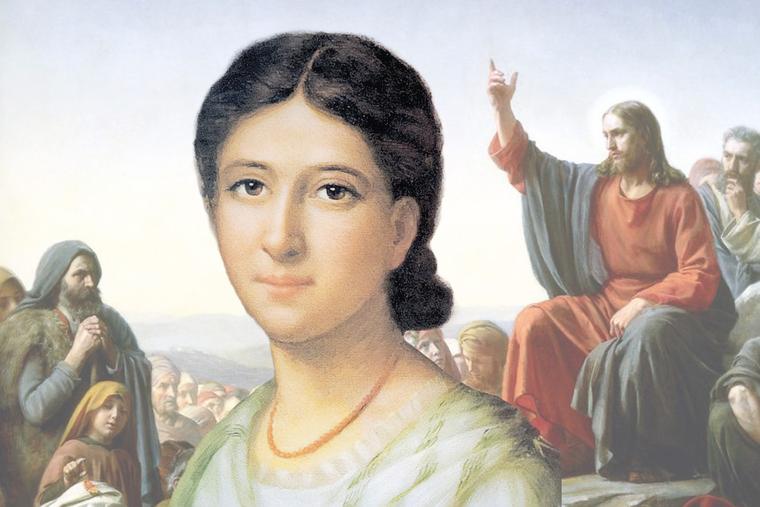
Today, the Church celebrates the memorial of one of the consequential young people in Church history. In her young 20s, Blessed Pauline-Marie Jaricot helped found what became the Society for the Propagation of the Faith.
Like the young boy in the Gospel whose five loaves and two fish became the raw material for Jesus’ miracle of the feeding of the multitudes, Blessed Pauline is an inspiring witness to Catholics young and old of the entrepreneurial inventiveness of youth that, placed in God’s providential hands, can change both the Church and the world.
Born in Lyon, France, in 1799 to a well-to-do family, Pauline’s early life was marked by social privilege and cultural refinement. She loved music, dancing, fine clothes and the admiration of others. After hearing a homily on vanity when she was 17, she experienced a radical conversion from worldliness and began to dedicate herself to pleasing God and helping others come to know and love him.
In prayer, she was given a vision of two lamps: one empty, representing the faith in post-revolutionary France, and the other overflowing with oil, symbolizing the vibrant faith of mission territories. In her vision, she saw the oil flowing from the full lamp into the empty one, which she interpreted as an indication of how post-revolutionary France would be re-evangelized by the oil of faith, hope and love overflowing from mission territories.
So she began to organize circles of 10 women at a time to pray an Our Father, Hail Mary, and invocation of St. Francis Xavier each day for the success of the missions, and to contribute a sou, or penny, a week to help fund church-building and programs in missionary territories.
What she began as a small movement soon grew and, in 1822, with the help of others, became formalized. Soon there were thousands of circles of 10. The initial support of the society helped the French Foreign Mission Society in its work in China, Japan and Vietnam and — hugely important for us in the United States — the Church in the then-Diocese of Louisiana and the Two Floridas (stretching from the Florida Keys to the Canadian border) and the Diocese of Bardstown, Kentucky, which was created in 1808 when it was split from the Archdiocese of Baltimore alongside the new dioceses of Boston, New York and Philadelphia.
Further support from the society was essential to the growth of the Catholic Church in the United States until it ceased being a missionary territory in 1908, helping to build cathedrals, churches, seminaries, convents, schools and so much of the infrastructure of the Church.
In the first century of its existence, the Society for the Propagation of the Faith gave more than $7 million to build up the Church in the United States, the equivalent of about $135 million today. Two centuries later, the society — with the help of the United States, which has been its main donor more than 110 years — continues to fund the Church’s growth in the 1,130 missionary dioceses and territories worldwide.
Everything began with a young laywoman asking the Lord in prayer what she could do to help assist missionaries, like her older brother Phileas, who aspired to be one. From that humble beginning of prayers and pennies in 1822, the Society for the Propagation of the Faith was born and grew rapidly.
Blessed Pauline presciently saw that every Catholic, through prayer and daily work, could — and is called to — participate in the Church’s missionary mandate.
Exactly one century after its founding, Pope Pius XI adopted the society as pontifical and brought its headquarters to the Vatican’s Congregation for the Propagation of the Faith (now the Dicastery for Evangelization). Together with the other three pontifical mission societies — the Missionary Childhood Association, the Society of St. Peter the Apostle, and the Pontifical Missionary Union — the Pontifical Society for the Propagation of the Faith helps continue Blessed Pauline’s missionary work and vision, building churches and chapels, erecting and funding Catholic schools, forming thousands of seminarians and religious novices, and helping the Church survive, grow and begin to thrive — at which point dioceses graduate from missionary status and become self-supporting.
The Pontifical Mission Societies likewise facilitate the spiritual exchange that Blessed Pauline envisioned, whereby missionaries bring the light of faith (symbolized by oil lamps) to the ends of the earth and, in turn, the vibrant faith of mission territories — keeping that light burning brightly — begins to overflow, enriching and renewing the faith of established Catholic communities.
That is very much what is happening in the Church in the United States today, as the generosity of generations of American Catholics to the Society for the Propagation of the Faith is now being rewarded by God through the work of so many priests and religious coming to serve here from Nigeria, Kenya, Uganda, Tanzania, India, Vietnam and other countries full of missionary dioceses and territories.
Blessed Pauline also founded something else in 1826, which marks its 200th anniversary this year.
In order to revive the faith of the French after the spiritual ravages of the French Revolution, she founded the Association of the Living Rosary. Using a similar methodology to the early days of the Society for the Propagation of the Faith, she formed groups of 15 people, asking each participant to commit each day to praying a given one of the then-15 mysteries of the Rosary.
She realized that to spread a renewed love of the Rosary, it would be easier to have people pray one mystery a day than five or 15, and that the commitment would be strengthened by their awareness that the other 14 members were counting on them. For her, the Rosary was never a private devotion detached from the world and its needs, but an opportunity to enter into, and emulate, the Mother of God’s solicitude for all her children.
As we celebrate the bicentennial of the Living Rosary Association, which remains very active in France and helped inspire Archbishop Fulton Sheen’s World Mission Rosary initiative in the United States, it’s an opportunity for us to commit ourselves to the prayer that nourishes missionary zeal and makes possible missionary fruitfulness.
Recent popes have heaped praise upon Blessed Pauline and lifted up her example for us to follow.
Pope Benedict XVI stated in 2012 that she “inspired a new missionary impetus in the Church.”
Pope Francis said in 2012:
A young 23-year-old woman, Pauline Marie Jaricot, had the courage to found a society to support the missionary activity of the Church. … Pauline Jaricot loved to say that the Church is missionary by nature and that every baptized person therefore has a mission; rather, is a mission.
Pope St. John Paul II, celebrating the bicentenary of her birth in 1999, said she was “distinguished at a young age by an unprecedented spirit of initiative” that led her to encourage “a life of prayer and the missionary activity of the whole Church. … Pauline's witness reminds us that mission is an issue of faith. Concerned to extend the Church on all the continents, as in her own surroundings, she inspired great missionary zeal in her own time. Learning from Pauline, the Church must … continue her missionary tradition in its most varied forms.”
Pope St. Paul VI said of her in 1972:
This young girl knew how to face, from 1819, a pressing need of the Church and to associate the whole People of God with it; his views have proved to be insightful and truly prophetic. … If, with abnegation, she left it to others to develop this work, she was nonetheless, in her own words, ‘the first match to light the fire.’
Today, as we prayerfully mark the 153rd anniversary of her birth into eternal life, we ask the Lord to stir into a flame within us the fire of missionary zeal and prayer that he used her to ignite.
- Keywords:
- blessed pauline-marie jaricot
- society for the propagation of the faith
- association of the living rosary
- lay faithful
- missionaries
- france
- pontifical mission societies
- pontifical missions