Does Our Lady of Guadalupe’s Tilma Still Speak to Us Today?
COMMENTARY: Researchers continue to examine the tilma’s stars, flowers and even the reflections in Our Lady’s eyes. Their findings, while speculative, deepen appreciation of an image that transformed a culture — and still stirs hearts now.
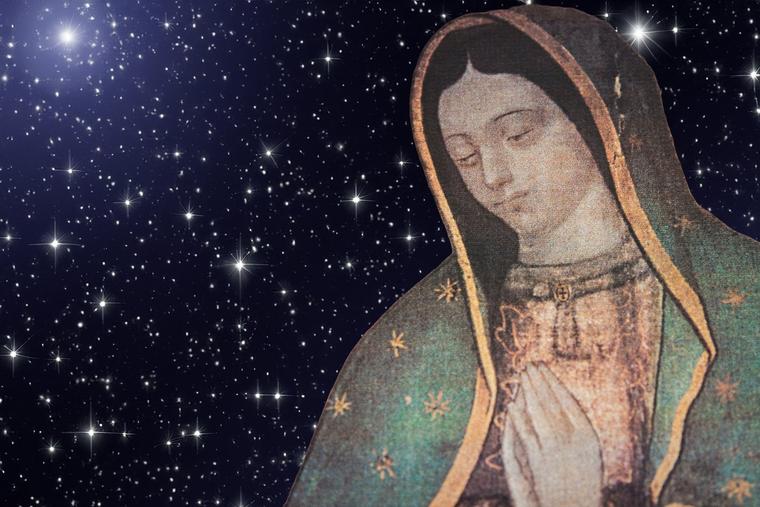
During the decade after Our Lady’s miraculous image was found on St. Juan Diego’s tilma in Mexico in 1531, an estimated 10 million Aztec people converted to Christianity because they saw in the image’s codex or “picture manuscript” details and symbols from their own culture.
Since then, theologians and scientists have continued to study the physical properties and context of the Mexican apparitions from the image impressed on the humble cactus-fiber garment. In recent decades, mathematicians, theologians, astronomers and engineers using modern technology have proposed that further information may be embedded in the tilma’s imagery.
In 1531, the Blessed Mother appeared four times to St. Juan Diego, an Aztec peasant and convert to Christianity, at Tepeyac Hill (now part of Mexico City). She requested that St. Juan Diego ask his bishop to build a church in her honor, according to EWTN.
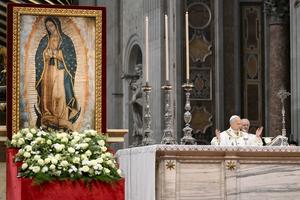
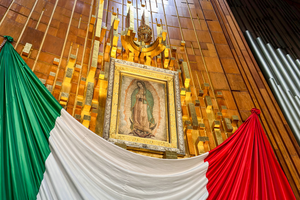
During her final apparition on Dec. 12, 1531, St. Juan reported that Our Lady arranged roses in his tilma, asking him to bring them to his bishop, who had requested a sign. As it was winter, no roses were growing in the area. When St. Juan opened his tilma to show the bishop the roses, the now-famous image of Our Lady of Guadalupe became visible.
Due to widespread devotion to Our Lady depicted in the tilma — who, according to Aztec tradition, appears pregnant — in 1999 Pope St. John Paul II bestowed on her the title “Patroness of the Americas.” Three years later, the Holy Father canonized St. Juan Diego.
In 1981, Mexican priest and astronomer Father Mario Rojas and Juan Hernández Illescas, a medical doctor and amateur astronomer, analyzed the 46 stars on Our Lady’s mantle on the tilma and argued that the stars may correspond to an accurate map of the night sky on the night of the apparition, according to MiracleHunter.com.
They further proposed that configuration might appear reversed — as if seen from behind, looking through the stars toward the earth.
Another longtime researcher, Fernando Ojedo Llanes, an account and mathematician from Mérida, Yucatán, has also studied the stars and other imagery on the tilma. He observed that the flowers on Our Lady’s gown seem to him proportionate to Mexico’s principal volcanoes.
He also noted that the stars forming the visible constellations appeared symmetrical to him. Drawing from the Greek philosopher and mathematician Pythagoras, Ojeda proposed that a golden rectangle may be present in the star formation on the mantle. A golden rectangle is formed if a square is added to the long side of a rectangle or removed from the short side, according to Wikipedia. When a square section is added or removed, the product is another golden rectangle, having the same aspect ratio as the first.
Knowing that Pythagoras also taught that music is found in perfect symmetry, he drew a vertical line between 23 stars on the left and 23 on the right, viewing them as musical notes, and outlined what he believed might be a musical composition. Ojeda asked a musician friend to play it on the piano.
Since introducing the musical piece in 1990, Ojeda has offered recordings of the piece with different instrumental and choral settings on his website. Other vocal and instrumental versions are available on YouTube.
Other studies have focused on the details found in Our Lady’s eyes. A Peruvian engineer, Dr. José Aste Tonsmann, began scanning at high resolution in 1979 a photo of her eyes on the image. Magnifying her eyes 2,500 times, Tonsmann reported that he believed he could see 13 human figures reflected in her eyes, including one corresponding to images of St. Juan Diego’s bishop, Juan Zumárraga.
He thought he saw in the magnification not only the bishop but a group of people he believed might be a family, consisting of parents and several children. He surmised that two other figures behind the family might represent grandparents, according to the Catholic Company.
Finding with modern technology what could be a family reflected in Our Lady’s eyes on the tilma, Tonsmann wondered if his finding may be a revelation for our time, as the family is especially under attack, the article stated.
Through her image, Our Lady of Guadalupe’s codex showed God’s love to millions of Aztecs and helped end the Aztec practice of human sacrifice. In a different age but amid comparable attacks on human dignity, Our Lord and his Blessed Mother may continue to draw hearts to conversion through the miraculous image in the 21st century, as abortion, trafficking and other violence continue to take the lives of many.
- Keywords:
- our lady of guadalupe