New Old Movie Review: Bing Crosby and ‘Going My Way’
Released in 1944, the Bing Crosby classic blends faith and humor into a film whose appeal has only deepened with time.
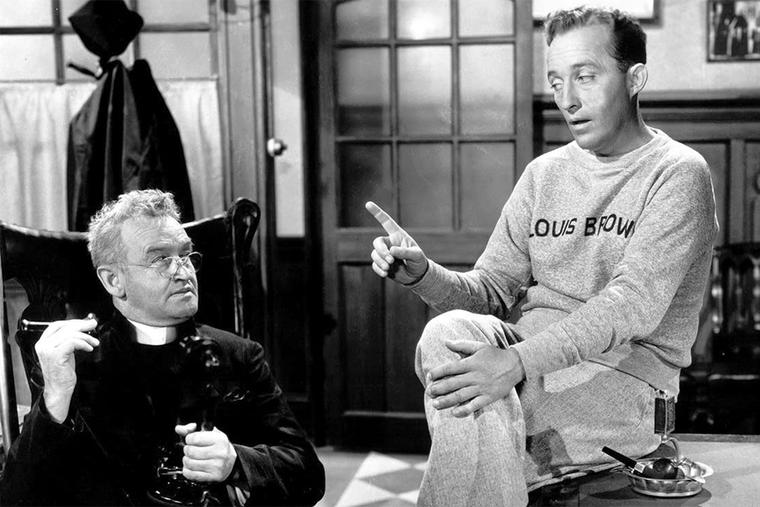
As families look for wholesome, inspiring stories to watch together, few classics fit the bill as well as Going My Way (1944), which was the winner of seven Academy Awards — including Best Picture, Best Direction, Best Actor, Best Supporting Actor and Best Screenplay — making it one of the most critically-acclaimed movies in Hollywood history.
Set in New York City, the comedy-drama-musical centers on a young priest, Father Charles O’Malley (Bing Crosby), who has been sent by the bishop to help the elderly Father Fitzgibbon (Barry Fitzgerald) save his parish, which is threatened with foreclosure. Upon arrival, the young priest makes a poor impression, causing Father Fitzgibbon to humorously ask, “Young man, as a matter of curiosity, what made you become a priest?”
As Father O’Malley begins his work, he surveys the parish and parishioners, as well as the characters in the area. He has a run-in with an atheist who unjustly blames O’Malley for breaking a window in a neighborhood baseball game. After taking repeated verbal jabs from the man and watching the man throw the baseball across the street in anger, O’Malley evaluates his technique: “You even throw like an atheist.” O’Malley notices a group of boys who are well on their way to a life of crime. To counter that, Father teaches them to sing and forms a choir, helping them understand their dignity and worth.
Father O’Malley also helps a young woman who has left home to become a singer. Later in the film, the woman gets married in a wedding ceremony conducted by Father O’Malley, to the angry disapproval of her father-in-law. Meeting in their apartment for the first time, her husband’s father assures the young couple, “Oh, I’ll have that annulled!” And then the young husband responds to his father with words that made me want to run up to my TV and give this film a hug. The husband shakes his head and says, “You can only get them annulled when they aren’t right in the first place. Ours was right. We said something about ‘Till death do us part.’” Then he turns to his smiling wife, and says, “Remember?”
Notwithstanding the other beautiful scenes, the best parts of the film involve the relationship and growing friendship between O’Malley and Fitzgibbon. Old age versus youth is one of my favorite literary and cinematic themes, and it plays out beautifully in the film. When Father Fitzgibbon discovers that the bishop had sent Father O’Malley to take over the parish, the old priest begins to doubt himself and his effectiveness. But Father O’Malley provides poignant reminders as to how much the parish needs Father Fitzgibbon.
The film forms a powerful illustration of a basic reality that we Catholic laity sometimes forget: Priests are human. Parish priests must routinely shoulder the crosses of their parishioners. And just as Jesus wept, so do priests.
One of my most resonating takeaways from this film is the invaluable goodness, greatness and centrality of the ordinary — yet extraordinary — parish priest. Many of us Catholics need to recognize the priest’s inestimable value much more than we do. Sadly, maybe some of them have forgotten, too.
We live in an age in which diocesan priests can become celebrities; indeed, many have. But whether that celebrity is good for their souls or the souls of their parishioners can be another matter entirely. Over the years, I’ve grown increasingly concerned for those parish priests (and bishops) who seem to feel the need — who appear eager — to travel outside their dioceses. Maybe they truly believe that it is not just their parish who needs to hear their words, but rather, the whole world.
I would recommend them, however, to St. John Vianney — the patron saint of parish priests — who never traveled more than a few miles from his parish church in his entire life. For Father John Vianney, his parish truly was the whole world.” And because of the souls that were saved within the confines of that tiny parish, the devil himself became frightened that just five Father John Vianneys could vanquish the devil’s hellish rule on earth.
I hope that priests have not lost sight of their importance and centrality in their own parishes. Alas, I know that we members of the laity have been sometimes remiss in reminding them.
Perhaps this is the perfect time for us to provide that reminder.
Especially for the priests reading this, I am confident I can speak for a good number of the laity when I say that my favorite priests are not the famous ones, but rather the men who hear my confessions and the confessions of my sons and daughters — over and over again. They are the men who wake up before sunrise every morning to say daily Mass for my fellow parishioners and myself. They are those faithful men who baptize my children. They are the ones who bless my scapulars and rosaries and Advent candles. These valiant men have foregone the goods of marriage and family, that my marriage and family may grow closer to God. As these men so often have a word of encouragement for me, even when I forget to have one for them.
These priests — these Father O’Malleys and Father Fitzgibbons — may be relative unknowns outside their parishes, but I suspect they’re just fine with that. And God bless the makers of this film for providing that reminder to us, and giving us a wonderful family film to watch together for Christmas.