The Surprising History of the ‘Fiddleback’ Chasuble
COMMENTARY: The evolution of the fiddleback chasuble offers a glimpse into how function and fashion shaped liturgical garments.
Bishop Michael Martin of Charlotte, North Carolina, has become the lightning rod in the latest wrinkle of the liturgy wars. The initial issue was diocesan policies toward the traditional Latin Mass, but the controversy expanded after the draft of a document on diocesan liturgical norms going far beyond the Latin Mass was leaked and became public.
The document contained a laundry list of practices and rubrical prescriptions Bishop Martin wanted to impose because he believed they were entailed by the liturgical vision of the Second Vatican Council. Whether some of them actually are is a matter for discussion, but there was one that might seem strange to the average Catholic: the shape of chasubles.
Chasubles are the outermost vestment a priest wears at Mass. Its color matches the liturgical feast, e.g., red for Pentecost, white (or gold) for Trinity Sunday and Corpus Christi, and then a long stretch of green for Ordinary Time lasting, but for individual interruptions, until violet arrives during Advent.
According to the leaked document, Bishop Martin strongly disapproves of “fiddleback” chasubles:
Similarly, chasubles cut in the manner commonly referred to as ‘fiddle back’, are strongly discouraged. These vestments are seen and understood by the faithful as a clear sign of a priest celebrant who prefers the liturgical (and possibly theological) life of the Church prior to Vatican II given that these vestments have not been seen in most churches around the world since the 1960’s.
What’s up? Those who don’t swim in liturgical theology probably have no clue. Let’s examine the issue.
First of all, why vestments? Clergy of the Catholic Church (across its various rites) and Orthodox Churches wear distinctive clothing for the Eucharistic liturgy. That stands in sharp contrast to many Protestant denominations, where either the clerical garb of the 16th century or contemporary vesture (suit and tie?) prevail. Where did those Catholic vestments come from?
From the people. Most liturgical historians agree that, at liturgy, the early Christian bishops, priests, and deacons wore clothing similar to that of their contemporaries. We see early on individual Fathers of the Church and local councils prescribing the clothing used at liturgy be set aside for the liturgy, i.e., there should be a clean set of better clothing just for Mass. Clergy shouldn’t wear the same actual clothes they worked in all week. They should have “Sunday best.”
Among the clothes used at the time was an outer garment called a paenula. Historian Herbert Norris, author of Church Vestments: Their Origin and Development, says the “useful garment, worn by the lower classes of classical Greece, was a calf-length cloak of felt or coarse cloth, and sometimes of skins, often if not always with a hood attached. It was adopted by the Romans of the republic, and was in common use among all classes, both men and women, as a comfortable traveling outfit, and was an important garment with the peasantry.” It was first shaped like a cone with a hole for the head but, over time, became somewhat more form-fitting. Because it so enveloped the person, it was warm. Norris even thinks it is the “cloak” St. Paul wanted brought to him in prison (2 Timothy 4:13).
By the time the Church got to the 400s, common fashions changed as the Western Roman Empire fell and invading tribes brought their own styles with them. But the Church kept to the vesture it had been using, that clothing now becoming liturgical even as it ceased being civil.
By this time, the paenula had become the common garment for clergy. It began being called a casula (“little house”) because it covered its bearer something like a tent. The casula would eventually become — both in liturgical practice and linguistic use — the chasuble.
As noted, the paenula was a large and flowing garment. If you look at mosaics and other artwork from the ancient and medieval Church, it was that large, cone-like garment seen in depictions of clergy at Mass.
But the chasuble also posed practical problems. As a large, flowing garment, it had to be gathered up when performing certain liturgical actions — such as elevating the Eucharist or incensing the altar. That’s why, among the duties deacons had in the liturgy was to gather and hold the priest’s chasuble at those moments (and why the diaconal dalmatic, that order’s equivalent outer garment, is squarer).
Over time, moral and mystical allusions got attached to vestments — for instance, the chasuble symbolized charity, which should be comprehensive and overflowing. But the practical aspect of raising arms remained and, with the Renaissance, styles changed. Renaissance and Baroque tailors went wild with embroidery and fancier threads (allegedly gold, often copper). That affected chasubles, too. Not only were they flowing, but they got markedly heavier and hotter.
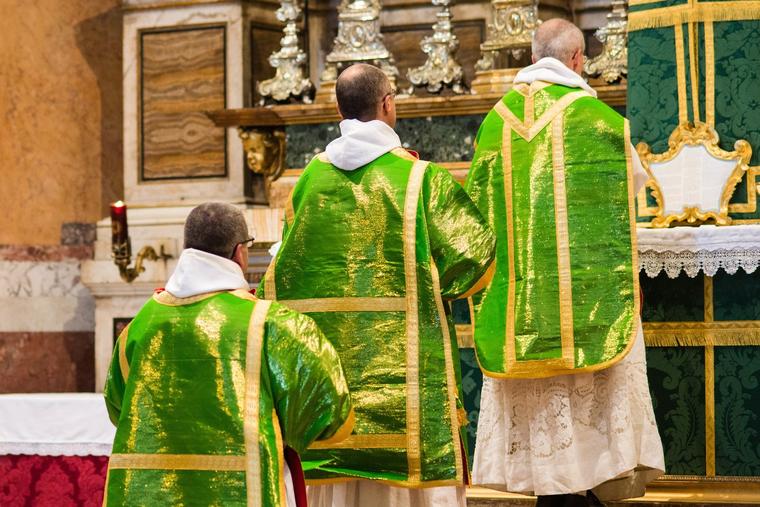
The Baroque solution was to cut back on material. The traditional flowing chasuble turned eventually into two kinds of stiffened but highly embroidered boards, usually not broader than the priest’s shoulders, though some variants got slightly wider at the bottom (like a spoon). This became known as the “fiddleback” chasuble.
At first, the Church pushed back hard against these mini-chasubles. Nobody less than St. Charles Borromeo prescribed that, in his diocese, chasubles had to be about 54 inches wide minimum at their broadest point. But, over time and particularly in some countries, the abbreviated fiddleback took hold.
The liturgical reformers of the early 20th century criticized this development and called for the restoration of what in fact had been the traditional, i.e., more flowing chasuble that Catholics commonly see at Mass today. While liturgists were calling for this back in the 1930s, recovery largely coincided with the implementation of Vatican II’s liturgical reforms in the 1960s, when the fiddleback chasuble largely went into eclipse.
So, the truth is that while some may imagine the fiddleback they remember from their youth was “traditional,” it in fact was not. It represents a Tridentine/post-Tridentine development. Today’s more common, flowing chasuble (some people call it “Gothic,” though its evolution long preceded the Middle Ages) is, in fact, the historically older form.
- Keywords:
- traditional latin mass
- fiddlebacks
- chasubles
- vestments