Pope Leo XIV: Toward a Liturgical Turning Point?
COMMENTARY: The Holy Father’s mission of unity, especially with regard to the Mass, would be a great accomplishment for the Catholic Church.
With a shrewd and thoughtful statement, Pope Leo XIV simultaneously refocused and relativized the issue of the use of the ancient rite of the Mass.
In a message to the French bishops gathered in Lourdes for their periodic plenary assembly, the Pope expressed his hope that the Holy Spirit would move the bishops to find “concrete solutions that will allow the generous inclusion of those who sincerely adhere to the Vetus Ordo” — that is, the older rites — “according to the guidelines established by the Second Vatican Council regarding the liturgy.”
This is a clever statement for several reasons. Notably, it cites the guidelines for reform established by the Second Vatican Council, which created space for the bishops to operate without breaking with Pope Francis’ stated goals for restricting the Traditional Latin Mass in 2021, while conspicuously omitting mention of Francis’ ‘motu proprio’ Traditiones Custodes, by which he restricted the old Mass and generated heavy criticism, primarily from the United States and France.
Leo demonstrated his desire to go beyond Pope Francis, in other words, seeking a “liturgical peace” that would be of great service to the Church today. Leo also acknowledged — though without laying blame — that Traditiones Custodes had created a rift that would be very difficult to heal.
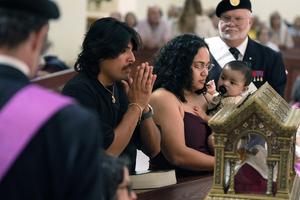
Faced with a Church in France questioning the ever-increasing number of adult baptisms in a generally traditional faith, Pope Leo emphasized that those faithful who feel closest to the ancient rite cannot be sidelined.
The Pope’s move is interesting because it suggests that the conflict could be overcome. Moreover, in France, even a nontraditionalist bishop like Cardinal Jean-Marc Aveline, now president of the French bishops’ conference, celebrated in the ancient rite precisely to avoid losing a significant group of faithful who nevertheless remain within the fold of Catholic tradition.
The topic is broad. In the face of growing secularization, we are seeing an ever-increasing interest in the Church’s tradition, also reflected in the use of the ancient rite. The return to the Church and to faith is also being observed in countries like Switzerland, where the bishops’ portal (catt.ch) has dedicated a major survey to the return of faith and the growth in adult baptisms.
The achievement of liturgical peace would be a great accomplishment for Pope Leo and for the Church.
Since the Second Vatican Council, the topic of liturgy has become heated, creating divisions and placing Christians in a before-and-after situation, either on one side or the other.
The Holy Father wants to absorb these divisions and restore them to unity. He wants to do so, as the letter demonstrates, starting from a local perspective, resolving each case individually, without changing Pope Francis’ provisions, but simply not fully implementing them.
It is a wise decision, which also marks a turning point in the pontificate.
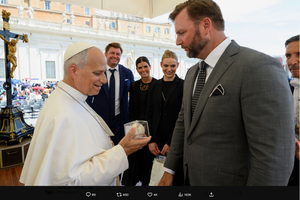
Leo XIV meets and listens to everyone. The audience granted to Gareth Gore, author of a highly critical book on Opus Dei, caused a stir, but was really a part of Leo’s “listening campaign” and also part of the pontiff’s practice of maintaining contacts with journalists he knew in Peru. While Leo is attentive to public opinion, he is not a slave to it. Gore has asked the Pope to establish a commission of inquiry into Opus Dei, but it is not a given that he will follow up on the request, especially since the Church has the resources to understand situations within religious organizations. This is Leo’s way: He gathers information and weighs the matter before making decisions.
The topic of liturgy is crucial, and indeed, a first test was the dialogue with the Priestly Society of St. Pius X when it announced its intention to ordain new bishops without a papal mandate. Even before that, Leo XIV had sent a message to the Paris-Chartres pilgrimage last summer, which was significant, considering that the pilgrimage was launched by an association of traditional Latin Mass devotées.
Across the board, Leo XIV is working to harmonize the Church’s government.
In this sense, Leo XIV is seeking profiles with very specific characteristics. The Curia’s latest appointment is that of Australian Bishop Anthony Randazzo as prefect of the Dicastery for Legislative Texts. Bishop Randazzo comes from far enough away not to become a slave to Roman procedures, but he has lived in Rome long enough to understand how the Curia operates. Bishop Randazzo was, among other things, an official of the Congregation for the Doctrine of the Faith when Cardinal Joseph Ratzinger was prefect. Bishop Randazzo, therefore, brings a traditional mindset rooted in the ways of the Curia in the late 1990s, as well as the pastoral experience of a bishop from the other side of the world and a certain ability to address major challenges without too much fanfare or visibility. This is what Leo XIV sought.
Msgr. Renzo Pegoraro, chancellor of the Pontifical Academy for Life, was also a highly visible figure elevated by Pope Leo. The Holy Father granted him the title of archbishop March 25, effectively reinstating the principle that heads of dicasteries and pontifical academies should be archbishops, in collegiality with the pope.
All eyes are now on the Dicastery for Communication, especially since it would make sense to replace a layman like the current prefect, Paolo Ruffini, with a cleric. It would demonstrate how this pontificate is taking a clear direction: No break with the previous pontificate, but a clear return to a pontificate that is “Roman” in form (with all dicastery heads at least archbishops, i.e., in collegiality with the Pope) and institutional in its ways.
On March 30, Leo XIV reshuffled the Secretariat of State, with a new “chief of staff” or “minister of interior affairs,” that is the sostituto. The sostituto is the No. 2 person in the Secretariat of State, and the head of the first section. Since 2018, the position was filled by Archbishop Edgar Peña Parra, a Venezuelan and trusted man of Pope Francis. After almost one year of his pontificate, Leo XIV decided to bring in a new sostituto, and appointed Archbishop Paolo Rudelli to the position. Archbishop Rudelli, 55, has an extensive diplomatic career and has been nuncio to Colombia until now.
Archbishop Peña Parra has been appointed nuncio to Italy and San Marino, in an unusual move, since generally the sostituto gets a dicastery or a cardinalatial position. The current nuncio to Italy, Archbishop Petar Rajič, was then appointed prefect of the Pontifical Household. The position was vacant since 2023, when Archbishop Georg Gänswein ended his mandate as prefect and was not replaced. However, it is a key position, as the Prefecture of the Pontifical Household manages and organizes the papal audiences, including the ones with sovereigns and heads of state.
Leo’s pontificate, in short, is increasingly appearing as one that does not seek a break, but rather seeks the opportunity to lead the Church into the middle of the 21st century and beyond.
For Leo XIV, a generational change is needed. But above all, people must be brought back to the faith and nurtured in it. Liturgical peace will help to do this. Institutional adjustments will allow the Pope to act as Pope.
- Keywords:
- 'pope leo xiv'
- traditional latin mass