Pope Leo Is Right: Colleges Should Help Students Seek and Live the Truth
COMMENTARY: As colleges and universities become places of encounter, they fulfill their highest obligation: to form saints.
Someone recently asked me if I worried about the impact of AI on our students. I replied, “If by ‘worried,’ you mean, ‘Am I working hard to provide the best human, spiritual, and academic formation to our kids?’ then the answer is Yes.”
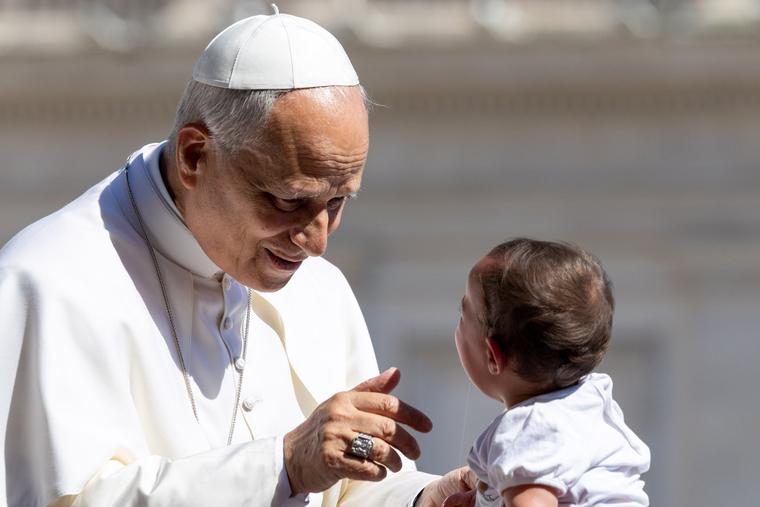
Pope Leo XIV seems to share my worry. He recently spoke with Catholic college and university leaders in Rome about the challenges educators face.
The first concern he addressed was an “increasing fragmentation of knowledge.” People often lack, he said, “a global vision of reality that is capable of uniting not only the various fields of knowledge, but also the multiple aspects of life and the inner longings of the human heart.”
Even as young men and women seek specific degrees and career preparation, he noted that educators have “the noble task of guiding that desire for knowledge so that they may also ‘learn to seek and love the truth, to reflect on the meaning of life and to recognize the dignity of every person’” (Magnifica Humanitas, 143).
After seven years as president of Franciscan University of Steubenville, I could not agree more with the Holy Father’s assessment of both the challenges and nobility of the task of Catholic higher education. Or with his dry admission: “This is not an easy feat.”
Today’s young people certainly live fragmented lives. How could they not? From their earliest years, they have turned to social media and AI as a source of answers, but the “truth” they discover there comes up empty. Even if they manage to receive a snapshot of truth, they lack a unifying vision of reality. Without a framework that helps them understand who they are, why they are here, and what is true, they become like a rudderless ship, at the mercy of whatever winds blow the strongest.
But the answer to this fragmentation is not simply better-quality information; it is an encounter with the One in whom all truth finds its source and unity. Pope Leo challenged university leaders to help students experience that encounter with “the Truth that is Christ himself” as well as intellectual truth.
This has been a central tenet of the mission of Franciscan University for decades. A Catholic university must create a community where Jesus is at the center of all it does. As Popes John Paul II, Benedict XVI, Francis, and now Leo have reminded us, it is this encounter with the person of Jesus that gives us life and saves us. It is not a theology, philosophy, or idea; it is always Jesus.
At Franciscan University, we wrestle with the serious questions of our day, issues that truly matter and impact our world, and we do this in the light of faith. Coming to discover that which is true is always at the center of our academic endeavors, and we are confident there is no separation or contradiction between the truth we discover and Jesus who is “the Way and the Truth and the Life” (John 14:6).
In fact, when students experience the unity that exists in truth, it becomes a healing balm to their fragmented existence.
It is also essential that young people encounter one another. One of the tragedies of social media and AI is the dependence they create on technology. Authentic human interactions are pushed to the periphery. A person’s world becomes smaller, less personal, less human, and he or she becomes increasingly isolated and fragmented.
College campuses must intentionally combat this. Young people need to encounter more—well, humans. At Franciscan University, we do this through faith households, small communities of young men or young women who pray, study, play, and serve together. We also do this with our Christ-centered sports teams who build each other up as Catholics as much as they do as athletes.
Mother Teresa once said, “We have forgotten that we belong to one another.” Catholic schools need to create an environment where people look to one another before they look to technology. Rather than turning to AI, students should seek out a classmate or professor when struggling in a class. This gives them the benefit of struggling, seeking help, and entering into a relationship with another person. Both the person helping and the one receiving help are better because of this simple encounter.
In this way, people encounter the beauty and diversity that God intended when he created us as communal beings.
As I continue to hear what our Holy Father is saying regarding AI, I recognize the need to be attentive to both its benefits and its dangers. Yet, he is ultimately much more concerned about the human person. His recent encyclical was not called Dangerous AI but Magnificent Humanity. The human person is the glory of God, and we image God like nothing else he has created.
I believe many young people find technology fascinating because they have yet to discover the magnificence of the human person. Universities need to help students discover the magnificence of humanity. Once they do, they too will be amazed by what God has created. No algorithm can rival the human person.
That’s why we’re forming students to use technology in ways that respect the human person. Toward that end, we’ve just launched a search for a professor for our newly established AI and the Human Flourishing Chair. Generous alumni donors in the tech industry funded the chair, which will provide expert guidance to engineering and computer science students learning to implement evolving technologies, as well as to students and faculty in other fields as they seek to master technology rather than find themselves mastered by it.
We need more human interaction. We need more community. We need more Christ. Anything that gets in the way of these should cause us concern.
In the end, Catholic colleges have an obligation to educate students, but the goal is not merely a diploma or a job, important as both are. We are educating and forming them to live the truth as joyful disciples, prepared to take their place in building the Kingdom of God. Only within this vision can the fragmentation they are experiencing be healed.
As colleges and universities become places of encounter, they fulfill their highest obligation: to form saints.
Franciscan Father Dave Pivonka has served as president of Franciscan University of Steubenville since 2019.
- Keywords:
- catholic higher education