When Colleges Cut Theology, Students Lose More Than Credits
COMMENTARY: Students need more theology, more humanities and more professors and administrators with a robust sense of mission.
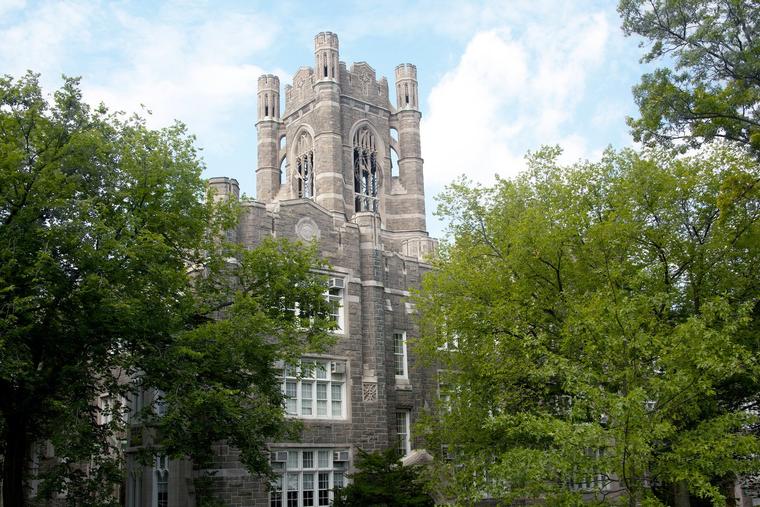
When I took my first required philosophy and theology courses at Fordham University as a freshman in 2010, I didn’t realize I was walking into what would become the beginning of an adventure of a lifetime.
As a kid, I was plagued with existential questions: Why does evil exist? Does love last forever? Is there a real point to life after all?
From my teachers to my family members, I was told time and time again to stop driving myself crazy over these questions. It wasn’t until Drs. McPherson and O’Brien’s classes that I finally met people who took my questions seriously. It was thanks to them, a holy Jesuit priest and several loving classmates, that I eventually decided to study theology, enter into full communion with the Catholic Church and live my faith seriously.
I likely would not have taken those professors’ courses if not for Fordham’s rigorous core curriculum. Inspired in part by the Jesuit tenet of “finding God in all things,” Fordham values exposing students to a variety of academic disciplines. As much as I may have complained about having to take classes that had little to do with my major, I later came to realize how much these “useless” classes gave me a broader view of life. Thus, I winced when Fordham announced last month that its new core curriculum will require 12 instead of 17 courses, knocking down the theology and philosophy requirement from two to one course of each. While this is better than eliminating the requirement, I can’t help but be concerned about the larger symbolic significance of this change.
After five years of devising the new curriculum, it was approved by a vote in late April, and is set to take effect in 2031. The news comes almost a year after the university’s announcement that it had accepted a $100 million gift to bolster its STEM program.
In response to the concern that its commitment — as a Catholic and Jesuit school — to its humanities programming and overall sense of mission is fading, Fordham’s president Tania Tetlow assured that these changes instead reflect “the best of our proud heritage of Ignatian pedagogy and Jesuit mission, not simply as a set of requirements, but as a way to help students connect the dots across disciplines,” on top of giving students more room for “choice” in their studies.
While I am consoled that President Tetlow remains committed to the school’s Jesuit mission, I fear that such curriculum changes are a slippery slope that leads Catholic schools to abandon their sense of mission altogether.
Fordham is hardly the first Catholic university to cut down its theology and philosophy requirements. The average number of required theology credit hours in U.S. Catholic universities has dropped from 5.1 in 2015 to 4.5 in 2023. Some have gone as far as eliminating their theology or religious studies core requirement, and others have eliminated their departments altogether. The number of Catholic universities with theology or religious studies departments dropped from 69% in 2016 to 63% in 2023. Plenty more universities — both Catholic and non-Catholic — are pulling money from humanities programs to invest in STEM.
Granted, in the face of economic instability and the so-called “enrollment cliff,” university administrators are in a challenging position. Yet there is a fine line between making tough decisions to keep a school afloat and prioritizing the bottom line over your school’s mission to educate and form its students — especially for faith-based schools.
It wasn’t until years later that I understood that professors like McPherson and O’Brien were of a dying breed.
As I continued my education, I found fewer and fewer professors like them who were not only competent but who took their faith, vocation and their role in the school’s mission seriously.
I particularly struggled with the younger theology professors, many of whom specialized in markedly progressive theological specializations, like postcolonial, intersectional and “womanist” theology. Their regurgitating what eventually became “woke” platitudes demonstrated less a commitment to certain progressive or liberal principles for their own sake, and more so a desire to keep up with academic “trends” to keep their resumes marketable.
Similarly, the university’s decision to hire such faculty members demonstrated that its brand of liberal Catholicism was in function of meeting the bottom line. Contrary to the fears of some conservative Catholics, such shifts are less a sign of the “liberalization” of Catholic schools and more of their neoliberalization — which is to say the collapse of their mission under the pressure to cater to the almighty market.
Similarly, some schools promote themselves by appealing to their “conservative Catholic” credentials. This tendency of polemicizing a school's Catholic mission — whether toward the left or right — as a marketing point runs the risk of reducing said values to being to the service of the bottom line rather than to the benefit of students.
To be frank, can a school that installs “gender-inclusive” restrooms and offers “queer proms,” but that invests in union-busting lawyers to avoid paying grad students and adjuncts a livable wage, really claim to be so “progressive”? Minimizing the theology requirement to make more room for STEM programming is only the logical next step after investing in “marketable” strains of theology.
In an address June 3 to presidents of U.S. Catholic colleges, Pope Leo XIV reminded them that "Catholic institutions are called to be a living environment in which the Christian vision permeates every discipline and every interaction,” adding that their own discipleship will help them “in transmitting the living Gospel” so that students can “discover in the Catholic faith the unifying vision that Truth alone can provide.”
When Catholic schools start losing sight of their mission, they do a disservice not only to students’ intellects, but also to their souls and psyches. My first theology and philosophy courses spoke to my intellectual hunger, but also saved me when I was drowning spiritually and emotionally.
Above all, it was the relationship with my professors — who looked at me as a whole person, and not just a number on a roster — that helped me find hope when I was deeply depressed during my freshman year. Without them, I would’ve remained stuck in that dark abyss. Thus, my fear that other students who were lost like me won’t be lucky enough to encounter people who are a living sign that life is more than the measurable and utilitarian, than machines and algorithms and the demands of the bottom line.
Indeed, in the face of soaring rates of depression, anxiety and suicide among young adults, it seems that students need more theology, more humanities and more professors and administrators with a robust sense of mission. Complementary counseling services alone — though surely of some value — can’t imbue students with the sense that life is sacred.
Again, I concede that maintaining a school’s mission is easier said than done in this economy. Administrators can’t afford to be purists.
What’s required rather than simple idealism is the commitment to pulling off a prudent and creative balancing act — looking for ways to build the school up in ways that does not compromise its mission, combining the old and the new, and meeting the needs of both their students’ souls as well as the demands of the market.
While challenging, this is far from impossible. I look at Catholic universities like Seton Hall in New Jersey — where I completed a master’s degree in theology and currently teach as an adjunct professor — as an example. On top of steering clear from polemicizing the school’s Catholic identity, the administration has gone out of its way to provide students opportunities to grow in faith through its course offerings, on-campus events and liturgical life, while investing in more “marketable” programs like its nursing, law and business schools.
In addition to being a matter of integrity, investing in their mission is likely to prove more financially expedient for Catholic universities in the long run. The impulse to invest in STEM in order to compete with other schools is understandable, yet short-sighted.
In our age where young people are getting fed up with the excesses of technology and AI, and are unplugging and “touching grass” en masse and returning to tradition and religion, a solid religious identity and humanities programming will likely prove themselves to be valuable marketing points in the near future. Besides, students who felt that their academic institution fed their intellects and accompanied them in their journey toward Truth will be more inclined to donate to it. Institutions that function as mere means to an end in students’ journey toward “success” don’t exactly incentivize the desire to give back.
Stephen G. Adubato is associate editor of Compact Magazine, an adjunct professor of theology and philosophy, and the curator of the Cracks in Postmodernity platform. Follow him @stephenadubato.
(Editor's note. This story was updated June 10.)