Pope Leo XIV’s Motto, Drawn from St. Augustine, Speaks Volumes to This Moment
COMMENTARY: The words of the doctor of the Church, In Illo uno unum — ‘In the One, we are one’ — express the spiritual unity of all Christians as members of Christ’s body.
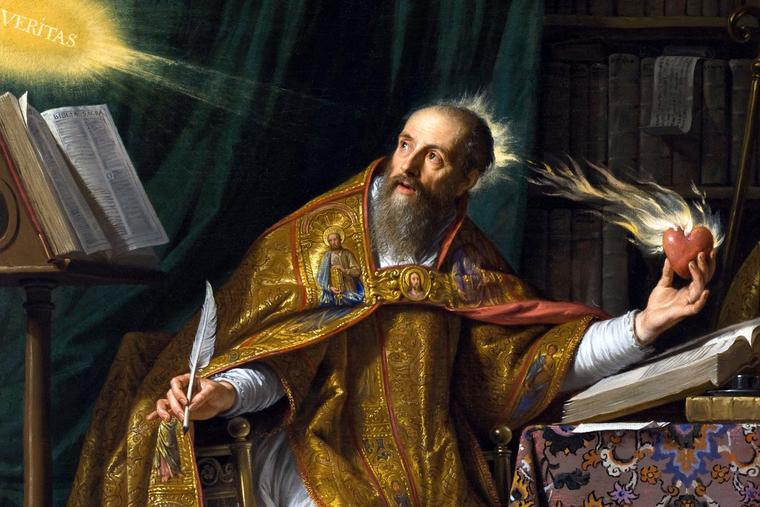
When biographers describe Pope Leo XIV as “Augustinian,” they mean more than just his membership in a religious order. They mean a certain cast of mind — an approach to theology and life that reflects the influence of St. Augustine of Hippo.
Pope Leo manifested this special character in the moments immediately following his election. He quoted Augustine in his first address to the crowd in St. Peter's Square, and he revealed that he would draw his motto from Augustine’s words: In Illo uno unum, which means “In the One, we are one.”
Leo gave this line to the world as a key to his pontificate. It would be worthwhile, then, to understand it in its original context of Augustine’s life and work.
A saint of the fourth and fifth centuries, Augustine lived a long and productive life. His collected works fill 46 volumes in English translation, and they include sermons, letters, poems, memoirs, theological treatises, philosophical studies and biblical commentaries. He wrote foundational works in catechetics, morals and Trinitarian theology, and some historians say he invented the genre of autobiography.
This makes the Augustinian cast of mind difficult to summarize. A key concept, however, is his notion of the Totus Christus — the “Whole Christ.” With this phrase, he described the spiritual unity of all Christians as members of Christ's body, with Christ himself as their head. For Augustine, it is something more than a metaphor. It is an image that describes the real and sacramental bond of Christians in the Church.
The idea, of course, is not original with Augustine. He learned it from St. Paul, who speaks of it repeatedly in many of his New Testament letters (see Romans 12:4-5; 1 Corinthians 10:17, 12:13-20; Ephesians 2:16, 4:4; and Colossians 3:15). But Augustine brings it to bear on topics ranging from ecclesiology to personal spirituality. It is from one such passage that Pope Leo has drawn his motto.
It comes from the discussion of Psalm 128 (127 in the Latin Vulgate) in Augustine’s Expositions of the Psalms. This particular Psalm was familiar to Augustine’s hearers, as it is to Catholics today. It begins:
Blessed are all who fear the LORD,
and who walk in his ways.
What your hands provide you will enjoy;
you will be blessed and prosper:
Your wife will be like a fruitful vine
within your home,
Your children like young olive plants
around your table.
In Augustine’s reading, the one who is truly “blessed” is Jesus Christ, whose fruitful bride is the Church (see Ephesians 5:31-32). But believers come to share Christ’s beatitude by their communion with him. Augustine wrote: “There is indeed a certain man who is blessed like this; and what is more, nobody fears the Lord without being among the members of this one man. He is many people yet one individual, many Christians but one Christ.”
Then comes the motto. “It is not as though he were one and we many; no, we who are many are one in him, who is one.”
From there Augustine continues, at great length, to apply this image to all the elements of the Psalm. For example, the children at table become for him an image of the Eucharistic banquet, where God’s “children take their rightful places around the Lord’s table.”
Augustine speaks of pagans taunting Christians: “Where is your god?” The idolaters could point to their idols, but the Christian God was invisible. But, again, Augustine points to the Sacrament, where God “himself has become bread for you by day and night.”
The bishop ends his consideration by envisioning lasting peace in the heavenly Jerusalem. Yet for those who are in Christ’s body that peace begins here and now in the communion of the Church. “Those who are at peace there beyond are the ones who have been peacemakers here, the ones who surround the Lord’s table like a nursery of young olive trees.”
Augustinian spirituality emphasizes the search for God through interiority, prayer, community, and service. The model for such a life is St. Augustine, who tells the story of conversion in his memoir, The Confessions. The narrative is personal but presumes that the desire for God is universally human — glimpsed in earthly desires, but not fulfilled by earthly objects.
In his exposition on Psalm 128 Augustine goes on to counsel his hearers: “Go back to God and moan in his ears, for he is the one you are sighing for until you come to see him.”
As we go to God we find one another in his Church, and we become ever more “one in him, who is one.”
The vision behind the Holy Father’s motto is deeply Augustinian, deeply Pauline, and now deeply Leonine. May it also be deeply ours.
The full text from Expositions of the Psalms is found in the New City Press edition of Augustine’s collected works.
- Keywords:
- pope leo xiv
- st. augustine