Our Lady of Guadalupe: Surprising Facts That Defy Explanation
You may know the story, but these lesser-known miracles and mysteries surrounding Our Lady of Guadalupe are sure to renew your wonder.

Most Catholics are well-versed in the details of the Marian apparitions that took place in Europe at Lourdes in 1858 and at Fatima in 1917. While many have knowledge of the apparitions of Our Lady of Guadalupe in the 1500s, there are a number of amazing details related to this event that some may find surprising.
Our Lady made four appearances in 1531 near what is today Mexico City. According to the documented account, the shrine that currently rests on Tepeyac hill was built at the request of Our Lady, at a time when only a few of the local inhabitants had converted to the faith. One of the great miracles that resulted from the apparition was that, within a relatively short period (by 1539), more than 8 million Aztecs became Christians as a result of the Virgin Mary’s appearance.
The Apparition
While there have been many Marian apparitions over the years, this one differs in a few key respects.
First, unlike Lourdes and Fatima, the name “Guadalupe” is not tied to the city where Mary appeared. At the time Mary appeared to St. Juan Diego, the name had no connection to the local region, but rather was the name of a well-known Marian shrine located in Spain (thus giving it meaning to the Spanish immigrants). To the local Aztecs, however, the word Guadalupe, as pronounced in Spanish, was phonetically similar (but not necessarily identical) to a phrase in their local Nahuatl language, which means “she who crushes the serpent.” What is interesting to note is that this is exactly what happened as a result of her appearance when the greatest mass conversion in the history of Christianity took place, bringing an end to the local practice of human sacrifice.
A second difference is that Our Lady of Guadalupe is one of the only Marian apparitions where Mary is pregnant. As we understand, Our Blessed Mother appeared to St. Juan Diego in order to introduce the local people to her unborn son Jesus Christ, which was ultimately successful in that it converted millions of people to the Christian faith. Because she appeared with child, Our Lady of Guadalupe will forever be considered “the patroness of the unborn.”
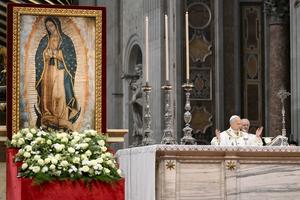
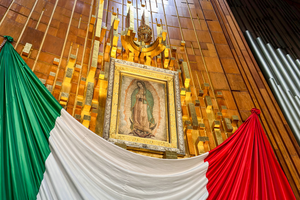
Third, this case differs significantly from other Marian apparitions in what was left behind. Besides the conversion of millions of souls, a second miracle that originated from the apparitions in 1531 is the creation of the image that we all know today as Our Lady of Guadalupe. It was miraculously placed by our Blessed Mother on Saint Juan Diego’s cloak or “tilma,” and was ultimately revealed when he unfurled his tilma, along with some Castilian roses that Our Lady had provided — roses that were both out of season and not native to the area — to the local bishop as proof of the interaction. Thus, while other Marian apparitions have also involved miracles, the image of Our Lady of Guadalupe is unique in that it provided the world with something physical that can be viewed, pondered and studied.
The Image
There are a number of amazing mysteries connected to the image. Some you may know; others might surprise you. Here are just a few:
Microscopic infrared examination has revealed no brush strokes or paint pigments on the cloak holding the image. Upon testing, the coloring materials were concluded to be neither animal, vegetable, nor mineral dyes. Synthetic coloring is not a possibility either, as it was not developed until three centuries later. How the image was created, and the methodology used to transfer it to the cloak, is nothing short of miraculous.
The image resides on a piece of clothing (a cloak) that is made of natural woven material. Such materials typically have an expected life of approximately 20 to 30 years. Given that it is almost 500 years old, appears to have no protective varnish, and was kept outside unprotected in the elements for its first 100 years (where it was touched by millions of hands and lips), it is unexplainable how it still exists today.
The cloak is made of ayate fiber, made from the agave plant (which is a succulent, but not a cactus, given that it has leaves). The side of the cloak containing the image appears as if it is made of silk, which defies scientific explanation.
When viewed from a distance, the coloring in the face and hands is olive, but when viewed up close, it is a gray-white color. It mirrors an effect found in nature whereby colors change when viewed at different angles, such as in the case of bird feathers, butterfly scales, and on the elytra of brightly-colored beetles. This light diffraction technique would seem impossible for any artist to achieve (both in 1531 and today), particularly when attempted on rough fabric.
The image managed to survive an accident in 1791 when a workman cleaning the gold and silver frame accidentally spilled a bottle of nitric acid on it. It is unexplainable how the acid did not destroy any of the delicate fabric, but left only a barely discernible watermark on the image.
An intentional attempt to destroy the image took place in 1921, when a bomb concealed in a large vase of flowers placed underneath it was detonated. The explosion managed to break the stained glass windows of the Basilica, and even twisted a heavy bronze and iron cross that sat on the altar nearby, but did not even crack the single thin pane of glass that was protecting the image of Our Lady at the time. It is symbolic that Jesus allowed the crucifix to be bent, but did not allow any harm to befall the image. An additional miraculous fact is that, while the bomb went off during a High Mass, not a single person in the church was injured.
A mystery that remained concealed for more than 400 years was eventually discovered in 1929 when microscopic images were found to be embedded in Mary’s eyes. Later in 1956, when the eyes were viewed using an ophthalmoscope, they were observed to produce images that are similar to the way that they appear in the human eye. No person (regardless of talent) could have painted images so small, and a potential human creator would not even have known about corneal eye reflections in 1531, since they were not given scientific verification until many years later in the late 1800s.
While all of the confirmed apparitions of Mary are in some way unique, Our Lady of Guadalupe is special in a number of ways. Her appearances, along with the image that she left behind, were responsible for the greatest mass conversion in the history of Christianity, and introduced mankind to the patroness of the unborn. In addition, Our Lady also gave us an amazing piece of physical evidence to ponder and study, which continues to defy conventional/scientific explanations.
It should therefore be no surprise that the Basilica of Our Lady of Guadalupe is the most visited Marian shrine in the world. Annually, millions of pilgrims travel to Mexico City to pray to Jesus, honor Mary, and view the beautiful image. With regards to non-believers who share a different worldview, whether they personally view or simply study/research the image from afar, we can pray that their exposure to Our Lady of Guadalupe will lead to additional conversions.