Bishop Paprocki: Eucharistic Revival Calls Catholics to Worthy Reception of Communion
Four years after the National Eucharistic Revival began, Bishop Thomas Paprocki says Catholics must unite belief in Christ’s real presence with moral life and worthy Communion.
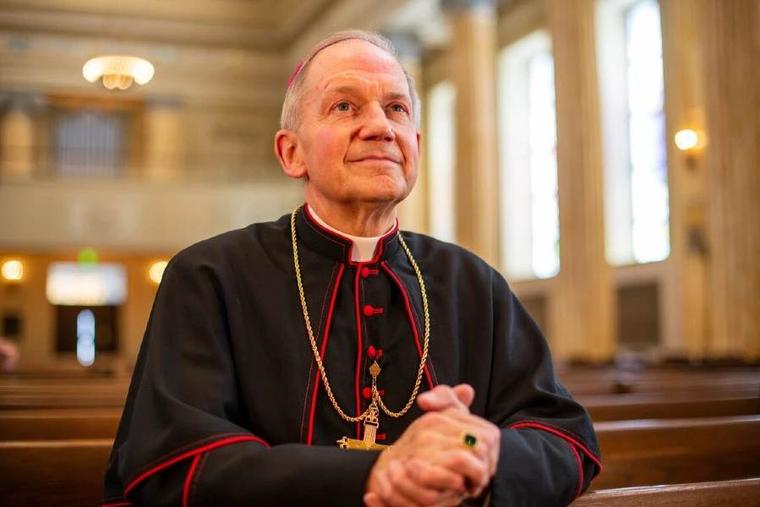
Four years after U.S. bishops launched the National Eucharistic Revival, Bishop Thomas Paprocki of Springfield, Illinois, said Catholics must recover “Eucharistic coherence,” saying belief in Christʼs real presence must be reflected in both moral life and the worthy reception of Communion.
The National Eucharistic Revival, a three‑year U.S. bishops’ initiative aimed at renewing Catholic belief in and devotion to the real presence of Christ in the Eucharist through teaching, parish outreach, and national events, was launched in 2022 in response to declining belief among Catholics in the Real Presence. The revival culminated in 2024's National Eucharistic Congress.
Speaking at the Institute for Catholic Culture on the topic “The Table of the Lord and the Table of Demons: Eucharistic Coherence and the Age of Moral Relativism,” Bishop Paprocki said July 14 that the revival’s mission extends beyond renewing devotion to the Eucharist to fostering lives that correspond to what Catholics profess to believe.
Bishop Paprockiʼs remarks revisit a debate that surfaced during the U.S. bishops’ 2021 spring meeting over reception of Communion for Catholic public officials who support abortion access. While some U.S. cardinals warned that denying Communion could politicize or “weaponize” the Eucharist, distort teaching on worthiness, and damage ecclesial unity, some bishops invoked a duty to safeguard the integrity of the sacrament and cited canon law, which provides circumstances in which ministers should withhold Communion.
Canon 915 says: “Those who have been excommunicated or interdicted after the imposition or declaration of the penalty and others obstinately persevering in manifest grave sin are not to be admitted to holy Communion.”
Communion with Christ
“The criteria for the worthy reception of holy Communion are discussed, but they flow from the foundational understanding of the meaning of the Eucharist,” Bishop Paprocki said, pointing to Christ’s words in the Gospel of John: “Unless you eat the flesh of the Son of Man and drink his blood, you do not have life within you.”
Bishop Paprocki emphasized that the Eucharist is both the sacrifice of Christ made present and the sacrament of communion with God and the Church.
“The core belief of Catholics about the mystery of the Eucharist is our faith in the real presence of Christ,” he said. “The sacrament of the Eucharist is called holy Communion precisely because, by placing us in intimate communion with the sacrifice of Christ, we are placed in intimate communion with him, and through him, with each other.”
Worthy Reception of Communion
Because of that reality, Bishop Paprocki said, Catholics conscious of mortal sin should first seek reconciliation before approaching the altar.
“As the Church has consistently taught, a person who receives holy Communion while in the state of mortal sin not only does not receive the grace that the sacrament conveys, he or she commits the sin of sacrilege,” Bishop Paprocki said.
Quoting St. Paul’s warning in 1 Corinthians, the bishop added that “whoever eats the bread or drinks the cup of the Lord unworthily will have to answer for the body and blood of the Lord.”
Bishop Paprocki said this understanding forms the basis for what the Church calls “Eucharistic coherence,” which he defined as consistency between belief and conduct.
“A person who, by his or her own action, has broken communion with Christ in his Church but receives the Blessed Sacrament acts incoherently, both claiming and rejecting communion at the same time. It is thus a countersign, a lie,” he said.
Canon Law and Public Witness
Referring to Canon 915, Bishop Paprocki said ministers of holy Communion must sometimes withhold Communion from those who obstinately persist in manifest grave sin.
The bishop cited a 2004 memorandum by then-Cardinal Joseph Ratzinger interpreting Canon 915, which addresses the denial of holy Communion to those who obstinately persist in manifest grave sin. Bishop Paprocki said those who publicly and obstinately support grave moral evils such as abortion or euthanasia fall under Canon 915ʼs provisions.
Bishop Paprocki quoted the memo: When “the person in question with obstinate persistence still presents himself to receive the whole Eucharist … the minister of holy Communion must refuse to distribute it.”
Bishop Paprocki clarified that this denial is not meant as a punishment but to encourage a change of heart.
Bishop Paprocki said behaviors that would warrant denial of Communion include heterosexuals cohabiting without marriage, homosexuals engaging in sexual activity, and divorced people remarrying without having received an annulment.
Bishop Paprocki referred to his 2018 denial of the Eucharist to Sen. Dick Durbin, D-Illinois, for supporting abortion access laws. Bishop Paprocki said: “The denial of Communion is a medicinal remedy that seeks to foster a change of heart” and is meant to encourage politicians “to repent and return to being pro-life.”
Bishop Paprocki concluded: “In seeking Eucharistic coherence in an age of moral relativism, it is important to remember that the ultimate goal is conversion and readmission to Communion. Even when a difficult decision must be made, not to admit someone to holy Communion until there has been repentance and reconciliation, such discipline does not contradict the law by which it is motivated.”