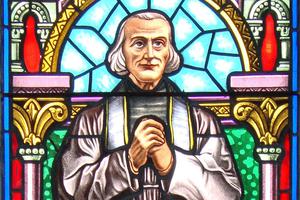
Canonized 100 Years Ago, St. John Vianney Still Converts Hearts
On the centennial of his canonization, the Curé of Ars continues to offer bold, clear guidance for souls seeking holiness today.

Although the feast day of St. John Vianney, the Curé of Ars, falls on Aug. 4, the 100th anniversary of his canonization was celebrated earlier this year, on May 31.
This centenary is a providential time for another look at his teaching and guidance given in sermons to his congregation in Ars and then to thousands of pilgrims flocking to the small village. Although in many sermons he pulled no punches about sin and the possibility of hell as he tried to save lax and sinful souls, he also emphasized God’s mercy to draw sinners back, whom he drew by the thousands as he spent countless hours in the confessional.
Let’s look at a few of the ways showing how easily his admonitions apply to what we see going on in the world today — and at a much-multiplied rate.
In one sermon, the Curé of Ars points out the dreadful state of the lukewarm soul:
That soul who would like to be worldly without ceasing to be a child of God. You will see such a one at one moment prostrate before God, his Savior and his master, and the next moment similarly prostrate before the world, his idol. … He loves God. Or rather, he would like to love him, but he would also like to please the world. Then, weary of wanting to give his allegiance to both, he ends up by giving it to the world alone.
In other words, as our Lord said, you can’t serve two masters.
Making Our Actions Worthy
St. John Vianney wanted to teach sinners to repent and change:
Jesus Christ, by his sufferings and his death, has made all our actions meritorious, so that for the good Christian there is no motion of our hearts or of our bodies which will not be rewarded if we perform them for him.
Again, he explains:
Follow me for a moment and you will know the way in which to make all your actions meritorious for eternal life without changing anything. In your way of behaving, all you have to do is to have in view the object of pleasing God in everything you do. And I would add that instead of making your actions more difficult by doing them for God, you will make them, on the contrary, much more pleasant and less arduous.
That practice should begin daily.
How to start the day? He counsels:
In the morning when you awake, think at once of God and quickly make the Sign of the Cross, saying to him, ‘My God, I give you my heart.’ And since you are so good as to give me another day, give me the grace that everything I do will be for your honor and for the salvation of my soul.” This is known as the morning offering prayer.
The Curé of Ars again explains these offerings:
Offer quite simply all your difficulties to God and renew from time to time this offering. For by that means you will have the happiness of drawing down the blessing of heaven on yourself and on all you do. Just think, my dear brethren, how many acts of virtue you can practice by behaving in this way, without making any change in what you are actually doing.
“If you work with the object of pleasing God and obeying his commandments, which order you to earn your bread by the sweat of your brow, that is an act of obedience. If you want to expiate your sins, you are making an act of penance. If you want to obtain some grace for yourself or for others, it is an act of hope and of charity. Oh, how we could merit heaven every day, my dear brethren, by doing just our duties, but by doing them for God and the salvation of our souls.”
And for any work?
“Before beginning your work, my dear brethren, never fail to make the Sign of the Cross,” counsels Vianney.
He also says:
The Sign of the Cross is the most terrible weapon against the devil. Thus the Church wishes not only that we should have it continually in front of our minds to recall to us just what our souls are worth and what they cost Jesus Christ, but also that we should make it at every juncture ourselves, when we go to bed, when we awaken, during the night, when we get up, when we begin any action, and above all, when we are tempted. We can say that a Christian who makes a sign at a cross with genuine religious sentiments, that is to say, when fully aware of the action which he is performing, makes all hell tremble. But when we make the Sign of the Cross, we must make it not by habit, but with respect, with attention, and thinking of what we are doing. Ah, dear Lord, with what devout awe we should be filled when we make the Sign of the Cross upon ourselves and recall that we are pronouncing all that we hold holy and most sacred in our religion!
Importance of Religion
Again, he states, “How happy man would be, even on this earth, if he knew his religion!” Because, he continues:
Neither wealth, nor honors, nor vanity can make a man happy during his life on earth, but only attachment to the service of God, when we are fortunate enough to realize that and to carry it out properly.
What power that person who is near to God possesses when he loves him and serves him faithfully! Alas, my dear brethren, anyone who is despised by worldly people, who appears to be unimportant and humble, look at him when he masters the very will and power of God himself. Look at Moses, who compels the Lord to grant pardon to 300,000 men who were indeed guilty. … Look at the Apostles: simply because they loved God, the devils fled before them, the lame walked, the blind saw, the dead arose to life.
Don’t be on the opposite side, he cautions emphatically:
Now take a look at all those impious people and all those famous ones of the world with all their wit and all their knowledge for achieving everything. Alas! Of what are they really capable? Nothing at all. And why not? Unless it is because they are not attached to the service of God. But how powerful and how happy at the same time is the person who knows his religion and who practices what it commands.
Alas, my dear brethren, the man who lives according to the direction of his passions and abandons the service of God is both unhappy and capable of so little!
But on the contrary, he preaches:
Only the service of God will console us and make us happy in the midst of all the miseries of life. To accomplish it, you do not need to leave either your belongings, or your parents, or even your friends, unless they are leading you to sin. You have no need to go and spend the rest of your lives in the desert to weep there for your sins. If that were necessary for us, indeed, we should be very happy to have such a remedy for our ills.
But no, a father and a mother of a family can serve God by living with their children and bringing them up in a Christian way. A servant can very easily serve God and his master, with nothing to stop him. No, my dear brethren, the way of life which means serving God changes nothing in all that we have to do. On the contrary, we simply do better all the things we must do.
God’s Mercy
Even as the Curé of Ars had much to say about sin and the path to hell, and he wanted to hammer that in and frighten in a good way those who are just wishy-washy and not concerned about living a good life, yet John Vianney wanted to make the love and mercy of God predominant, especially in his later sermons.
Take, for example, his advice on the Mass — and examples of daily Mass:
No, my dear children, we need never fear that the Mass hinders us in the fulfilment of our temporal affairs; it is altogether the other way around. We may be sure that all will go better and that even our business will succeed better than if we have the misfortune not to assist at Mass…Those who come often to holy Mass manage their affairs much better than those whose weak faith makes them think that they have no time for Mass. Alas, if only we put all our trust in God and relied on our own efforts for nothing, how much happier we should be than we are!
As he summed up another time:
Attending Mass is the most important thing we can do.
Then there is the matter of prayer. He says that a Catholic church is “the dwelling place of him Who loves me more than himself, since he died for me, Whose compassionate eyes are aware of my actions, Whose ears are attentive to my prayers, always ready to hear my prayers and to forgive.”
He continues:
Oh, what things I have to say to him, what graces I have to ask of him, what gratitude I have to pay him! I will speak to him of all my worries, and I know that he will console me. I will admit my faults to him, and he will forgive me. I am going to talk to him of my family, and he will bless it with all sorts of mercies. Yes, my God, I shall adore You in Your holy temple, and I shall return from there filled with all sorts of benedictions.
Confession and Mercy
“God’s mercy is like an overflowing torrent,” Vianney says. “It sweeps hearts along in its path.”
Echoing the Good Shepherd parable, he says, “It’s not the sinner who comes back to God to ask forgiveness, but it’s God who runs after the sinner and makes him come back to him.”
At the same time, “The good Lord is always ready to receive us. His patience awaits us!”
He explains the Divine Mercy of God also this way:
There are some who give the Eternal Father a hard heart. Oh, how wrong they are! The Eternal Father, to disarm his justice, gave his Son an excessively good heart: you don’t give what you don’t have.
That follows what we have learned from St. Faustina and Jesus and the message of Divine Mercy. Vianney says:
There are some who say, ‘I’ve done too much wrong, the Good Lord can’t forgive me’. This is blasphemy. It’s putting a limit on God’s mercy, which has none: it’s infinite.
And again:
Our faults are grains of sand beside the great mountain of God’s mercies.
Once sins are confessed, people should not have to worry because, as Vianney teaches:
When the priest gives absolution, we must only think of one thing: that the blood of the good Lord flows over our soul to wash it, purify it and make it as beautiful as it was after baptism.
And again:
The good Lord, at the moment of absolution, throws our sins behind his shoulders, that is to say, he forgets them, he annihilates them: they will never appear again. … There will be no more talk of forgiven sins. They have been erased; they no longer exist!
Put that together with his other preaching, and we can conclude with him, “If we understood well what it is to be a child of God, we could not do evil.”
- Keywords:
- st. john vianney
- cure d'ars