



Long Before the Burning Bush, God Prepared Moses
OLD TESTAMENT & ART: From hidden infant to royal court insider, Moses’ early years reveal God’s hand at work.
(Reading: Exodus 2:11-25)
Saved from a watery death by Pharaoh’s daughter and raised among Egyptian royalty, Moses would not have seemed to be a candidate for freeing the Hebrews from Egyptian slavery. God’s designs are not, however, man’s, and the specifics of Moses’ vocational call in Exodus 3 merit individual treatment.
Scripture doesn’t say much about Moses’ growing up. Pharaoh’s daughter takes him as her own. But women do not produce breast milk at will, and ancient Egypt is not modern America with baby formula at the supermarket. Coincidentally, Moses’ sister, who had been dispatched by his mother to monitor the fate of her mini-ark and its passenger, volunteers to find a wet nurse for Pharaoh’s daughter, who just happens to be … Moses’ real mother.
Fast-forward in the Book of Exodus to a grown Moses. His youth and education are passed over. We should not assume, however, that there was disagreement about his being brought up in Pharaoh’s circles. Unlike Cecil DeMille’s Ten Commandments, where Moses’ Hebrew origins are made a secret, we don’t see that in Exodus, at least not at that point. Egypt was an empire — in our terms, the “essential nation” of the region. By the times traditionally ascribed to Moses, the Pyramids of Giza had stood for over 1,200 years. Joseph had made many peoples dependent on Egypt. As in many Middle Eastern empires, rulers found it advantageous to have loyal sons of subject peoples to represent them to others.
The next scene Exodus presents us in Moses’ life may reflect this. When he is older, he sees the forced labor of the Hebrews and an Egyptian abusing a Hebrew slave. Whether out of ethnic solidarity or a mere human sense of fairness, Moses clandestinely kills the abuser and buries him in the sand. He thinks he’s gotten away with it until the next day when he intervenes in a fight between two Hebrews, one of whom taunts him, “Are you thinking of killing me like you killed the Egyptian?” (2:14). Moses fears exposure (foreigners may have risen in Egyptian society, but they still weren’t ours and disloyalty — especially in favor of their own national — would be punished). Indeed, the Bible says Pharaoh “tried to kill Moses” (2:15) on learning of what had happened, so Moses decides to “get out of Goshen” (again, in contrast to the Ten Commandments version where Moses is banished into Sinai exile). He goes to “Midian,” which modern scholars consider to be the coast of Saudi Arabia facing Sinai across the Gulf of Aqaba.
There he runs into the next shepherdess damsel-in-distress at a well (remember Jacob and Rachel?). Reuel/Jethro is priest of Midian (Exodus uses both names). He has seven daughters to tend his flocks. When local tribesmen try to shove the girls and their sheep out of the way, Moses defends them. They go home and report the event to Daddy, who — keeping with Middle Eastern conventions of hospitality — invites “the Egyptian” to dinner. Eventually, the “Egyptian” marries Reuel’s/Jethro’s daughter Zipporah and has a son.
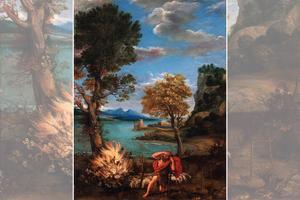
Life goes on. Egyptian oppression of the Hebrews continues, and Scripture speaks of God hearing their cry (2:24). Moses and family are incorporated into Reuel’s/Jethro’s larger clan. He assumes the role as shepherd of his father-in-law’s flock. Things would seem settled and stable for Moses, Zipporah and friends. In human terms. God, however, intends to light a fire in Moses’ life — in the form of a burning bush. That, however, is a separate story.
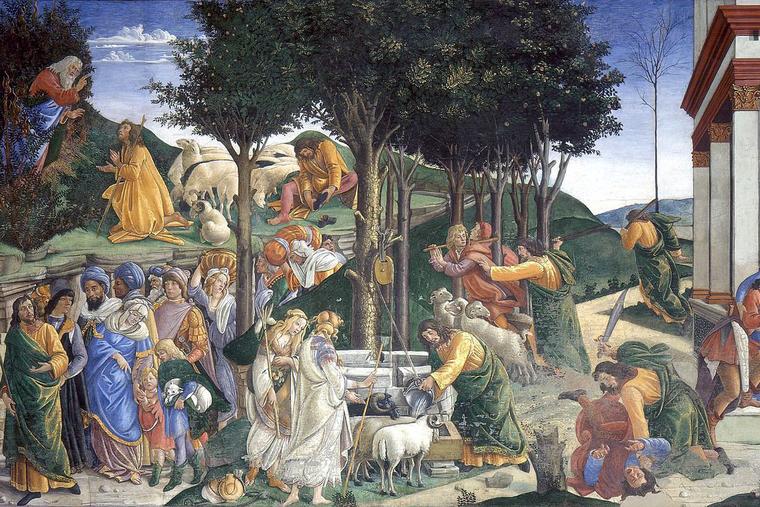
Renaissance painter Sandro Botticelli, who lived and worked primarily in the second half of the 1400s, captures several of these events in a composite fresco in the Vatican Museum/Sistine Chapel, part of a larger series, “The Life of Moses.” This particular painting, like the contemporary Biagio d’Antonio’s “Life of Joseph,” compresses seven events from Moses’ life into one work. It’s therefore not a “picture” of one historical moment. In that sense, Renaissance artists like Botticelli continued the perspective of medieval art that what was shown was not a depiction but a distillation of the essence — in this case, theological — of what mattered. And what mattered here were distinctive moments in Moses’ early life that led him out of Egypt, to his vocation, and brought him back.
Of course, the Renaissance does also change some things: whereas a medieval artist might have depicted just discrete events, Botticelli sets them in a nice landscape. Of course, that landscape looks a lot more lush, like Italy rather than Egypt or Midian. It’s really not until the 19th century that artists try to start painting the Middle East like the Middle East, e.g., James Tissot’s “Jethro and Moses.”
Start at the bottom right. We see Moses with a sword killing the abusive Egyptian; presumably, the two to their left are the witnesses whose remarks frighten Moses. Moving up above Moses’ sword, we see Moses in green fleeing Egypt. Move to Moses’ left, into the trees, and Moses is battling two men obstructing Reuel’s/Jethro’s daughters’ way to the well. Move down, and a nice Moses is at the well watering the sheep, to the admiration of two (how would you fit in seven?) daughters. That’s where today’s commentary leaves off. For artistic purposes, however, move above the two daughters and Moses is removing his shoes, “for the place you stand is holy ground.” Move to the left of the painting, and God appears to converse with Moses in a not-particularly-incendiary bush. There, he is commissioned to free the Hebrews in Egypt. Go down to the lower left, and Moses stands at the head of the Hebrew procession.
- Keywords:
- old testament & art
- moses
- genesis





#/media/File:Tissot_Jethro_and_Moses.jpg)