Why the American Revolution Brought Liberty — And the French Revolution a Reign of Terror
COMMENTARY: The experiences of Lafayette and other veterans of the American War of Independence reveal why many came to see the French Revolution as the opposite of the freedom they had defended across the Atlantic.
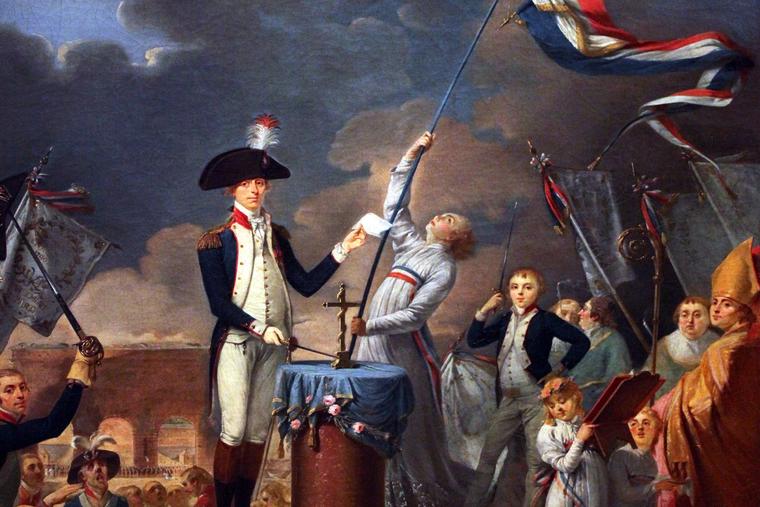
“Humanity has gained its suit. Liberty will never more be without an asylum.”
When the Marquis de Lafayette wrote these words in 1781, shortly after the Continental Army’s victory at Yorktown, he believed he had witnessed an event that the rest of the world would emulate: a people freeing themselves from tyranny to govern themselves as they had always wished.
Within a decade, this Frenchman would be forced into exile from his homeland, which was tearing itself apart in the name of the very ideals his example had helped inspire, and would spend years in an Austrian prison.
The 250th anniversary of American independence is an occasion to celebrate the long-standing Franco-American friendship. But it is also an opportunity to address a question absent from official commemorations: Were the American and French revolutions truly events of the same nature, separated only by time and geography?
The men who lived through both knew the answer. Many of the French officers whom King Louis XVI sent across the Atlantic to fight alongside the colonial insurgents found themselves on the other side of the barricades when revolution broke out in their own country (1789-1799) — hunted down, imprisoned and executed by a regime that proclaimed itself the legitimate heir to the freedom for which they had fought in America.
Political vs. Ideological Revolutions
“People are wrong to compare the two revolutions,” historian Reynald Sécher, one of France’s foremost scholars of the counterrevolutionary movements and author of A French Genocide: the Vendée, told the Register. “The American Revolution had for its sole aim to free itself from the tutelage of the king of England — a tutelage that expressed itself almost exclusively through fiscal obligations. Fundamentally, the insurgents did not call into question the nature of society.”
France was a very different matter, Sécher said.
“The revolutionaries had a specific program,” he explained, “which consisted of destroying the divine right monarchy and the traditional, ordered society, to replace them with a new world, a new order, a new man.”
He argued, moreover, that the American Revolution was political in nature — aimed at breaking away from a distant crown that had overstepped its rights — while the French Revolution was purely ideological. In Sécher’s view, it was a project of fundamental transformation that targeted everything beyond its control, including the faith of ordinary people.
The Civil Constitution of the Clergy, the systematic persecution of resistant priests, and the forced de-Christianization of entire regions were not merely excesses of this movement, Sécher insisted, but its natural corollary. This campaign against the Catholic faith also resulted in the public execution of the 16 Carmelite nuns of Compiègne during the Reign of Terror in 1794 for refusing to renounce their religious vocation.
King Louis XVI had entered the war in the U.S. for reasons that were far less philosophical than strategic; the Seven Years’ War (1756-1763) had cost France its first colonial empire, and supporting the insurgents was a way to settle scores with England.
But what the officers sent across the Atlantic discovered would leave a lasting impression on them. They encountered a society that aspired to autonomy without, however, upending the world in which it existed. Churches remained active and local institutions retained their vitality, even playing a key role in the independence process. It was this experience of an orderly and deeply rooted freedom that these men brought home with them. And it was precisely this that enabled them, when the time came, to recognize the opposite.
The Men Who Knew the Difference
France officially allied itself with the American insurgents in 1778. Among the officers deployed alongside the Americans were several men who would later become leading figures in the armed resistance against the French Revolution. “In reality,” noted Sécher, “the majority of the French Royal Navy officers rejected the revolution in their own country, which led to mass resignations and numerous exiles.”
Perhaps one of the most revealing examples of this paradox is that of Armand Tuffin de La Rouërie. A nobleman and personal friend of General George Washington, he distinguished himself by fighting in America, forging a reputation as a courageous commander.
“A parliamentarian and heir to an illustrious family, this man was a rebel who had risen up against his own world — the world of tradition — in the name of individual and collective freedom,” explained Sécher. “It was with this logic that he enlisted alongside the American insurgents.”
Yet, as soon as he set foot on his native soil again, a bitter reality dawned on him.
“He immediately understood that the nature of the revolution underway was contrary to natural law — and that the only true guarantor and protector of this natural law was the king, the divine right monarchy.”
He organized the resistance in his native province of Brittany and founded a counterrevolutionary movement that would come to be known as the Chouannerie.
Another veteran of the American campaigns, François-Athanase de Charette de la Contrie, would go on to become the most iconic figure of the Vendée counterrevolution. In 1793, this French naval officer was approached by Vendée peasants to lead their uprising against a republic that was closing their churches and conscripting their sons. The army he commanded called itself the Catholic and Royal Army.
“He did not fight for the monarchy out of nostalgia,” Sécher insisted, “but because it seemed to him the regime best suited to defend the natural rights set forth by Christ, St. Thomas Aquinas, and the Declaration of the Rights of Man. This is the paradox that his contemporaries struggle to grasp.”
At the Treaty of La Jaunaye in 1795, the terms he secured for the Vendéens were unambiguous: freedom of worship and exemption from conscription — the defense of local rights and individual freedoms against a revolution that, in his experience, was synonymous with de-Christianization, authoritarian centralization, and conscription forcibly imposed on the countryside. He was captured and executed by republican authorities in 1796.
This story remains in the collective consciousness of a segment of the country. At Puy-du-Fou, the famous historical theme park in the Vendée where Charette’s epic is reenacted every year before hundreds of thousands of visitors, Nicolas de Villiers — whose father Philippe, the park’s founder, considers himself an heir to the White Vendée fighters — keeps a certificate on his office wall attesting that his family is among the “Sons of the American Revolution.” This paradox, it seems, has never required explanation.
Burke’s Verdict
No contemporary grasped the stakes more clearly than Edmund Burke, one of the greatest minds of his time, as early as 1790. The Irish statesman and philosopher who had passionately defended the American colonists in the British Parliament — while opposing their complete independence — was dismayed by what he saw unfolding in France, viewing the revolution as the end of chivalry and the extinction of the glory of Europe.
As he wrote in his pamphlet “Reflections on the Revolution in France,” the revolutionaries were jeopardizing their posterity by failing to preserve the legacy of their ancestors, unlike the Americans. Burke put into powerful and definitive words what figures such as La Rouërie and Charette had already come to understand through experience on the ground.
“You began ill,” he wrote, “because you began by despising everything that belonged to you. You set up your trade without a capital.”
To Burke, freedom detached from moral restraint inevitably became destructive: “It is ordained in the eternal constitution of things, that men of intemperate minds cannot be free. Their passions forge their fetters.”
These reflections remain as relevant as ever 250 years later.
What set the American Revolution apart from the French Revolution was, above all, a conception of freedom that Western societies are now compelled to reconsider: the idea that freedom without roots, without heritage, and without a moral order is merely a prelude to tyranny.