Saints Come in All Shapes and Sizes
C.S. Lewis saw monotony in evil but dazzling variety in the saints. Patrick O’Hearn’s children’s book brings that truth to life, joyfully and memorably.

I had two science colleagues at my school with the same last name for a little while. Let’s say they were both named Mr. Doyle, and they were unrelated to each other. I realized at one point that the easiest way to tell them apart was their … well, to put it gently, their shape. And more specifically, their girth. One had a lot, and one had a little.
Both men took themselves lightly, even though only one could be called light. So, when students came to me and asked for Mr. Doyle, I would ask, “Spherical Doyle or Linear Doyle?” Spherical Doyle himself referred to Linear Doyle as y=mx+b (the equation for a linear function) and referred to himself as (4/3)πr³ (the formula for the volume of a sphere). Even though they were different shapes, they still had the same name.
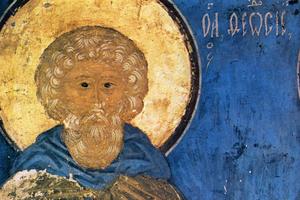
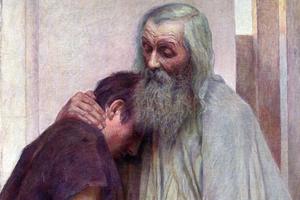
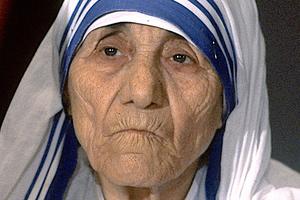
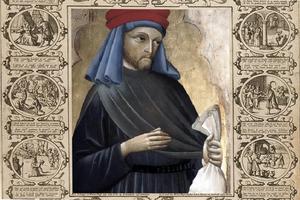
I ran across a similar comparison between St. Thomas Aquinas and St. John the Baptist. In Patrick O’Hearn’s book Saints Come in All Shapes and Sizes, O’Hearn refers delightfully to St. Thomas as round and St. John as thin, but he emphasizes the point that they are both saints. These two saints, very different in shape and lifestyle and culture, do not share a common family name, but they do share a common prefix to their names: Saint. It is remarkable to reflect on how different these two saints are and yet how they are both venerated by the Church.
Soon after my college conversion, I remember being struck by the point that C.S. Lewis makes near the end of Mere Christianity: If you look at all the worst people in history, the tyrants who lived only for themselves, you will find incessant monotony, all the same kinds of people; but if you look at the best people in history, the saints, you will find an astounding variety of personalities and types. If we cling to ourselves, we become a copy of the worst in all people; but if we give ourselves to Jesus and seek to copy him in our lives, we will be given a new and truly original self, unlike anyone or anything else in the entire universe, radiant with joy and gratitude.
O’Hearn’s book presents this same doctrine, so central to the Church’s teaching (CCC 2013: “All are called to holiness.”), by presenting a wide variety of saints and emphasizing their differences as well as the glorious fact that they are all saints, to demonstrate that sanctity is for everyone. It is too easy to imagine, as we often do, that saintliness is only for priests and professed religious who go around solemn and serious without any variety or enjoyment in life, drearily praying (a phrase that should be an oxymoron) and frowning at the people who are having fun. O’Hearn’s book aids in shattering the image of the plain, miserable saint (another oxymoron) and demonstrating the historical reality of the light that shines from the saints, the many facets in the diamond of the Church.
The deepest truths should be presented to children in a way that is suitable to their age, but presented nonetheless, through stories and people who exemplify those eternal and life-giving truths. Children should begin to hear, at a very young age, and then incessantly throughout their childhood, about God’s love, Christian joy, and the universal call to holiness. We adults, too, are edified as we share these truths in ways and through books that children can enjoy and understand, and we come to understand them in new ways as well.
When I first took out O’Hearn’s book, my children (the ones who happened to be with me on the couch at the moment were ages 3, 5 and 9) stopped me to admire the amusing illustration on the cover (by Elizabeth Blair) of a barefooted St. Francis standing and showing his dirty feet to a little boy, also barefoot and with dirty feet. After reading it to them for the third time (because two encores were requested), I asked them if they had a favorite, and, in the spirit of the book, all three chose different saints. It was wonderful to ponder: all three, though unique, were saints.
Though we don’t all have the same family name, we all belong to the same family of God, and we are all called to sanctity, whether we are old or young, barefoot or shod, rich or poor, single or married, and, yes, even spherical or linear.
- Keywords:
- saints
- books
- children's books