Will Leo XIV Visit Vietnam?
ANALYSIS: The southeast Asian country is one of the few countries that still does not have diplomatic ties with the Holy See.

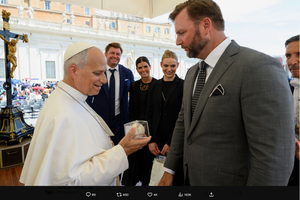
After Vice President Võ Thị Ánh Xuân of Vietnam visited Pope Leo XIV on June 30, Vietnamese media reported that the Pope intends to visit Vietnam to “show his closeness to the Catholic Church and Vietnamese Catholics, as well as to strengthen relations between Vietnam and the Vatican.”
There is an important detail that is not present in the Vatican statement. Vietnam is one of the few countries that still does not have diplomatic ties with the Holy See. However, they are one step away from exchanging ambassadors, and it would be a significant turning point for the country.
And so, there is hope for the Catholic community in Vietnam. Although they are still considered a minority (currently about 7.2 million people, or 7.2% of Vietnam’s population), Catholics in Vietnam are quite numerous compared to many Asian countries and regions (ranking fifth in Asia, after the Philippines, India, China and Indonesia). Furthermore, the Catholic Church in Vietnam is very organized and lively.
Recent History
The visit of Vice President Xuan, on the other hand, is a clear sign of Vietnam’s commitment to maintaining good relations with the Holy See.
Over the past 20 years, high-level visits by representatives of the socialist country have been frequent. In 2005, Deputy Prime Minister Vũ Khoan arrived in the Vatican. In 2007, Prime Minister Nguyễn Tấn Dũng arrived.
A series of other high-ranking Vietnamese leaders followed with visits to the Vatican, such as President Nguyễn Minh Triết (December 2009), Secretary General Nguyễn Phú Trọng (January 2013), President Trần Đại Quang (November 2016), National Assembly Speaker Nguyễn Sinh Hùng (March 2014), Deputy Prime Minister General Trương Hòa Bình (October 2018); and a 16-member delegation of the Communist Party of Vietnam had visited Pope Francis in January 2024.
The crucial visit, however, was in July 2023, when then-President of Vietnam Võ Văn Thưởng arrived at the Vatican to define the regulation that would lead the Holy See to have a resident representative in Hanoi. Until that moment, the nuncio in Singapore had also served as a non-resident representative in Vietnam. The appointment of a resident representative, that is, a representative with “an official address” in the Vietnamese capital, is the last step before the establishment of full diplomatic relations.
To get to this point, the path has been long and, at times, bumpy.
Since 1975, relations between Vietnam and the Holy See have been virtually interrupted. In 1989, Cardinal Roger Etchegaray, then president of the Pontifical Council for Justice and Peace, visited Vietnam and helped to restart the dialogue; a dialogue that continued under the radar until the historic meeting between Benedict XVI and Hanoi Prime Minister Nguyễn Tấn Dũng in the Vatican in 2007.
A year after the meeting, the Vietnam-Holy See Joint Working Group was established, which has met 11 times to date.
The central turning point came at the 10th round of meetings between Vietnam and the Holy See in March 2023, when agreements were reached on the location of the headquarters, the number of staff, the activities to be carried out, and the relationship between the resident representative and the state.
In December 2023, the Holy See appointed Archbishop Marek Zalewski of Poland as apostolic nuncio to Singapore, succeeding Archbishop Paul Gallagher, who had been the non-resident representative of the Holy See in Vietnam. On Jan. 31, 2024, Archbishop Zalewski made his visit to Hanoi in his new role.
Hope of a Papal Trip?
The appointment of a resident representative had opened the hope of a papal trip to Hanoi. Additional steps would be necessary. In April 2024, there was the first historic visit to Vietnam by Archbishop Paul Gallagher, Vatican minister for relations with states. It was the first visit of the Holy See at the level of “foreign minister” because previously all Vatican visits to Hanoi had been at most at the level of “deputy foreign minister.” A visit by Cardinal Pietro Parolin, Vatican secretary of state, was also expected, but it has not yet been organized.
In the meantime, on the occasion of Pope Francis’ trip to Asia in September 2024, the hypothesis of a brief stopover by the papal flight in Hanoi to engage with Vietnamese reality had been proposed. It was, however, only a hypothesis.
With the May 8 election of Leo XIV, Vietnamese public opinion immediately began to launch an invitation to the Pope for a visit — an invitation that was reiterated to Leo by Vice President Xuân.
The statement issued by the Vietnamese Ministry of Foreign Affairs following the visit states that “appreciating the instructions, teachings and messages of the Popes to the Vietnamese Church, the vice president asked Pope Leo XIV to continue to support and pay attention to promoting good relations between Vietnam and the Holy See; to guide and encourage the Vietnamese Catholic community to put into practice the guidelines of “Respect God, love the homeland” and “Live a good life, live a good religion.”
The release also emphasizes the principles of “actively contributing to the cause of national development.”
Other concepts emphasized: that “a good Catholic must also be a good citizen” and “living the Gospel in the heart of the nation to serve the happiness of compatriots.”
These mottos also recall some of the slogans that the Chinese Communist Party uses to describe the life of Catholics in the country. It is also worth remembering that the Holy See and Vietnam have a confidential agreement regarding the appointment of bishops. More than an agreement, it is a modus operandi that was part of the Vietnam-Vatican talks.
3 Keys to Improved Relations
There are three key features of Vietnam-Holy See relations that demonstrate the potential for improving relations.
First, through the meetings and the work of the working group, the two sides have attempted to promote “similarities and respect for differences” at the same time.
Secondly, Vietnamese leaders have come to the Vatican one after another and been welcomed by the pope. Rarely has a single country seen so many high-ranking leaders visit the Vatican and meet with the head of the Catholic Church. Delegations from the Holy See at the vice-ministerial level also visit Hanoi annually. Thanks to this, mutual suspicions are gradually being eliminated, and the two sides are developing more mutual trust.
Third, as Prime Minister Dũng pointed out when meeting Pope Benedict XVI in 2007, it appears that “the Vietnamese government always values the relationship with the Vatican” and takes specific actions to improve relations with the Vatican.
Although the Holy See and China made a confidential agreement for the appointment of bishops in 2018, diplomatic relations are at a standstill. China does not seem to value the relationship with the Holy See as much as Vietnam does.
Existing Problems
However, relations between Vietnam and the Holy See are not free from some problems. After all, it is a socialist state led by a single party.
Among the problematic issues is the restitution of the lands and properties of the Church that were nationalized in the North in 1954 and subsequently in the South starting in 1975. Moreover, religious freedom is still hindered in many places, particularly in the northwestern and central highlands.
These are not insurmountable issues. However, if all goes well, Leo XIV could become the first pope to visit Hanoi and its surroundings. And Vietnam could be the 185th state with which the Holy See maintains full diplomatic relations.
- Keywords:
- 'pope leo xiv'
- vietnam
- catholics in vietnam