Café Catholicism: Parishes Are Upping Their Coffee Game
Coffeehouses aren’t a nice added extra for a Catholic parish, but rather an essential, one priest told the Register.
Salvation through coffee?
Not quite.
But at Our Mother of Sorrows Church in Johnstown, Pennsylvania, making a coffeehouse out of the first floor of a former convent in 2016 was one of many decisions that helped turn it around.
Known at the time as “the rich church on the hill,” the parish had a reputation for being unfriendly and transactional, said Julie Sheehan, a parishioner for 35 years and the current parish administrator.
“Just extremely cold,” said the pastor (then and now), Father Mark Begly.
He had in mind a church that was more welcoming, more giving to the needy, and more of a community.
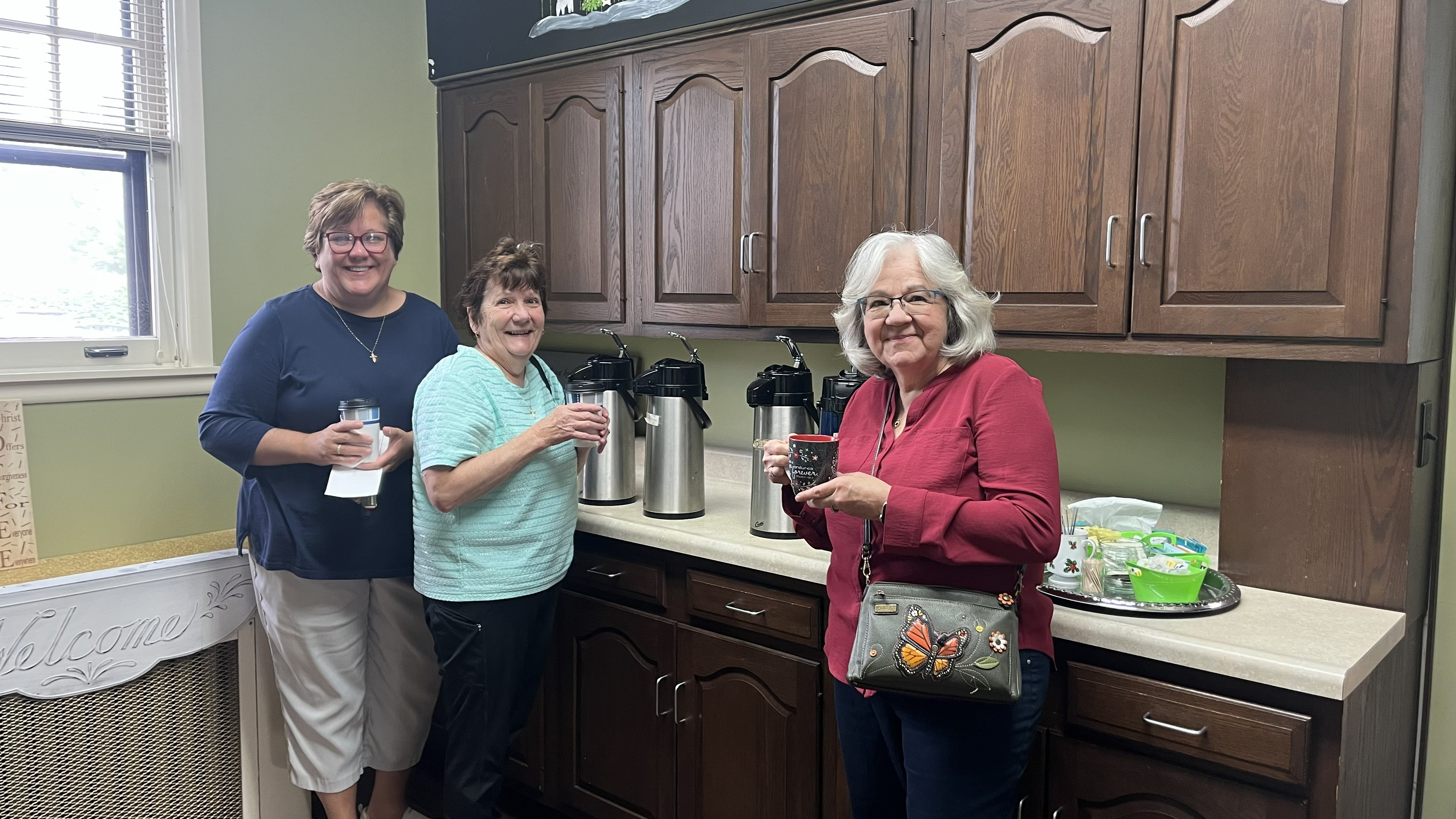
Holy Grounds, as the coffee shop is called, is far from the only change during the past dozen years or so. Sheehan ticked off a long list of improvements in charity, evangelizing, catechesis, and the spiritual life. Nor is coffee anywhere near as important as the sacraments and the teachings of the Church, Father Begly said.
But the free high-quality, fresh-ground coffee, baked goods, and conversation on Sundays and after the 8 a.m. Mass on most weekdays helps.
“Holy Grounds has been a place where people can gather, and they share life stories with each other. They share aches and pains and ups and downs,” Sheehan told the Register. “They pray for each other down there. They laugh with each other. They cry with each other. It really has offered a place of community for us — family.”
Coffee and doughnuts in the parish hall after Sunday Mass has been commonplace at Catholic churches in America since at least the 1940s, but in recent years some parishes have stepped up their approach, offering a cut-above coffee in a dedicated space with regular hours.
Drawing Them In
That describes yet another Holy Grounds, a café at St. Monica Catholic Church in Santa Monica, California, which is open seven days a week, beginning on weekdays after the 7 a.m. Mass. Among its workers are students at the parish’s high school, Saint Monica Preparatory.
Paying customers can get Holy Grounds’ daily brew hot coffee, along with lattes, cappuccinos and macchiatos; pastries; and Catholic books and gifts. It has room for about 50 people, said Felipe Sanchez, the parish’s director of administration.
The coffee comes from a local company that uses so-called “fair trade” practices, Sanchez said — meaning it attempts to make sure workers in the countries where the coffee beans are grown are treated fairly.
Msgr. Lloyd Torgerson, pastor of the urban parish of 9,000-plus households, told the Register he was inspired by Pope Francis’ call to seek out people who live on the margins of society.
“They won’t come into church, perhaps. But if they come in for coffee, it’s a chance to meet them, to get them to participate in a closer relationship with God,” Msgr. Torgerson said.
“For me, it’s to gather people so that they feel comfortable and warm in a place like this, and then consider coming to church,” he said.
The original plans for the parish’s Caruso Community Center called for the entrance to the coffee shop to come from inside the parish grounds, which take up a full city block of 6.5 acres. But someone suggested putting the door on the street side instead, which helps draw in people who have no personal connection with the parish, Sanchez told the Register.
“I think that’s the biggest strategic thing they did, which has led to its success, because it’s not an enclosed space just for our parish. It’s for the community, and it’s on the peripheries,” Sanchez said.
And it works, he said.
“We know that there are some people who may have some trepidation about entering a church, or may not know about it. But a coffee shop — people seem to have no problem entering a coffee shop,” Sanchez said.
“We know it’s a place that’s easy to invite people to,” Sanchez said. “I’ve invited people who are non-Catholics, saying, ‘Let’s go have a cup of coffee,’ and then they start asking questions about the Church.”
“It’s also brought a certain energy to St. Monica’s, just because there’s always people in there,” he said.
Bringing Parishioners and Neighbors in Need Together
At America’s first cathedral, a coffeehouse in the renovated first floor of a brick 1840 former caretaker’s house is part of a reinvigoration of the parish over the past several years.
Situated in a dense urban area with visible homelessness, The Basilica of the National Shrine of the Assumption of the Blessed Virgin Mary in Baltimore for years had a mostly older clientele, but in recent years it has attracted young families, according to Maria Veres-Smith, director of parish operations, and Abigail Kourtz, director of outreach.
The parish also hosts several young-adult missionaries from Source of All Hope, who serve the neighborhood’s homeless — whom parish officials call “friends on the street” and who (starting in April 2024) are specially invited to the Sexton’s Lodge Café for free regular black coffee and green and black tea (donated by two local coffee providers) and baked goods (donated by two bakeries).
“We hope it’s a place where our friends from the street can come in and experience beauty and rest in a special way,” Veres-Smith said.
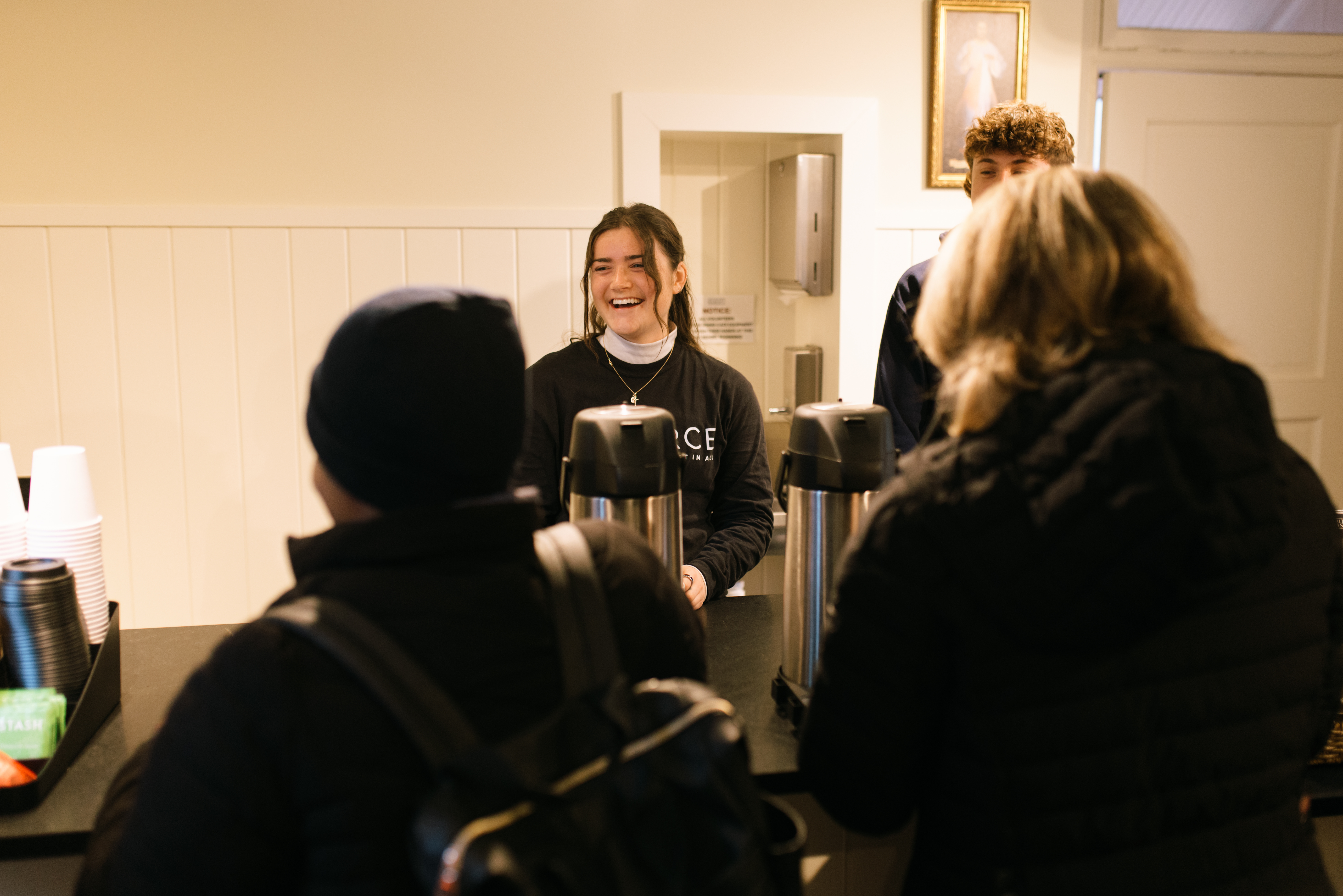
All are welcome at the parish’s café after morning Mass on Thursdays and Sundays, which makes for an unusual mix — particularly on Sunday mornings, when routinely more than 100 people come, forming a line out the door.
“We have friends on the street who know the names of the children of the parish, and the children of the parish know the names of our friends on the street. It’s a beautiful thing that I’ve not seen before,” Kourtz said.
Excellence in Brewing
For parish coffeehouses, quality is key, say those who run them.
“It’s got to be excellent. We’ve got to get past this, like, ‘If it’s the church, it’s okay to be mediocre.’ Like, that has to die,” said Father Keith O’Hare, pastor of St. Louis Catholic Church in Alexandria, Virginia, which in March 2021 opened Little Way Café in an 1888 wooden former one-room schoolhouse (and former church and former chapel) on the parish property.
“I mean, people are not going to hang out if it’s not excellent. So, just practically speaking, we’ve got to make it excellent. And, you know, it shows,” he added.
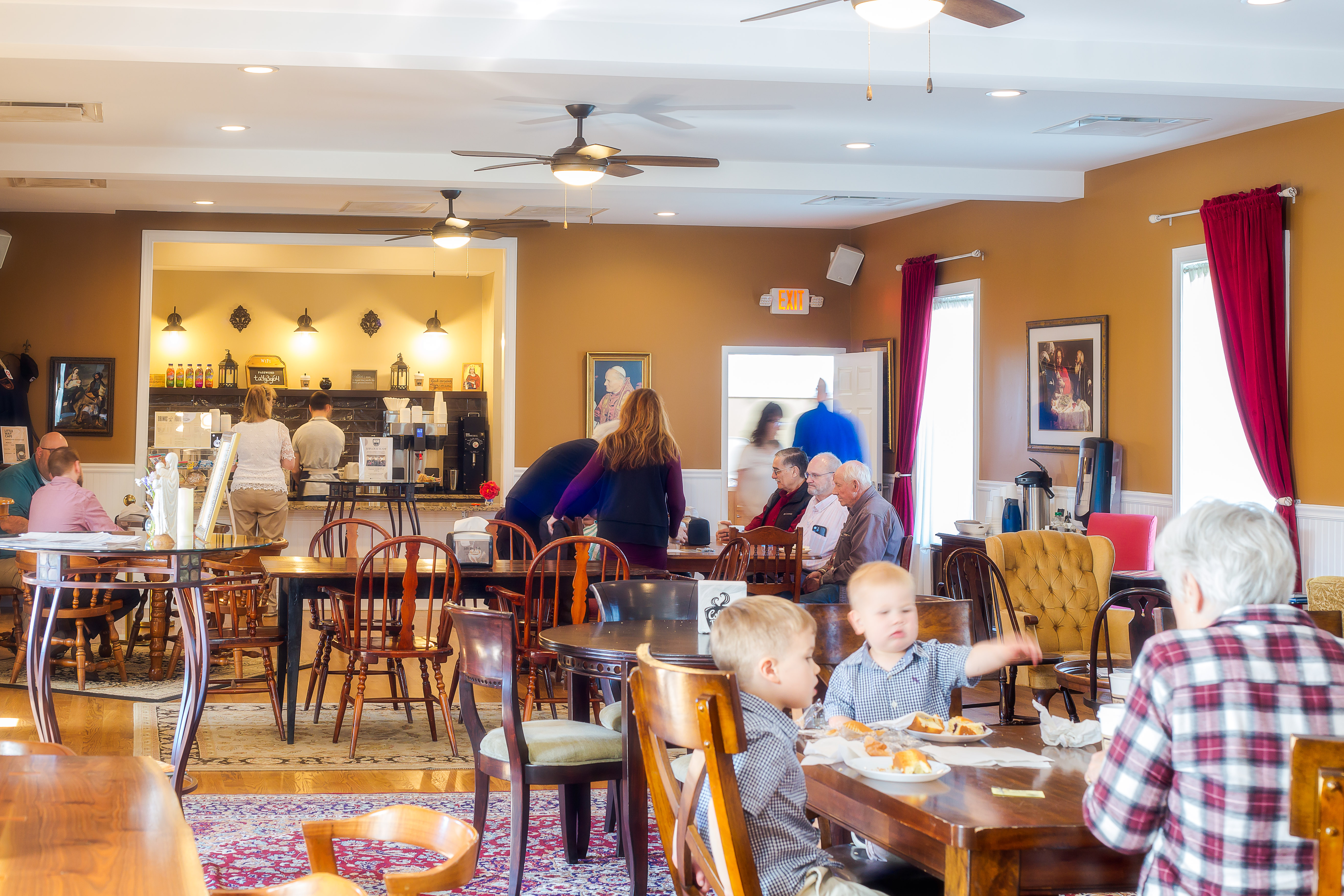
For suggested donations at a price point similar to regular coffee-shop prices, customers can get high-quality regular coffee, lattes, tea, muffins, bagels, croissants, breakfast sandwiches, danishes, cookies and juice.
The café plays two roles. One is to bring parishioners together. Father O’Hare described a scene where two women who had been going to the same 7:30 a.m. Sunday Mass for perhaps two decades finally had a conversation. “I hear one say to the other, ‘I’ve been admiring your hair for years,’” Father O’Hare said.
The other role is to reach people who don’t want church but may want coffee.
“Now, it’s also a welcome mat for anybody who’s just driving by or lives in the neighborhood. And people of little or no religion are rubbing shoulders with religious people and even a priest,” Father O’Hare said.
“Yes, it’s an evangelization tool,” added Carmen Lane, the parish’s director of operations.
She described a woman who last year went from café customer to joining the parish’s conversion program. (The woman became a Catholic this past Easter.)
Also because of the café: A conversation that started when a non-practicing Catholic woman met a friend for coffee led to the woman having her children baptized, Father O’Hare said.
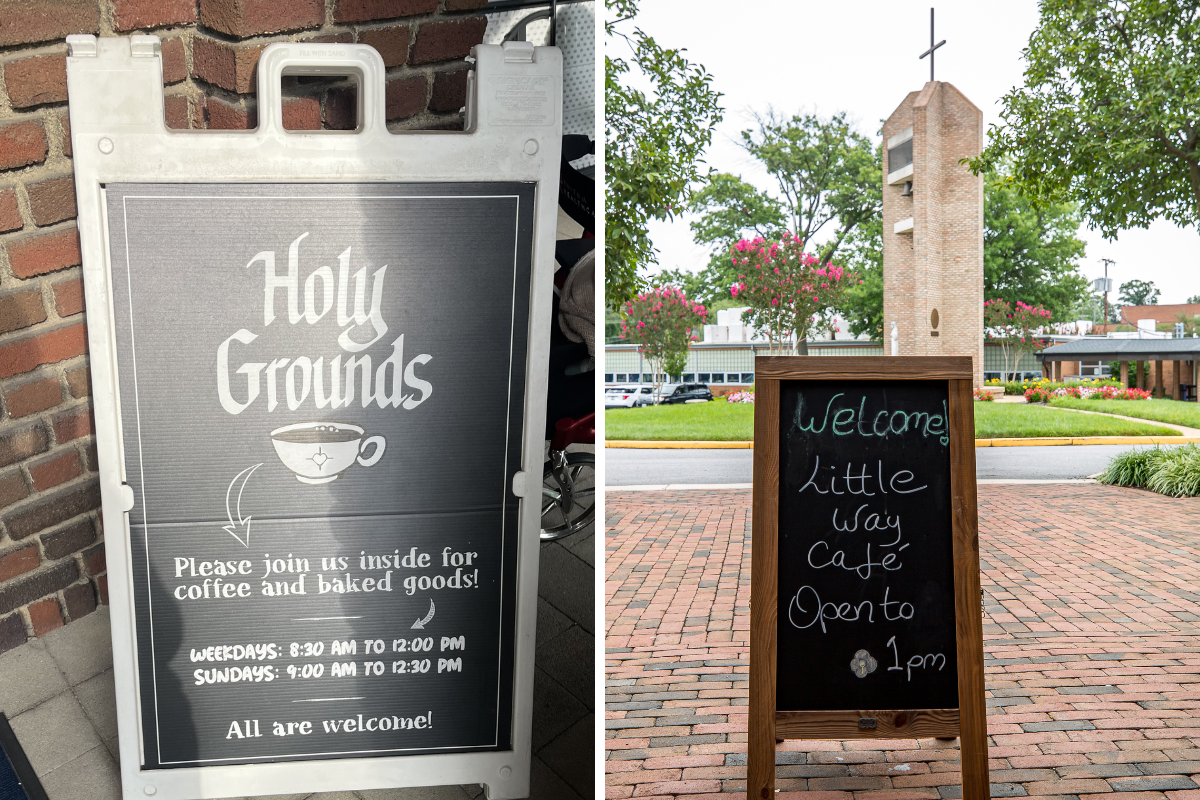
In the fractured, modern suburban world, coffeehouses aren’t a nice added extra for a Catholic parish, but rather an essential, the priest told the Register.
“Get the word out there. Parishes need cafés. They need them. They should make them happen however they can do it. Whatever your facilities are, do something, because people are hungering for the fellowship element,” Father O’Hare said. “And if you don’t get fed, you’re going to start looking elsewhere for it.”
- Keywords:
- coffee
- catholic parish life
- catholic parishes