Where Is Catholicism Growing in the US?
Out of the top 10 gainers, only one diocese — the Archdiocese of New York — is located outside of the South or the West. Of the 10, six are in Texas or California.
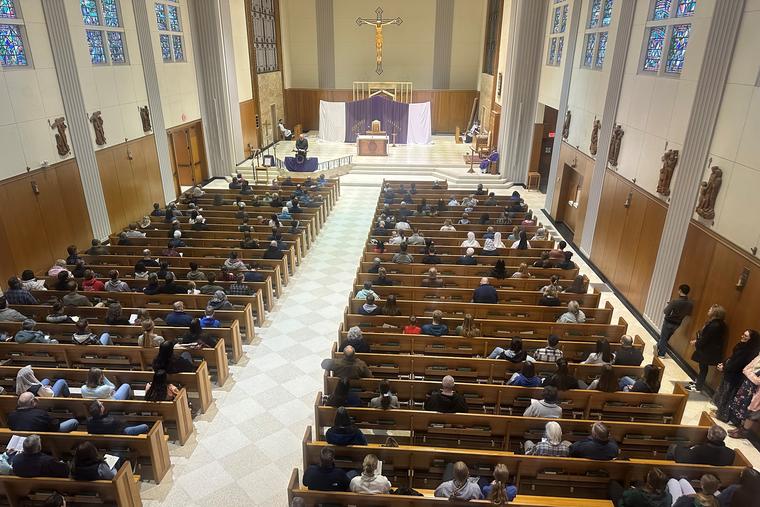
As the number of Catholics in the U.S. has grown by 40% in the past 40 years — from 48 million to 67 million — new hubs of Catholic life have emerged — ranging from booming major metro areas to smaller communities that are punching well above their weight on vocations.
Several dioceses in the South and the West, centered on growing cities, have gained literally hundreds of thousands of Catholics in recent decades, to the point where some of those dioceses have found themselves lacking the infrastructure to accommodate the new crush of parishioners.
At the same time, many areas of the country once considered Catholic strongholds — particularly the Northeast and the Midwest — have continued, in a decades-long trend, to see their Catholic population atrophy. In 1980, nearly 70% of the nation’s Catholics lived in the Northeast or Midwest. By 2000, that percentage was 58%. And by 2019, it was just 47%, Church statistics show.
A laundry list of some of the oldest and most distinguished dioceses in these regions, such as Chicago and Baltimore, have had to undergo complex and divisive parish-merger processes in recent decades, closing many once-vibrant parishes that are now too large for the extant Catholic population.
The Center for Applied Research in the Apostolate (CARA) at Georgetown University studied this phenomenon in depth in a 2021 study, which showed that over the past 40 years in the United States, the South and West have largely experienced a Catholic population “boom,” in contrast to a population “bust” in the Northeast and Midwest.
“While the overall numbers show tremendous growth in the Catholic population nationally, examining the data in more depth regionally reveals areas of serious decline as well as of rapid growth,” wrote Jonathon Wiggins, Mary Gautier and Jesuit Father Thomas Gaunt for the journal Theology Today. “As parts of the South struggle to provide enough infrastructure to accommodate the influx of parishioners, parts of the Northeast and Midwest find themselves with a surplus of buildings in areas that no longer have enough parishioners to keep them open.”
What Areas Are Trending?
Father Gaunt, one of the authors of the 2021 study, told the Register in an interview that the trends they identified four years ago seem to hold true today. To further illustrate those trends, Father Gaunt shared data compiled by CARA from the Official Catholic Directory (OCD) that shows which dioceses have gained and lost the most people, in raw numbers, during the period 2000-2020.
Out of the top 10 gainers, only one diocese — the Archdiocese of New York — is located outside of the South or the West. Of the 10, six are in Texas or California.
The Archdiocese of Atlanta gained 939,000 Catholics during the two-decade period, followed by San Bernardino, California, with 878,000; Fort Worth, Texas, with 871,000; Galveston-Houston, with 749,000; Dallas with 691,000; Phoenix with 649,000; San Diego with 591,000; Sacramento, California, with 571,000; New York with 419,000; and, finally, Charlotte, North Carolina, with 390,000.
In contrast, the top 10 dioceses that have lost the most Catholics are all located in the Northeast and Midwest — three located in New York state alone — with the notable exception of Miami, which posted the largest loss of all, at 340,000 Catholics during the time period studied.
Rounding out the “bottom” 10 with a loss of 335,000 Catholics was Brooklyn, followed by Detroit with 300,000; Hartford, Connecticut, with 296,000; Chicago with 231,000; Cleveland with 183,000; Philadelphia with 164,000; Buffalo, New York, with 162,000; Syracuse, New York, with 149,000; and Milwaukee with 137,000.
In the study, the researchers used four major U.S. cities — Fresno, California; Pittsburgh; Atlanta; and Milwaukee — as a reference to illustrate the growth and decline of Catholic populations across the four main regions of the country.
They found that while younger dioceses like Fresno and Atlanta are experiencing robust growth driven by demographic shifts, economic vitality and new infrastructure, older dioceses like Pittsburgh and Milwaukee are grappling with declining populations, the lingering effects of abuse scandals, and challenges in engaging younger, more mobile generations.
Of course, it’s worth noting that a large increase in the number of Catholics over a period of decades isn’t the only measure of the spiritual vitality of a diocese or metro area. In terms of fostering vocations to the priesthood, smaller dioceses — especially those located in the Midwest and Great Plains — may still hold an edge over many of the fast-growing large dioceses in the South and West.
Church statistics show that the Diocese of Bismarck, North Dakota, for example, with just 60,000 Catholics, has had more priestly ordinations in the last five years — 15 — than eight dioceses with more than a million Catholics, including San Diego, Fort Worth and Fresno. All three of those large dioceses have posted massive gains in the raw numbers of Catholics living there in recent decades.
Of note, many of the bottom performers on priestly ordinations are dioceses covering major metro areas like New York, Los Angeles, Chicago, Seattle, Dallas and Pittsburgh.
Mass attendance, too, is an important metric. Data from the OCD suggest that the areas currently experiencing massive Catholic growth are not necessarily the nationwide leaders on attracting people to Sunday Mass.
According to that data, the highest rates of Mass attendance can be found, at the state level, on the Great Plains — especially in the Dakotas and Nebraska. Historically Catholic Louisiana posted the second-highest rate of Mass attendance in the country, behind only Nebraska.
A Story of Growth
Though not one of the top-10 largest gainers in terms of raw numbers, Fresno stands out as a prime example of the opportunities and challenges that face a growing Catholic community in 2025.
Like many other metros that have seen their Catholic populations grow, Fresno has benefited from a high rate of growth in general, led by a strong economy, a good quality of life, proximity to several national parks, and its central location in California, which has attracted major companies like Amazon and United Parcel Service in recent years. The area surrounding Fresno is also very important agriculturally, with a large resident Hispanic population of more than 40% and many seasonal migrant workers from Mexico contributing to the Catholic community’s expansion.
Since 1980, the Catholic population in the Fresno Diocese has more than tripled. This growth is not without its pains, however; despite the remarkable surge in the Catholic laity, the number of parishes in the Fresno Diocese has largely remained stable during this period, and the number of priests has declined by approximately 26%. This disparity has led to a quadrupling of the Catholic-per-priest ratio, giving Fresno the highest ratio among the four regions that the CARA researchers studied.
Atlanta, representing the South in the study, mirrors Fresno’s trajectory of significant growth. The data indicate that the Catholic population in Atlanta has grown tenfold since 1980, with the proportion of Catholics per priest increasing sixfold. Demographically, the South’s Catholic population is notably young, with 71% being of working age and only 29% aged 65 and older, suggesting continued growth in the short term.
The Catholic population in the South is also characterized by its much greater racial diversity, with only 45% being white. While priests in the South are racially more diverse than in the Northeast, there’s still a disparity: Black priests are twice as represented as the Black Catholic population (13% vs. 6%), but Hispanic or Latino priests are significantly underrepresented (8% compared to 36% of parishioners).
While Catholics remain a minority in some Southern states — such as Alabama, where Catholics make up only about 7% of the nearly 5 million population — other areas show tremendous expansion.
For instance, new seminaries are opening in North Carolina to serve the burgeoning Catholic population. The Diocese of Charlotte has seen its Catholic population swell to an estimated 400,000 in 2020, more than 10 times the number present when the diocese was established in 1972. This diocese is also home to St. Matthew’s parish, one of the largest in the country by registration, boasting more than 11,500 families.
Signs of Decline
In stark contrast to the growth seen in the South and parts of the West, Pittsburgh serves as a good example of broader demographic trends leading to a marked downturn in the Northeast. The Pittsburgh Diocese has experienced a decline of 31% in its Catholic population since 1980.
The Church in Pennsylvania has been particularly impacted by recent sexual-abuse scandals. Following the 2018 release of the Pennsylvania grand jury report, which detailed thousands of abuse cases, Mass attendance in Pittsburgh dropped by 9%, and offertory donations declined by 11%. In response to declining Mass attendance, the Pittsburgh Diocese has undergone several rounds of parish mergers.
Milwaukee, in the upper Midwest, also faces significant decline overall. The Archdiocese of Milwaukee has seen its Catholic population and the number of parishes both decline by about 25% from 1980 to 2019, while the number of priests plummeted even faster: by nearly 75% over the same period. The researchers suggested in 2021 that the Catholic Church in this region is unlikely to grow much in the short term. Diversity is also a challenge, with about eight in 10 priests and three in four parishioners being non-Hispanic white.
- Keywords:
- u.s. catholics