The Powerful St. Michael Prayer Should Not Incite Controversy, but Calls to Intercession
There are plenty of reasons for invoking the help of the most powerful archangel in today’s battles against the devil.
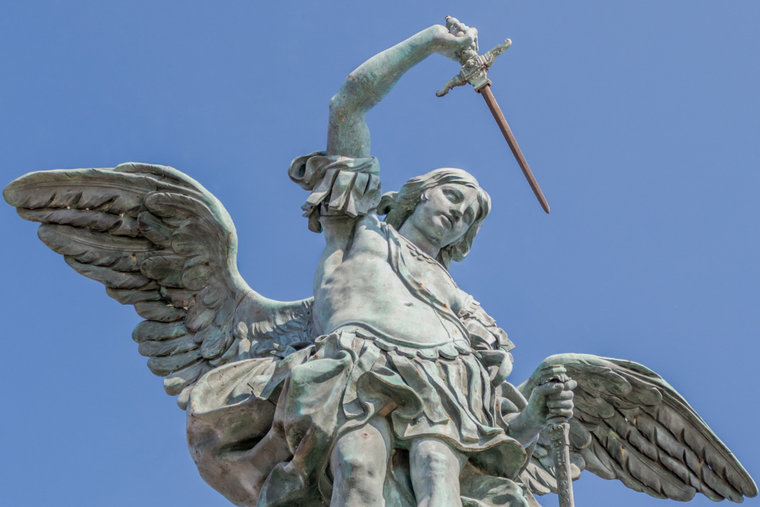
When Pope Leo XIV was elected on May 8, the date providentially fell on two important feasts. The new Pope said, “Today is the day of the Prayer of Supplication to Our Lady of Pompeii.” The date also marked the feast of the appearance of St. Michael the Archangel on Mount Gargano in the fifth century.
Leo XIV purposely chose the name of his predecessor Leo XIII, who wrote 10 encyclicals on the Rosary and also composed and mandated the Prayer to St. Michael and other prayers — the Leonine prayers — to be recited after all low Masses beginning in 1886. He did so as secularism was increasing — and after he had an alarming vision following Mass of demonic forces threatening the Church and world. St. Michael the Archangel would be petitioned to protect humanity from the devil’s snares.
After Vatican II, the Leonine prayers were sidelined in 1964; however, as a result of the various dire situations in the world, specifically the clergy-sex-abuse scandal, the Prayer to St. Michael began making a strong comeback in some dioceses.
Despite the increasing turns to evil in the world, this traditional prayer has become a recent lightning rod for nitpicking and controversy.
For example, in the Diocese of Charlotte, North Carolina, proposed restrictions in new liturgical norms state, “If parishes have the custom of praying this prayer communally at the end of Mass, it ought to be done separate from the liturgy and, therefore, no sooner than after the Recessional hymn.”
Since many people begin leaving the church during the recessional hymn, that all but eliminates most of them from saying the prayer. Yet there are plenty of reasons for invoking the help of the most powerful archangel in today’s battles against the devil.
Strong Evidence
There are dioceses from coast to coast that do urge parishes to return to and continue to pray the St. Michael Prayer after Masses — and have done so for several years — such as the Archdiocese of Portland, Oregon, and the Diocese of Bridgeport, Connecticut (begun in 2018).
In the Diocese of Springfield, Illinois, shortly after Bishop Thomas Paprocki was installed in June 2010, he visited all seven deaneries to celebrate Mass, telling his flock, as he recounted to the Register, “The devil or Satan is real, and he will do everything he can to deflect us from this vision, from our goals, and particularly our ultimate goal, which is eternal life, on high with Christ as his kingdom. That shouldn’t either frighten or despair us” because “Christ is more powerful than Satan.”
Next, he told the Register, “I simply mentioned in passing, ‘It’s good to remember the Prayer to St. Michael, which used to be prayed after every Mass and which we could still pray beneficially for our spiritual well-being.’ Then I said the Prayer to St. Michael.”
Shortly after, his chancellor at the time proposed the promotion of the St. Michael Prayer, and 50,000 cards were printed and sent around to the parishes of the diocese. Bishop Paprocki never really mandated it. “It was a suggestion that we say that prayer after Mass,” he explained to the Register. The suggestion was taken to heart and spread quickly.
“When I would go to parishes, and invite people to take out the prayer card that they had in their pews, we would say the St. Michael Prayer after Mass. Sometimes I would go to a parish and I would forget to do that. The people then would start the St. Michael Prayer themselves because they apparently liked the prayer and found it very meaningful,” he recounted to the Register.
He continued, “As the years have gone on, I don’t see anybody using the prayer cards anymore. They all have that prayer memorized. And they join in that prayer very robustly at the end of Mass. What’s interesting about that is, I’ve noticed also, sometimes there’ll be young people, teenagers or adolescents … not participating very enthusiastically [at Mass] and then comes time for the St. Michael Prayer, and they’re saying it with a lot of gusto and enthusiasm. … They really mean it.”
Has he had any complaints? “Sometimes I hear from people that we shouldn’t be adding anything to the liturgy, and that’s true. But my answer to that is we’re not adding [to] it. I’m not replacing some other prayers in the liturgy. The Mass is actually over. It’s actually at that point, after I’ve given the final blessing and say, ‘The Mass is ended; go in peace,’ Mass is over. And then we say the St. Michael Prayer.”
Additionally, no one is required to say it. People are free to join in, or not. “But most people are very enthusiastic about wanting to say the St. Michael Prayer after events,” he reported.
In the Diocese of Madison, Wisconsin, Bishop Donald Hying explained that the St. Michael Prayer is “a long-standing tradition that takes place at the end of Mass.” He told the Register, “While it became less prominent after the Second Vatican Council, Pope Francis encouraged the practice be resumed in 2018. Since the Sacrifice of Mass re-presents Christ’s ultimate victory over sin, death and Satan, it is fitting to invoke angelic assistance as we engage in spiritual battle at the present moment.”
Suppressed or Not?
Bishop Paprocki also clarified some common misconceptions.
“Sometimes somebody who knows maybe a little bit more about liturgy will say, well, the St. Michael Prayer with all the Leonine prayers, as they were called by Pope Leo XIII, were prescribed to be said after a low Mass, and that was changed by Vatican II. The terminology that was used was that the Leonine prayers are ‘suppressed.’ That doesn’t mean they’re prohibited. We can certainly say the St. Michael Prayer. The St. Michael Prayer has not been banned by saying it’s ‘suppressed.’ It’s simply saying that it’s no longer prescribed as something that must be said at the end of a low Mass. But, in case anybody was interested in that technical point, too, there is nothing preventing the praying of the St. Michael Prayer after Mass, either privately or even together as a community.”
What might Pope Leo XIV think about this? Although Bishop Paprocki has not seen the Pope say anything specifically about the St. Michael Prayer, he thinks his papal name serves as a likely indicator. “[C]hoosing the name Leo — and he has referred to Pope Leo XIII — I would think that this would be one of Pope Leo XIII’s contributions that he would want to continue.”
Calling the Flock to Prayer
This prayer seeking protection “against the wickedness and snares of the devil” has been promoted by other past popes.
On April 24, 1994, during his Regina Caeli, St. John Paul II spoke about the spiritual battle in Revelation, “bringing before our eyes the image of St. Michael the Archangel (Revelation 12:1-4, 7). Pope Leo XIII certainly had this scene clearly in mind when, at the end of the last century, he introduced throughout the Church a special prayer to St. Michael. … Even though today this prayer is no longer recited at the end of the Eucharistic celebration, I invite everyone not to forget it, but to recite it to obtain help in the battle against the forces of darkness and against the spirit of this world.”
Archbishop Alexander Sample of Portland, Oregon, emphasized the same point when he called for the St. Michael Prayer in 2018. “It seems to me that the evil one has intensified his war against the Mystical Body and its members,” he wrote. “There are many things we can do as a local church to play our part in the purification of the Church at this time, however prayer will also be the foremost and most appropriate response, on which all other efforts will build. I would like to strongly encourage you therefore to pray the St. Michael Prayer after each parish Mass and in turn encourage your parishioners also to personally say this prayer daily.”
He concluded, “The St. Michael Prayer, composed by Pope Leo XIII, is a forceful weapon in our armory of devotions, and St. Michael the Archangel is an intercessor of great power.”
In the Archdiocese of Philadelphia, Father Dennis Gill, director of the Office for Divine Worship as well as rector of the Cathedral-Basilica of Sts. Peter and Paul, told the Register, “The praying of the Prayer to St. Michael is now rather typical in the Archdiocese of Philadelphia.”
He also emphasized that Pope Leo XIII wrote this prayer and asked for it to be prayed following Mass, explaining that the Pope who reigned as the Industrial Revolution got underway “recognized the forces of evil in the world that were wreaking havoc in the lives of good people, good Christian people. He wanted people to have the heavenly help of the archangel who defeated the devil, as told in the Scriptures, to be available to them in their everyday circumstances of life.”
Father Gill said that though the prayer “practically disappeared in its use after Mass” following the Second Vatican Council, “Pope Francis in 2018, with a similar concern as Pope Leo XIII, once again asked that we return to the use of this prayer.” Since the fall of 2018, it has become rather normative in the archdiocese. Many parishes and institutions within the archdiocese pray the St. Michael Prayer, and priests are reminded that this devotional prayer takes place outside of Mass.
What do pastors think?
At Holy Name Parish in Cleveland, Msgr. Richard Antall, the pastor, said in his diocese it is the norm to recite the prayer in accordance with the pastor’s directive. His parish has been praying the St. Michael Prayer for nine years.
“We have the tradition with Leo XIII,” he explained, “but also, we’re in terrible times. The devil is very active. So we should be aware of the battle between good and evil that the prayer implies. It’s invoking the intercession of St. Michael, which is in the Bible, both in the Book of Daniel and in Revelation. So it is a biblical prayer, and the times warrant it.”
“They like it a lot,” he said of his parishioners’ response. “And a lot of people learned it right away.” He advises others “not to be afraid to use a prayer that has a lot of popular appeal.” To make the point, he is being assigned to another church this June, La Sagrada Familia, and already, “one of the things some of the new people tell me is, ‘I hope we go back to the St. Michael Prayer.’”
- Keywords:
- st. michael prayer