Smart Glasses Offer a Glimpse of the Future — But the Church Sees More Clearly
ANALYSIS: With wearable AI gaining traction, Catholics face a growing call to engage technology with wisdom and care.
Eyeglasses have been around since the 13th century.
Early precursors to so-called smart glasses came on the scene in the 1960s — but the technology evolved in the early 2000s and gained mainstream traction about a dozen years ago.
These developments illustrate the march of technological advancement. What was once the dream of sci-fi shows like The Jetsons is now very much a reality in 2025.
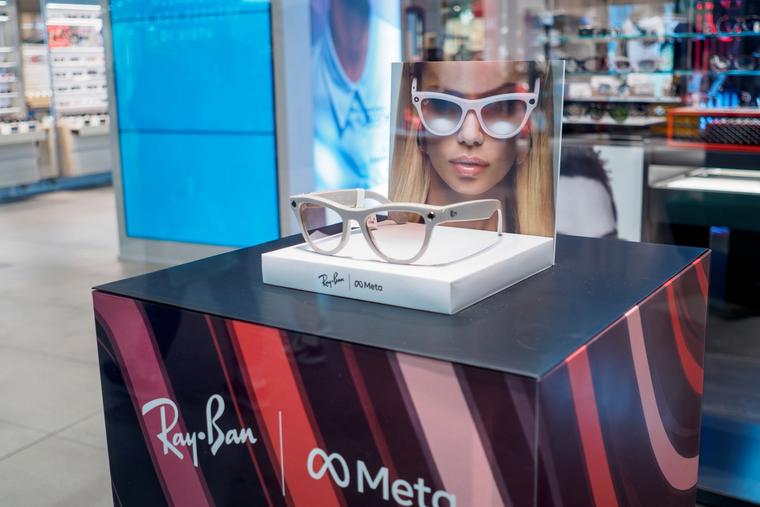
In the first half of 2025, sales of Meta’s AI-powered Ray-Ban and Oakley glasses have tripled, according to AInvest. This is the result of a collaboration between Meta and the luxury eyewear company EssilorLuxottica, whose CEO, Francesco Milleri, has touted the glasses as the “next computing platform,” providing fertile ground for the convergence of artificial intelligence, sensory technology and health-care infrastructure.
This report comes as Meta founder Mark Zuckerberg, in a letter posted to the company blog, made his pitch for “personal superintelligence.” He writes: “I think in the future, if you don’t have glasses that have AI — or some way to interact with AI — I think you’re … probably [going to] be at a pretty significant cognitive disadvantage compared to other people.”
Perspective of the Church
The debate over AI’s rapid advance has moved beyond developers and investors, reaching the Vatican, where Church leaders are weighing the technology’s theological, ethical and social implications — and the stakes they entail.
In his first address to the cardinals this May, Pope Leo XIV described the present moment as “another industrial revolution” — a qualitatively new revolution shaped not by steel or the printing press, but by artificial intelligence and emerging technologies that challenge the way we understand work, communication, and even the human person.
Just two months later, in July, addressing the international “AI for Good” summit in Geneva, he urged legislators to build regulatory frameworks that place the human person — not data — at the center of innovation, with what he called an “integral human development.”
The Church’s engagement with AI builds on a foundation laid by the Vatican earlier this year. In January, the Dicasteries for the Doctrine of the Faith and for Culture issued Antiqua et Nova, a theological framework outlining seven principles — among them rationality, embodiment and relationality — to guide moral reflection on technologies that shape cognition and development.
These questions aren’t merely theoretical. The rise of AI-powered smart glasses is already making waves. These devices allow users to check messages, stream audio and navigate a city with a simple tap on the frame near the temple, accompanied by a quick voice command.
Once a novelty, this kind of wearable tech is becoming mainstream — especially among young adults — bolstered by high-profile sports endorsements and national advertising.
Meta’s Ray-Ban smart glasses lead the market, promoted by NFL star Patrick Mahomes and LSU gymnast Livvy Dunne, and featured in a commercial during Super Bowl LIX.
A 2023 Vision Council report found that “93 percent of adults in the United States regularly wear some form of eyewear,” and that “more than a third of Americans intend to purchase tech eyewear within the year, with men aged 18-44, those in urban communities, and early adopters of technology, especially likely to purchase.” This points to a market ripe for growth.
As new gadgets like this reshape how we experience the world, the Church is asking: Will they deepen our humanity — or distract us from it?
According to a 2018 report by the market research firm Nielsen, Americans were already spending an average of 11 hours and 6 minutes per day consuming media — more than half of it on screens, including smartphones, TVs and computers.
The journey of smart glasses began in 2013 with early models like the now-defunct Google Glass. Despite initial excitement, those early versions drew criticism for unwelcome video recording and limited functionality. Meta’s smart glasses, which feature a built-in ultra-wide 12-megapixel camera, have improved upon Google Glass by adding a blinking light on the front of the frame to indicate when a user is recording — an addition that has allowed some critics to breathe a sigh of relief.
Some users, however, have found ways to “jailbreak” the technology, disabling or covering the recording indicator light. Concerns about data privacy have also grown, especially after two Harvard students showed that Meta’s AI glasses, when paired with facial-recognition software, could retrieve personal data through a simple reverse-image search. The glasses have even been linked to criminal activity — most notably during the New Year’s Day 2025 terror attack in New Orleans.
The evolution of these devices has been driven by advances in artificial intelligence and hands-free integration with platforms like WhatsApp, Instagram and Messenger. With a simple “Hey, Meta,” users can ask questions and receive AI-informed responses about their environment or queries. The glasses can also translate foreign languages directly to the wearer through over-ear speakers.
Ray-Ban, Oakley, Warby Parker and others have helped retire the notion that wearable tech is unfashionable, according to Vogue Business.
A 2019 Pew study shows millennials warming to this new spectacle of tech — pun intended — as Pew has tracked rising new-media use among younger age groups.
A 2023 Pew Research study shows that apps like YouTube and TikTok dominate the attention of teens, with 58% using TikTok daily and 16% saying they use it almost constantly. In addition, 46% of teens report being “almost constantly” online, while 47% say they’re online several times a day.
Taking on the Future
Critics warn of potential negative social implications, such as increased dependence on these technologies, yet proponents such as Zuckerberg argue that personal interactions will benefit from real-time AI assistance, Fortune magazine reported.
Meta has already enacted a “soft opt-out” data-collection policy with its AI glasses, meaning users’ video and voice data is automatically collected to train future AI models — unless the feature is manually disabled in settings. The company already controls the algorithms behind Facebook and Instagram, which play an outsized role in shaping human cognition and behavior through ad targeting and digital engagement.
Meta has also produced a working prototype of its augmented reality Orion glasses, which offer interactive holographic displays and are projected to be commercially available in 2027. Meta is also developing wearable wristbands that detect nerve impulses to send commands to devices, powered by its large language model, Llama 3.
Other tech giants are also pursuing wearable technologies. Samsung has filed a patent for a wearable device that monitors and influences dreams using neural feedback, potentially allowing so-called dream customization. Google has filed a patent for “Smart Skin” wearable sensors, a tech layer worn on the body that monitors vital signs and interfaces with other devices. Apple has patented AirPods capable of scanning brain activity.
Against that backdrop, smart glasses represent just the most visible tip of the AI iceberg — a glimpse of the technocratic future that we as a society are moving toward full steam ahead, pending further course correction.
Will an encyclical from Pope Leo XIV address the coming challenges of AI and offer a road map for Catholics grappling with the social, economic and ethical tech-imposed challenges of our day? One might hope.
The potential implications of widespread adoption of these devices on human presence are vast and pass yet another road marker on the march toward a highly technology-dependent future.
The question facing the faithful today is whether we can embrace this technology in a way that enlarges our humanity — or whether we will allow it to narrow our humanity instead.
Over the weekend at the Jubilee of Youth, Pope Leo reminded young people that technology must not come at the expense of fraternity.
“Today there are algorithms that tell us what we should watch, what we should think, and who our friends should be. And so our relationships become confusing, sometimes anxious. When a tool controls someone, that person becomes a tool: a commodity on the market and, in turn, a piece of merchandise,” the Holy Father said.
“Only genuine relationships and stable connections,” he added, “can build good lives.”
- Keywords:
- artificial intelligence
- technology
- church teaching