Open Letter Defends Traditional Mass Against Cardinal Cupich’s ‘Spectacle’ Claims
The Chicago cardinal made oblique criticisms of the traditional Mass in an Oct. 22 reflection.
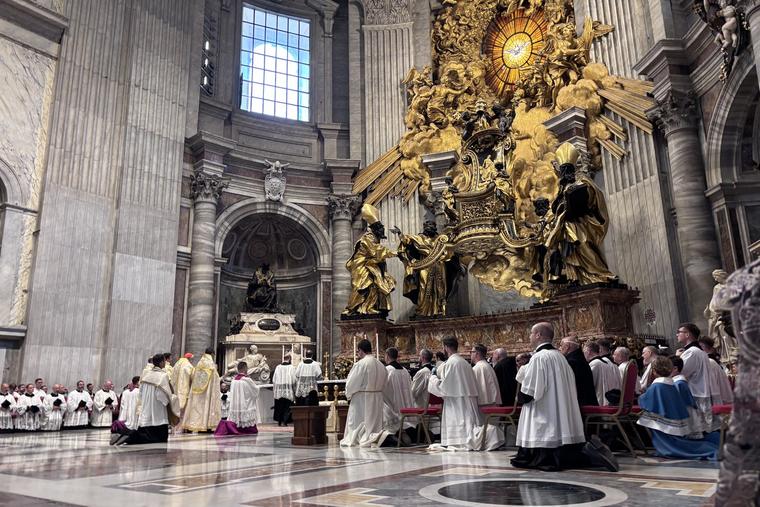
An Italian expert liturgist has written an open letter to Cardinal Blase Cupich of Chicago, criticizing the cardinal’s recent assertions, published by the Vatican’s news website, that the traditional Latin Mass is a “spectacle” that prevents “active participation” of all the baptized.
In his letter published Nov. 18, Father Nicola Bux, a former consultor during Benedict XVI’s pontificate to the then-Congregations for the Doctrine of the Faith and Causes of Saints, took issue with the cardinal’s argument, saying that he had effectively misunderstood both the aims of the Council Fathers and the historical meaning and importance of the traditional Roman Rite.
Cardinal Cupich had made oblique criticisms of the traditional Mass in an Oct. 22 reflection on Pope Leo’s apostolic exhortation Dilexi Te. In his commentary, published on Vatican News, he drew attention to a passage of the exhortation, which, he said, provided a “fresh understanding” of the Council Father’s reform of the liturgy. Quoting from the text, Cardinal Cupich wrote that the world needed a “new image of Church, one simpler and more sober,” that more closely resembled “the Lord than worldly powers” and which was committed to solving world poverty.
Cardinal Cupich maintained that the liturgical reforms of the 1970s tried to do just that: by purifying worship, making it simple and sober, able to “speak to the people of this age in a way that more closely resembles the Lord, and allowing it to take up, in a fresh way, the mission of proclaiming good news to the poor.”
This was in keeping with the Council Fathers, the cardinal asserted, adding that their desire was to present “a church defined not by the trappings of world power” but enabling it to “speak [to] the people of this age in a way that more closely resembles the Lord.”
The cardinal backed up his assertions with “scholarly research” that he said had gone into the liturgical reform and which had found that the traditional Roman Rite had “incorporated elements from imperial and royal courts,” making its liturgy “more of a spectacle rather than the active participation of all the baptized.”
“By purifying the liturgy of these adaptations, the aim was to enable the liturgy to sustain the Church's renewed sense of herself,” Cardinal Cupich wrote. Pope St. Paul VI noted this at the Second Vatican Council, he said, adding that John XXIII’s purpose in calling the Council was to “open new horizons for the Church and to channel over the earth the new and yet untapped spring waters of Christ our Lord’s doctrine and grace.”
Open Letter
But in his open letter to the cardinal, Father Bux countered Cardinal Cupich’s assertions by saying the liturgy should be a sacred spectacle to glorify God and insisting it was “untrue” that the Council “desired a poor liturgy.” He said the Council’s sacred constitution on the liturgy, Sacrosanctum Concilium, instead asks that “‘rites should be distinguished by a noble simplicity,’ because they must speak of the majesty of God, who is noble beauty itself, and not of worldly trivialities.” Father Bux said the Church understood this from the beginning, both in East and West, adding that “even Saint Francis prescribed that the most precious linens and vessels be used in worship.”
On the issue of participation, Father Bux said the pre-reformed, traditional Roman Rite, also known as the usus antiquior, conforms to what the Council taught on the subject: that participation be “full, conscious, active, and fruitful,” that it help the worshipper enter into the mystery that takes place through prayers and rites, and that the liturgy “elevate us as much as possible to divine truth and beauty.” And he quoted the words of Pope Leo, spoken before his election, when he said that evangelization must find a way of reorienting the public’s attention “toward mystery.”
“The usus antiquior of the Roman Rite performs this function,” said Father Bux, “otherwise it could not have withstood the secularization of the sacred that entered into the Roman liturgy, to the point of making people believe that the Council itself wanted it.”
Lastly, Father Bux stressed that since ancient times, the liturgy was “solemn in order to convert many to the faith” and for this reason it must not “imitate the fashions of the world,” employing dancing, applause or other such novelties. Solemn worship is authentic, he said, and he asked the cardinal to “engage in a synodal dialogue” on this issue, “for the good of ecclesial unity.”
In comments to the Register, other liturgists also criticized Cardinal Cupich’s position on the traditional liturgy. Underlining the deep connection between royalty and temple liturgy, Catholic author and composer Peter Kwasniewski explained how the image of a royal court was adopted in Christian worship as a natural and normative framework.
This theme, he said, quoting from a lecture he gave in May 2022, runs through the Old and New Testaments, highlighting God as the supreme King, Israel’s kingly and priestly identity, Christ as the King of all creation, and his angels and saints as his royal court.
“Our ecclesial sacrifice, the Most Holy Eucharist, is a kingly and high-priestly oblation,” he said. “The liturgy should reflect the truth of God — his absolute monarchy, his paternal rule, his hierarchical court in the unspeakable splendor of the heavenly Jerusalem — and not the passing truths of our modern provisional political organizations.”
Furthermore, Kwasniewski underlined how conducting the liturgy so that it appears “less courtly, less regal, less hieratic, less splendid” is to make the liturgy what it is not: “less truthful, less heavenly, less real” — in other words, it amounts to a Protestantization of it. One of the “greatest blessings of the traditional Latin liturgy,” he said, is therefore its “pure, open, unembarrassed representation of the court of the great King of heaven and earth, in all of its prayers, rubrics and ceremonies and in the magnificent art forms that emerged from its ‘courtliness’ and reinforce the ‘drama’ of the holy mysteries of our redemption.” He added: “We are wrapped in an atmosphere of spiritual aristocracy, namely, the world of the saints, who reign with Christ.”
Striving for Transcendence
Father Claude Barthe, an expert author on the traditional liturgy and priest of the Diocese of Fréjus-Toulon in France, said Cardinal Cupich was “clearly speaking about something he does not understand,” adding that the research to which the cardinal referred sought to recover a “dreamed-of” liturgy of the pre-Middle Ages and Carolingian era (seventh to ninth centuries) about which “very few documents exist.”
He noted that, assuming the ancient papal Mass (and thus the pontifical Mass) borrowed certain elements from court ceremonial, the "traditional sung solemn Mass and the low Mass are marked by great Roman simplicity." Father Barthe said the reverse was also true, as "imperial and royal rituals were sacralized."
Regarding participation, Kwasniewski said that once one is present at the Mass, what is then important is “to unite oneself interiorly to the holy sacrifice,” but he said he would bet that a “vast number” of those attending the new Mass do not do this because “they don't even think of the Mass as a sacrifice” and because they are “too distracted by what’s going on to have any interior attention left to expend.” Cardinal Cupich had made the point in his Vatican media article that historical “adaptations” had led to the traditional Latin Mass detracting from active participation and thereby from helping the faithful to “join in the saving action of Christ crucified.”
Cardinal Cupich has made similar points before about the usus antiquior, which he was quick to restrict in his archdiocese following the 2021 publication of Traditionis Custodes, Pope Francis’ motu proprio which suppressed the traditional Roman Rite.
Writing in the Chicago Catholic newspaper in September, the cardinal said he believed “the correct development of Church teaching” manifests itself “in the way we worship.” For this reason, he sees the reformed liturgy as “a recovery of truths of the faith, which over time were obscured by a series of adaptations and influences that reflected the Church’s expanding relationship with secular power and society.”
As in the Vatican News article, he argued that the liturgical reforms “were a direct response to the centuries of development that erroneously had transformed the Mass from a communal event into a more clerical, complex and dramatic spectacle.”
The cardinal believes his reading is a “true understanding of Catholic tradition,” helping her “to witness to the Gospel in new contexts,” and that “true reform is the Church’s way of going deeper into the tradition in order to move forward.”
- Keywords:
- traditional latin mass
- cardinal blase cupich

Edward Pentin Edward Pentin is the Register’s Senior Contributor and EWTN News Vatican Analyst. He began reporting on the Pope and the Vatican with Vatican Radio before moving on to become the Rome correspondent for EWTN's National Catholic Register. He has also reported on the Holy See and the Catholic Church for a number of other publications including Newsweek, Newsmax, Zenit, The Catholic Herald, and The Holy Land Review, a Franciscan publication specializing in the Church and the Middle East. Edward is the author of The Next Pope: The Leading Cardinal Candidates (Sophia Institute Press, 2020) and The Rigging of a Vatican Synod? An Investigation into Alleged Manipulation at the Extraordinary Synod on the Family (Ignatius Press, 2015). Follow him on Twitter at @edwardpentin.