Claiming Newman: Inside the Tug-of-War Over the Newest Doctor of the Church — And Why It Matters
Different camps are taking the English convert’s teaching on doctrinal development in different directions, with big implications for contested issues.
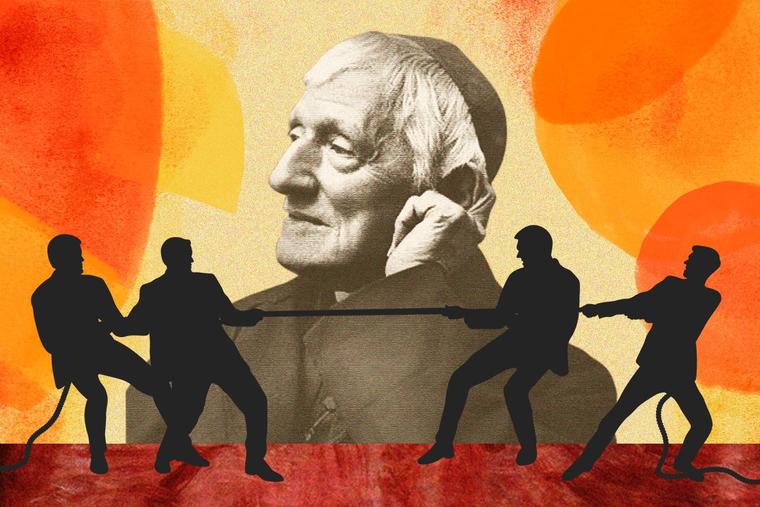
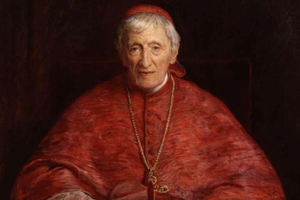
Come Nov. 1, St. John Henry Newman will be a doctor of the Church. The official designation, given out by the Catholic Church to only 37 holy geniuses before him, will enshrine the 19th-century English convert as one of the leading Catholic intellects of all time.
But it will also raise the stakes of an ongoing tug-of-war over Newman’s thought and how to apply it to modern challenges — with big implications for some of the most contentious issues facing the Church today.
In particular, Newman’s thought on the development of doctrine, or how the Church’s teaching can and cannot change over time, continues to be hotly contested among scholars. Different camps take Newman in different directions, with some portraying him as a springboard for innovation while others present him as a bulwark against error.
The topic isn’t just academic. It undergirds ongoing disputes over whether the Church should or even can revisit some of its most contested teachings, on everything from holy orders to sexual morality. Therefore, what’s at stake in the Newman debates isn’t just bragging rights, but the way the faithful — from bishops with magisterial authority to seminarians who will one day lead parishes to the laity in the pews — understand the nature of Church teaching itself.
“We thus need to explain Newman’s theory of development of doctrine clearly,” said Father Juan Vélez, an Opus Dei priest and Newman scholar, who worries that some are using the saint’s thought to push for changes that Newman would have never condoned.
What’s more, the Newman debates are also linked to something else: the Second Vatican Council. Although he died 72 years before the Council began in 1962, Newman is considered to be a “Father of Vatican II.” He addressed many of the challenges of modernity taken up by the Council, such as secularism and the rise of historical consciousness, and his views were influential on the Council’s teaching on development, conscience and the laity. Therefore, debates over Newman are in many ways debates about what Vatican II really taught and how to apply it today.
And with the Church set to place the Englishman alongside the likes of Sts. Augustine, Athanasius and Thomas Aquinas, the contest to count Newman on one’s side is likely only to intensify.
“You can see how some would like to make him a champion of one cause or another,” acknowledged Kenneth Parker of the National Institute for Newman Studies in Pittsburgh, adding that he would rather see Newman’s elevation “provoke us to deeper thought.”
Disputes About Development
Newman didn’t come up with the concept of developmental doctrine. Theologians before him, like Vincent of Lerins and St. Bonaventure, had already touched on the reality. But Newman did crystalize it into a systematic framework and in many ways set the parameters for today’s debates.
Newman’s 1845 “An Essay on the Development of Christian Doctrine,” which he wrote while working his way from Anglicanism to Catholicism, is a central text. Reflecting upon Church teaching throughout history, the scholar observed that while God’s revelation is complete, the Church’s grasp of divine truth has been enlarged over time. For example, Newman cited the Trinitarian definitions taught at Nicaea (A.D. 325) and Constantinople (A.D. 381) as genuine developments, instances of something implicit being made explicit through debate, contemplation and authoritative teaching.
In contrast to both lifeless stagnation and errant innovation, Newman likened development to organic growth. He compared it to a seed growing into a tree, including both change but also continuity at the level of essence. Newman contrasted this kind of development with what he called doctrinal corruption, or unfaithful changes. Reflecting on how doctrine had in fact expanded, Newman provided seven “notes,” or hallmarks of authentic development, such as “anticipation of its future” and “continuity of principles.”
Not all theologians look to Newman as a guide today. Some progressives, like German theologian Michael Seewald, see the Englishman as an important historical figure but downplay his relevance to current debates. Some traditionalists, on the other hand, avoid Newman out of concern that he is being used as a Trojan horse.
But for the majority of Catholic scholars interested in development, Newman remains a vital touchstone — although he is approached in different ways.
“There are those who want to use Newman’s theory of development ‘negatively’ and lean into his notes in quests for identifying corruption,” said Parker. “And then there are those want to embrace it and apply it rather vigorously, positively, and say, ‘This is a development of doctrine.’”
Parker cited Matthew Levering, a Mundelein Seminary theologian and author of Newman on Doctrinal Corruption, as an exemplar of the more conservative use of Newman. On the other hand, he suggested American theologian Shaun Blanchard, who teaches at the University of Notre Dame Australia, as someone who employs a more proactive approach to doctrinal development.
Blanchard, for instance, has written approvingly of Pope Francis’ appeal to Newman “as a vanguard in justification” of some of the late pope’s controversial reforms and has argued that Newman’s thought on the laity’s role in doctrinal development can serve as a key building block for establishing synodal forms of “theological discernment."
Levering, meanwhile, has emphasized that Newman’s theology of development should not be used as a prescriptive tool for doctrinal innovation and that the English theologian’s consideration of the importance of lay consultation should not be employed to overturn “solemnly taught doctrine of prior eras.”
Levering has warned against interpreting Newman along “religiously liberal lines” that seek to justify change, while Blanchard has critiqued what he calls a view of “rigid continuity” — concerns that are echoed elsewhere among Newman scholars.
Andrew Meszaros, who holds the newly created St. John Henry Newman chair at the Angelicum in Rome, suggests that that the key distinction between the camps’ approaches lies in the weight placed on a pivotal Newmanian concept: “the dogmatic principle.”
This principle holds that supernatural truths can be imperfectly but reliably communicated in human words and authoritatively taught by the Church. In other words, the Church’s propositional teaching from past eras articulates claims that remain true today and cannot be contradicted without undermining doctrinal integrity.
Meszaros said that Newman scholars who emphasize the centrality of the dogmatic principle tend to underscore the need for authentic development to be consistent with previously articulated principles in Scripture and tradition. But those who emphasize other factors, such as Newman’s appreciation for the role that history plays in shaping the Christian tradition and the Church’s “power of assimilation” (one of Newman’s notes), “might be more happy to appeal to contemporary experience, context, or exigency to justify a development.”
“I think it’s fair to say that Newman’s thought contains both of these dimensions,” explained Meszaros. “How one orders them and relates them to each other will vary from theologian to theologian.”
A Pivotal Thinker
If the tug-of-war over Newman intensifies after Nov. 1, it won’t be anything new. Towering intellects in the Church have been appropriated in different, even mutually exclusive, ways before, especially in the wake of receiving official ecclesial backing.
St. Thomas Aquinas might be the best example. When Pope Leo XIII mandated in 1879 that all seminaries hold the Angelic Doctor’s philosophy and theology in pride of place, the effect wasn’t uniform engagement with Thomas’s thought. Instead, different thinkers took the scholastic saint in dramatically different directions. As a result, theologians as different as Réginald Garrigou-Lagrange, known as a strict Vatican watchdog, and the progressive, controversy-courting Karl Rahner are both broadly labeled as “Thomists.”
Newman himself has already received a similar treatment. He was the darling of early 20th-century modernists, such as Alfred Loisy, who heretically claimed that dogma was constantly evolving, but was eventually reclaimed by more orthodox voices, like the future pope Joseph Ratzinger, who came across the English theologian as a seminarian in the 1940s.
But the struggle to define Newman has continued. For instance, dueling reference books from Cambridge and Oxford published in the past 16 years present differing interpretive frameworks of Newman. The Cambridge companion, edited by the late Newman expert Father Ian Kerr, frames the English saint as a faithful and perennially valuable Catholic thinker, while the Oxford version presents him as more of a historical figure than a saintly authority.
Even the Angelicum’s recent establishment of the Newman chair, which is dedicated to fostering additional research and teaching on Newman’s theology, can be viewed as a response to the rising significance of the Englishman in contemporary Church debates — and a desire to contribute to the conversation accordingly.
Newman’s new designation, however, could take things to a whole new level, given the rhetorical purchase that will come with associating one’s views with the about-to-be minted doctor of the Church. And theologians have already warned against Newman’s thought, complex and nuance as it is, being taken out of context to push for certain issues.
Perhaps to avoid exacerbating any tensions, Pope Leo XIV appears to be framing Newman’s elevation to doctor of the Church-status in connection with his contributions to education, not doctrinal development.
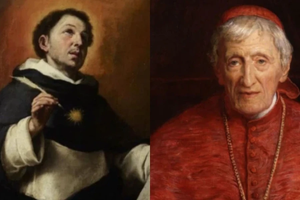
The Pope will declare the famed Oxford don and author of The Idea of a University a doctor during a Mass marking the end of the Jubilee of the World of Education. And earlier in the week, he declared Newman a co-patron of education, alongside Aquinas.
More a Bridge Than a Battle?
But Newman scholars aren’t necessarily worried about a bit of push and pull. In fact, a variety of voices underscore that vigorous and respectful debate is all part of the process of unpacking the thought of an undeniable, but complex, genius.
To that end, conferences with a variety of viewpoints included are being held at both the Angelicum and the Pontifical Gregorian University alongside Saturday’s papal proclamation Mass at the Vatican.
Parker, who will speak at the Gregorian conference, said that Newman “was a great believer in letting debate happen and exploring the merits of arguments” over time.
“We’re a little impatient with that, aren’t we?” he said, expressing his hope that Newman’s broad appeal could serve as a bridge, creating opportunities for constructive dialogue in a divided Church.
Parker added that it was important to distinguish between arguments that are truly appealing to Newman’s theory, which was always rooted in the insights of the early Church, and those that are appealing to other approaches to development, such as heightened consciousness. He suggested that Newman stands along “other theologians that we want to gain insight from” and who are relevant to ongoing debates.
Meszaros, who is set to speak at both conferences, added that the “diverse appeals to Newman are simply part of any reception process.”
In the long run, he hopes that Newman can “help shape a more cohesive theological landscape that allows for a healthy diversity of thought while maintaining a Christocentric and dogmatic foundation for Catholic unity.”
And in his opinion, the more people studying and discussing Newman, the better.
“Newman said that the development of great ideas takes time,” said Meszaros. “And I think it’s the same with his own thought.”