At the USCCB Meeting, Is There a ‘Leo Effect’ — or Just Business as Usual?
ANALYSIS: Immigration, leadership elections and synodality shaped the bishops’ meeting, but the evidence suggests these developments were already in motion before Pope Leo’s recent interventions.
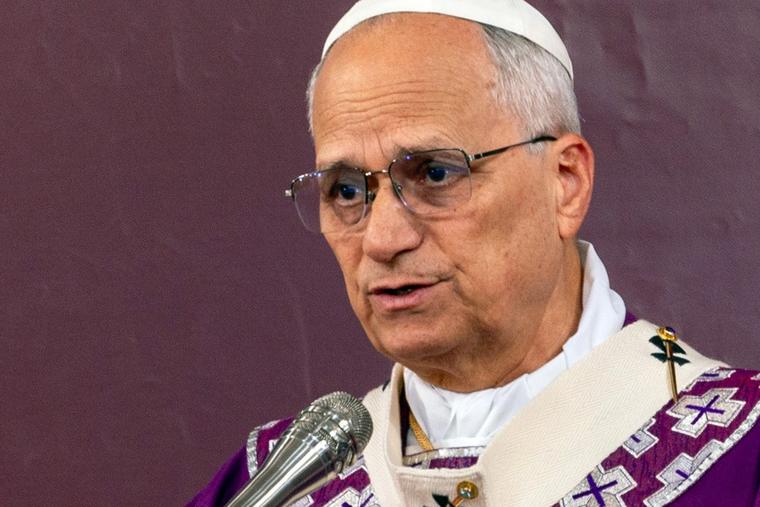
BALTIMORE — With the U.S. bishops meeting for business for the first time ever during the reign of an American pope, it’s fair to ask how much Pope Leo XIV’s influence has affected the proceedings.
After all, the Chicago-born Pontiff has indicated that he sees the U.S. bishops as a key part of his engagement with American society and has expressed his hope that bishops would speak out more boldly against injustices. And at first glance, it’d be easy to form a narrative that Pope Leo has had a big impact on how the USCCB’s Nov. 11-12 public sessions in Baltimore have played out thus far.
For one, immigration concerns have dominated the proceedings, from the message the U.S. bishops sent to the Holy Father to their strong critiques of the Trump administration during a press conference with USCCB leadership. The issue is an important one to Pope Leo, who has made several remarks critical of the U.S. government’s current enforcement campaign. And given the fact that Pope Leo had told a group of Americans just a few weeks before the Baltimore meeting that he wished the U.S. bishops “were stronger in their own voice” on immigration — and had raised concerns about related “challenges” in the conference — the timing of their recent push is impossible to ignore.
Secondly, Pope Leo’s tablemate at last year’s Synod on Synodality session, Bishop Daniel Flores of Brownsville, Texas, had an impressive showing in the USCCB leadership elections.
The Brownsville bishop nearly beat out Archbishop Paul Coakley of Oklahoma City for the presidency, losing only 128-109. As the highest-ranking USCCB officer who was eligible for the top job, Archbishop Coakley was the presumptive favorite, making it a strong performance by Bishop Flores. The Texas bishop, who is currently a member of a Vatican council overseeing the next steps of synodal reform, followed that up by winning the vice presidency on the first ballot — a sign of strong support from his confreres.
Given Bishop Flores’ outspokenness on the rights of migrants and his continued leadership on synodality, both priorities of Pope Leo’s, it would be easy to think his sudden surge is the product of an apparent alignment with the first American pope.
But while these outcomes appear to align with the Holy Father’s priorities, a simpler explanation than overt papal influence suffices. Namely, that the conference was just doing its business as it likely would have done.
For instance, consider Bishop Flores’ strong showing. The border bishop may be known as something of an independent thinker among the conference, but he is hardly a “counterweight” against the conference’s current leadership. In fact, he has been an important part of that leadership over the past four years.
In 2020, Bishop Flores was selected by his brother bishops to chair the USCCB’s doctrine committee with 62% of the vote. That was followed by then-USCCB president Archbishop José Gómez of Los Angeles tapping the Brownsville bishop to lead the Synod on Synodality’s efforts in the U.S.
Synodality may be controversial, but Bishop Flores’ leadership of the initiative was so popular that when Cardinal Robert McElroy of Washington, D.C., suggested last November that the Texan be the conference’s point man going forward, there was unanimous approval in the room.
In other words, Bishop Flores has earned the confidence of his brother bishops, bridging apparent divides in a way few U.S. prelates seem capable of doing. He may very well have been elected vice president regardless of who occupies the chair of St. Peter.
Next, consider the timeline of the bishops’ immigration overtures. While Pope Leo has certainly indicated his desire for the conference to be bolder on the issue, the wheels of the USCCB’s current push were set in motion before the Holy Father’s recent public interventions on the topic.
Bishop Mark Seitz of El Paso, Texas, chairman of the USCCB’s Committee on Migration, told the Register that the committee voted unanimously to push for a conference-wide statement all the way back in June. The USCCB’s administrative committee approved adding the measure to the November agenda during their Sept. 9-10 meeting. Both measures happened before Pope Leo publicly spoke of his desire to impact the U.S. through the bishops, before his Oct. 10 meeting with USCCB leadership, and certainly before his comments about “challenges” related to immigration in the USCCB.
When asked to what extent Pope Leo’s most recent comments affected the U.S. bishops’ focus on immigration, Bishop Seitz said the Pope’s words have served more as “an added support, an affirmation” of steps the USCCB was already taking than as the primary motive for action.
It’s quite likely that Leo’s attention will influence the tone of the bishops’ forthcoming statement on the Trump administration’s immigration policies. Or that his outspokenness on the issue increased the frequency with which the bishops have addressed it throughout the Baltimore proceedings. But it's clear that even without the Holy Father’s intervention, it would’ve been a big topic for the U.S. bishops.
In other words, although these outcomes might be consistent with what one would expect if there had been a “Leo effect” on the USCCB’s meeting, they seem to have happened independent of the American Pope’s influence. If outcomes that could easily be characterized as consistent with Pope Leo’s priorities were really just the product of “business as usual” at the USCCB, the conference may be far closer to Pope Leo’s vision than some make it out to be.
Of course, some commentators have already suggested the opposite and seem committed to creating the impression that there is a gulf between the Vatican and America’s Catholic leaders. But by and large, the kind of “Pope vs. the U.S. bishops” narrative that was advanced during Francis’ pontificate seems far weaker now. The headlines generated at the USCCB meeting, from a forceful focus on the dignity of migrants to the elevation of a synodality-supporting, border bishop to the conference’s No. 2 spot, appear to be aligned, not at odds, with Pope Leo’s priorities.
What’s more, the bishops don’t appear to have made these moves simply to appease their countryman who is now the Pope. Instead, they seemed to have pursued them of their own accord, because they believed they were the right ones to make.
- Keywords:
- usccb
- pope leo xiv