Is ‘KPop Demon Hunters’ Suitable for Kids? Christian Parents Weigh In
The animated hit, which won a pair of Oscars on Sunday, has sparked debate among Catholics over demons, imagination and how parents should guide children’s media.
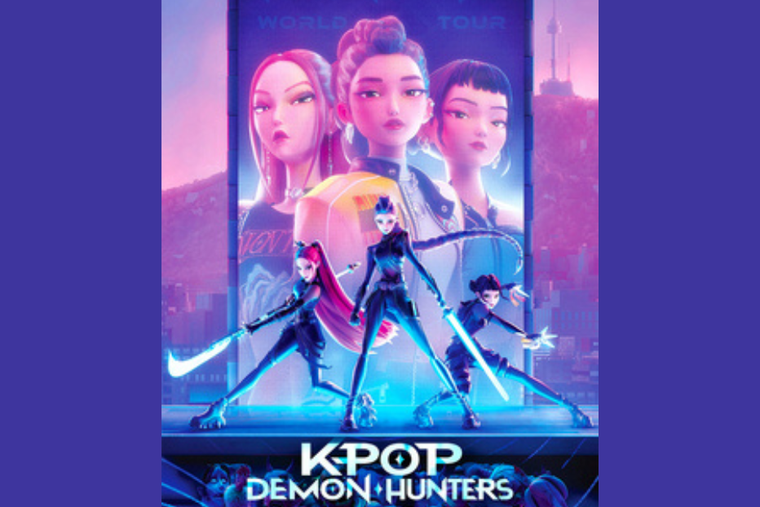
In the runaway hit film KPop Demon Hunters, a battle rages between good and evil. By day, members of the K-pop girl group HUNTR/X are global pop sensations; by night, they fight demons, using their music to maintain a mystical barrier that protects humanity from supernatural forces seeking to consume souls.
But beyond the animated film’s supernatural storyline, another battle has been unfolding off screen.
Since its release in June 2025, KPop Demon Hunters has become a cultural phenomenon, blending Koren pop-idol culture with fantasy adventure and attracting a devoted young fan base. Now the most-watched Netflix film of all time, the movie capped its success at the 2026 Academy Awards, winning Best Animated Feature and Best Original Song on Sunday for its breakout anthem “Golden.”
Yet as the film’s popularity has grown, so too has a debate among Christian families about whether its inclusion of demons and supernatural power make it appropriate viewing for children.
For Catholic parents, the question echoes earlier debates about fantasy entertainment — most notably surrounding the Harry Potter series and Wicked. Critics argue that KPop Demon Hunters risks normalizing demonic imagery through catchy music and colorful animation, while supporters say the film’s themes of identity, sacrifice and redemption can spark meaningful conversations about the faith.
The story follows Rumi, the leader of HUNTR/X, who discovers she if half-demon while battling a rival K-pop boy band secretly sent by a demonic ruler to lure human souls away. As her hidden identity is revealed, Rumi must confront her fears and accept who she is in order to restore the protective barrier that keeps demonic forces at bay.
A ‘Black and White’ Issue
Among the most outspoken critics of the film is Susan Brinkmann of Women of Grace, a Catholic apostolate for women headed by EWTN host Johnette B. Williams.
Having written extensively on children’s exposure to entertainment, occult practices and superstition, Brinkmann said KPop Demon Hunters risks presenting evil in an appealing light.
“It’s so important to show [children], ‘This is good, and this is bad,’” she told the Register. “Forget the gray. When they’re older, they can handle the gray a little bit better. But in cases like this, especially when it has to do with demons and … demonology, it’s black and white.”
Movies like KPop Demon Hunters and Wicked, she added, are wrapped in catchy music and colorful visuals.
“That shows how clever and how well Satan is reading society right now,” Brinkmann said.
According to Brinkmann, many parents have reached out sharing examples of children who, after watching KPop Demon Hunters at home, began singing its songs at school around their peers. One track in particular, Your Idol, contains lyrics that she described as “especially problematic”:
Know I'm the only one right now
I will love you more when it all burns down
More than power, more than gold
Yeah, you gave mе your heart, now I'm here for your soul
“We don’t want children singing this,” she said. “If there is any risk at all to a child, why take it? Even little things like movies … open doors.”
Similar concerns have surfaced among other Christian commentators. Rebecca Hunter-Kelm of Premier Woman Alive, a UK Christian women’s magazine, praised a Christian school in England for banning pupils from singing songs from the film, writing that “when there are so many other great movies out there that don’t glorify demons, as Christians, why not stay away from this one?”
Father Paul Born of the Archdiocese of Boston raised comparable questions on an episode of the podcast Ask A Priest Live, even without having seen the film.
“Is [the movie] attributing power to fight demons with other powers that are not holy?” he asked. “Is it leading those who know the faith well away from the faith, or is it leading those who do not know the faith into error?”
Exploring Christian Themes
Not all Christian voices, however, view the film negatively.
Father Daniel Seo, a Korean Catholic priest based in Irvine, California, with 18,000 followers on Instagram, said the film touches on themes familiar to Christian teaching. After watching it in response to questions from families in his church community, Father Seo found that the movie, despite its fanatical settings, explores ideas such as spiritual warfare, identity and redemption.
“I think we shouldn’t reduce a child’s imagination for the sake of protecting them when the imagination is helping them to understand that there is a spiritual reality that we need to be mindful of,” he told the Register.
“If we’re not aware that there are spirits in this world and we are witnessing evil,” he continued, “we can forget how to trust each other and realize that a person and their dignity is not merited by their sins, but by their identity as being loved by God.”
Father Seo also pointed to Rumi’s fear of revealing her true self as mirroring a deeper moral lesson. “When she is able to break through that [fear], there is this incredible peace and joy … we can allude that to the fruits of confession,” he said.
To dismiss KPop Demon Hunters entirely, Father Seo argued, would be like refusing to engage with other works of fantasy literature, such as The Lord of the Rings and The Chronicles of Narnia, that have been widely appreciated by Christians.
“I think the movie allows for us to have a heightened awareness that not everything is only as it seems or appears on the surface,” he said.
Other Catholic commentators have also highlighted the film’s themes. In an episode of the podcast Ascension Presents, Father Mark-Mary Ames reflected on how Rumi’s internal struggle may resonate with viewers.
“We often have these parts of our lives that we’re ashamed of, that we’re hiding, that we’re avoiding,” he said.
Seeing that struggle unfold in a story, he suggested, can offer parents a “beautiful opportunity” to talk with their children about bringing those struggles to others and God.
In a conversation between Catholic radio host Katie Prejean McGrady and Dominican Father Gregory Pine, the pair likewise discussed the film’s lessons and storytelling.
“Nothing in the movie screamed to me, ‘Heresy! Avoid! Turn off! Don’t watch!’” McGrady said. “In fact, it actually led to some really great conversations with my daughter.”
Father Pine pointed to the film’s emphasis on belonging and community.
“I like the idea that a community ought to be such that it creates a space in which people feel like they belong,” he said. “Maybe not losing sight of the fact that they’re each unique, but that they belong and it gives them a kind of meaning and purpose.”
That dynamic, he added, captures the way human beings “are built for community,” while struggles such as shame can sometimes draw people away from that “pursuit of love and happiness” among others.
Approaching Children’s Entertainment
Despite their differing views on the film itself, both Brinkmann and Father Seo agreed on one practical point: Parents play a crucial role in guiding their children through modern media.
Brinkmann encouraged parents to educate themselves about spiritual themes in entertainment and, when appropriate, “to sit with their child, watch [the film] and explain to them what is wrong with it.”
Father Seo similarly urged parents to exercise discernment when deciding what their children should be exposed to.
“Obviously, not everything should be exposed,” he said. “There needs to be discretion, but children also need to engage with the world.”
For some families, that may mean avoiding certain films. For others, it may mean watching together and discussing the themes afterward.
The debate surrounding KPop Demon Hunters reflects a familiar challenge for Christian families navigating contemporary entertainment, particularly as fantasy storytelling continues to draw on spiritual imagery and concepts.
For now, the film has accomplished at least one thing beyond its awards and box-office success: It has given parents something other than Harry Potter to argue about at the dinner table.
- Keywords:
- christian movies