In Gaza and Israel, Fragile Peace Brings Hope and Heartache
As Gazans return to ruins and Israelis mark Simchat Torah in uneasy calm, prayers rise for healing and trust to take root.
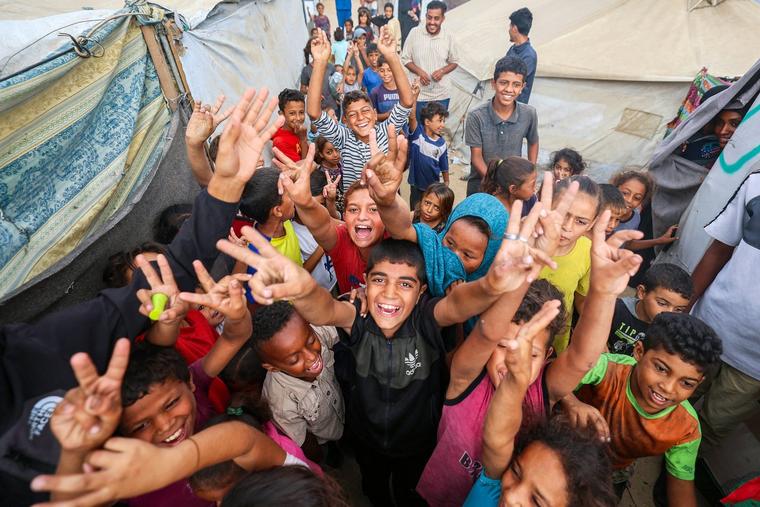
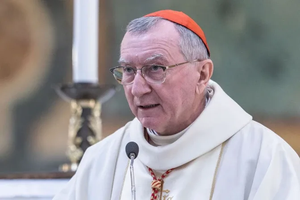
Christians in Gaza are relieved by the ceasefire that took effect on Oct. 13 between Israel and Hamas, but they understand that hostilities could break out again at any time, Cardinal Pierbattista Pizzaballa, the Latin Patriarch of Jerusalem, told Vatican Radio in an Oct. 15 interview.
“We are in daily contact with them. They keep writing that they still cannot believe they were able to sleep through the night without hearing the sound of bombs,” the patriarch said during a visit to Rome, where Father Gabriel Romanelli, pastor of the Holy Family Parish in Gaza, and his small team of priests and nuns received the Achille Silvestrini Prize later that evening. The award, established in 2022 to honor the legacy of the late Cardinal Achille Silvestrini, recognizes those who embody the spirit of dialogue, reconciliation and human fraternity.
Cardinal Pizzaballa said the situation “remains very fluid,” noting that the Israeli military continues to fly drones over Gaza and that deadly clashes between Hamas and various factions persist.
Under the 20-point peace plan presented by President Donald Trump, Israeli troops have withdrawn from parts of Gaza, and Hamas has exploited the vacuum to attack rival clans. “All this was predictable because of the suspension of the war — we still do not know if it has ended — and the following stages are quite uncertain, unclear and ambiguous,” the patriarch said.
“The situation remains dramatic because everything is destroyed. People are returning, but they are returning to the ruins. Hospitals are not functioning, schools do not exist,” he said. The truce remains fragile, as Hamas has yet to return all the bodies of deceased Israeli hostages.
Returning the hostages’ bodies “is not simple, since in the chaos that has taken place, the locations of these bodies have often been lost,” he added. “The mistrust between the parties remains high. However, despite all this, there is a new atmosphere — still fragile, but we hope it will become more stable.”
President Trump has said that the IDF can return to fight in the Gaza Strip “the moment I give the signal, if Hamas does not comply with the deal” to return every hostage’s body and disarm.
Israelis, too, are hoping for the war to end, but bitter experience has taught them to be wary. A ceasefire was in place on Oct. 7, 2023, when thousands of Hamas terrorists infiltrated Israel, killing about 1,200 people and kidnapping 251 others.
While thousands of rockets and missiles fired by Hamas in Gaza, Hezbollah in Lebanon, and Iran since Oct. 7 damaged or destroyed hundreds of buildings and disrupted life across Israel, the fact that Israel has advanced air defense systems and that bomb shelters are widely available prevented widespread death and destruction. Nearly 2,000 civilians and soldiers have been killed during two years of war, while thousands more were injured or displaced.
The return of the remaining live hostages, just hours before the second Hebrew anniversary of the massacre, was an emotional rollercoaster on a national scale.
The morning Hamas attacked Israel in 2023, Jews were celebrating Simchat Torah, a holiday that celebrates the Hebrew Bible, the Torah. On Simchat Torah, synagogues complete the year-long cycle of Torah readings and begin again with the reading of Genesis. It is a time of hope and renewal.
Two years later, on the eve of Simchat Torah — which began on Oct. 13 this year according to the Hebrew calendar — Hamas released the last 20 living hostages, and Israel released nearly 2,000 Palestinian prisoners, including 250 serving long sentences for terror attacks, in the first phase of the Trump peace plan. President Trump, who flew to Israel for the momentous occasion, told the Israeli parliament that the war is over.
Before the hostage release, Rachel Goldberg-Polin, whose American Israeli son Hersh Goldberg-Polin was captured on Oct. 7, starved in a tunnel, and later murdered by Hamas, told a gathering of hostage supporters that families of living and dead hostages had reached out to her and her husband in recent days.
“All were asking a variation of ‘how do we do this?’ They know that Jon and I know what it is to get your child home in a [body] bag,” she said.
Quoting from the Book of Ecclesiastes, which is read during this season of Jewish holidays, Goldberg-Polin said, “We are told in Chapter 3 there is a season for everything and a time for everything, but now we are being asked to digest all of those seasons, all of those times, at the exact same second — winter, spring, summer, fall — experience all four right now.”
“It says there is a time to be born and a time to die, and we have to do both right now,” she said. “It says there is a time to weep and a time to laugh, and we have to do both right now. It says there is a time to tear and to heal, and we have to do both right now.”
Tal Hartuv, who survived a machete attack by a Palestinian terrorist 15 years ago that killed her friend Kristine Luken, an American tourist visiting Israel, now knows that her assailant was released as part of the hostage/prisoner exchange.
“I can feel thrilled and hopeful and joyful that our hostages are coming home,” said Hartuv, who changed her name as part of her rehabilitation. “But I can still feel angry, I can feel betrayed, I can feel hollow. They’re not mutually exclusive,” she told the Associated Press.
Cardinal Pizzaballa emphasized that building trust between Israelis and Palestinians will “take time.”
“We must not confuse hope with a solution to the conflict, which is not mediated,” he said. “The end of the war is not the beginning of peace, nor is it the end of the conflict.”
For peace to endure, “we must build fraternity,” the patriarch said. “I believe there is a need for new political leadership, but also religious leadership. We need new faces, new figures who can help rebuild a different narrative, one based on mutual respect. It will take a long time, because the wounds are deep, but we must not give up.”