‘A Hopeful Document’: Catholic Thinkers on AI Assess ‘Magnifica Humanitas’
Experts praised Pope Leo’s encyclical both for its broader articulation of the proper relationship between humanity and technology, as well for its evaluation of AI using Catholic social principles such as subsidiarity, solidarity and the common good.
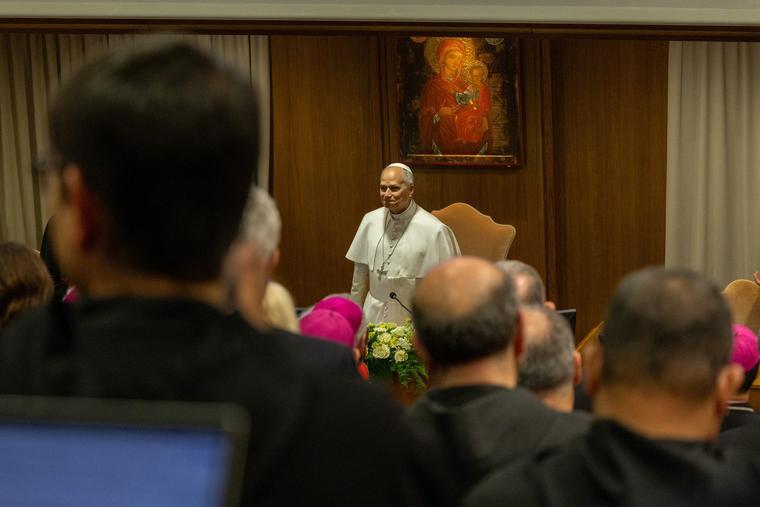
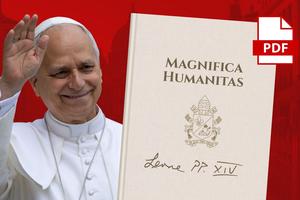
Catholics involved in the artificial intelligence (AI) conversation are sharing their appreciation for Pope Leo XIV’s first encyclical, Magnifica Humanitas, which warns against an “anti-human” trajectory of the technology, calling instead for an approach rooted in the common good and a recognition of God’s creation of humanity.
Experts praised Pope Leo’s encyclical both for its broader articulation of the proper relationship between humanity and technology, as well for its evaluation of the usage of AI in areas like education, labor, and even warfare using Catholic social principles such as subsidiarity, solidarity and the common good.
Matthew Harvey Sanders, the architect of several Catholic AI products, including Magisterium AI, told the Register that by establishing a Catholic foundation for what human flourishing actually looks like — measured by care for others and not by the optimization of abilities — Pope Leo gave AI builders a better metric for civilizational progress than simply output and a vision of the human being that has to “precede any serious work on the technology that will reshape daily life.”
Sanders said it was also important that Pope Leo criticized certain structural aspects of the tech and AI economy directly, including the fact that “platforms and services are often designed to capture users’ time and attention, exploiting their vulnerabilities and weakening their inner freedom.” Sanders said Catholics working in the AI space should take Pope Leo’s words to heart and continue building systems that reflect a true vision of humanity.
“For Catholics building in this space, the practical implication is clear enough. We do not need to wait for regulators to constrain systems we had no hand in designing. We need to build our own,” Sanders said. “Those who own the infrastructure of intelligence will shape what flourishing looks like for everyone downstream. If you know what a human being is for, you have an obligation to build toward it.”
Engaging, Not Rejecting
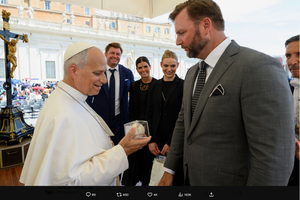
Sanders was present at the Vatican for the encyclical’s release, along with Chris Olah, one of the founders of the U.S. AI company Anthropic, and Amanda Askell, a philosopher who works to shape the “personalities” that Anthropic’s AI products exhibit.
Some Catholic observers have criticized Olah’s appearance at the encyclical launch as suggesting that the Vatican is not serious about confronting the AI industry and its negative aspects; Matthew Walther, for instance, writing in The New York Times, described Olah’s presence as akin to Leo XIII inviting “John D. Rockefeller to hear him speak on the dignity of labor.”
For his part, Sanders said he did not view the presence of Anthropic as a Vatican endorsement, but rather as an opportunity for a respectful dialogue on areas of agreement and disagreement.
“The Holy See is not selecting a preferred partner from the AI industry,” Sanders said. “It is engaging all of them, on its own terms, with its own framework for what is at stake. That is the right posture, and it is one the industry should take seriously.”
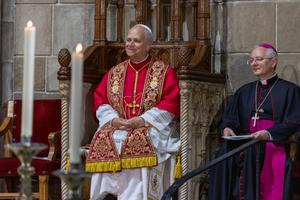
Jesuit Father Robert Spitzer, who has spent decades speaking and writing about the harmony of faith and science, expressed appreciation that Pope Leo encouraged greater discernment around AI rather than rejecting it.
“Pope Leo asserts that ignoring, fearing and rejecting AI are not realistic because AI is part of our reality and is becoming ever more pervasive in virtually every dimension of our lives,” Father Spitzer told the Register. “Thus, we must find a way to integrate AI into our personal lives and communities in a way that will lead to greater human dignity and flourishing rather than degradation and diminishment.”
A Call to Responsibility
Paolo Carozza, a Notre Dame law professor and human rights expert who co-chairs Meta’s Oversight Board, which serves as in independent check on the tech giant’s content moderation decisions, similarly appraised Magnifica Humanitas as “not an anti-technology document,” but rather one which “calls on each of us individually to examine our own personal relationship to the technological project that is transforming the world around us.”
Carozza said he sees the real crux of the encyclical as not adjudicating whether AI as such is good or bad, but rather imploring all people — especially those with power over the ways AI is developed and deployed — to consider whether it helps individuals and communities become more humane, just and participatory, or whether instead it fosters exclusion, control and inequality.
“It is, in the end, a very hopeful document, not a doomsaying one. [Leo] insists that moral progress here is possible, and the negative consequences of AI technologies are far from inevitable,” Carozza said. “He calls us to reclaim our moral agency in the face of the challenges. But we can only do that if we take seriously the drama and gravity of the question that is urgently before us: What kind of a world are we building? One of presumption, idolatry, the logic of power, exploitation and enslavement? Or one of cooperation, mutual care and interdependence, and love?”
Describing Magnifica Humanitas as “a Nova Rerum Novarum,” philosopher Steven Umbrello told the Register he sees the encyclical as being in deep and deliberate continuity with Pope Francis in its rejection of the “technocratic paradigm” — a worldview that “seeks to reduce everything to an object to be dominated” — that Leo’s predecessor had diagnosed in the 2015 encyclical Laudato Si’.
Umbrello, who serves as managing director of the Institute for Ethics and Emerging Technologies at the University of Turin, said he was surprised and glad to see Pope Leo express care for the many underpaid workers who do exhausting labor necessary to train and maintain AI models. According to Umbrello, most of the people who do data labeling and content moderation for Silicon Valley chatbots are “young people, predominantly women, mostly in the Global South.”
“They look at disturbing material for hours, often for pennies, so the model in the product demo can sound friendly,” Umbrello said. He said that “for Catholic readers in the wealthy West who use these tools without thinking about who makes them possible,” the encyclical’s recognition of exploited laborers in the AI industry (Paragraph 173) “should keep them up at night.”
The document’s most original contribution, Umbrello said, is Pope Leo’s assessment of the effort by some in the secular space to “align” AI with human values, which the Pope warned will not work if the morality is being dictated by the moral vision of a few individuals and companies, thereby creating an “invisible infrastructure.” Pope Leo recognizes that any ethical standards baked into AI must be openly discussed and subjected to standards of social justice, Umbrello said.
Man Is Greater Than Machine
Umbrello, who recently spoke to the Register about his hope that Jesuit Father Bernard Lonergan might be cited in the encyclical — he wasn’t — nevertheless appreciated Pope Leo’s assessment of the difference between the human mind and AI systems, namely that the latter do “not understand what they produce, for they lack the affective, relational and spiritual perspective through which human beings grow in wisdom.”
The encyclical contains a section on the concept of transhumanism — the idea that human nature can be surpassed or perfected by various technological interventions. Warning that attempting to optimize humanity through technology will leave the vulnerable behind, the Pope instead reflected on the fact that the finitude and weakness of created beings allows us to “embrace the possibility of transcending ourselves through God’s grace.”
Legionary Father Michael Baggot, associate professor of bioethics at the Pontifical Athenaeum Regina Apostolorum in Rome, said he was very glad to see the concept addressed in the encyclical. Father Baggot, who has written extensively on transhumanism, said it informs how some very influential figures in the tech world think about and shape emerging technologies, including AI, with some leaders continuing to propose that humans merge more deeply with AI systems.
Transhumanism appears in Magnifica Humanitas not in a way that entirely dismisses the idea and its sometimes noble aspirations, but the Pope nonetheless clearly teaches that secular transhumanism settles for too little, he continued.
Rather, Father Baggot said Pope Leo offers “a very positive counterproposal”: participation in God’s divine nature and not merely an indefinite extension of earthly life, recognizing that “we are embodied creatures who actually flourish, not despite of, but in and through our vulnerabilities.” Human bodies are not an obstacle to our progress, but an essential part of how God created us, he continued.
“Our human vulnerabilities, our experience of limits, of weakness, are often the occasion to grow in virtue,” the priest said, as when we learn from an experience of suffering to turn back to God, or show compassion for a person in need.