The Patrons of Catholic ‘Tech Bros’: 2 Thinkers Shaping the Catholic Response to AI
Pivotal players have emerged in the conversation — despite never having seen AI firsthand: Jesuit Father Bernard Lonergan and French philosopher René Girard.
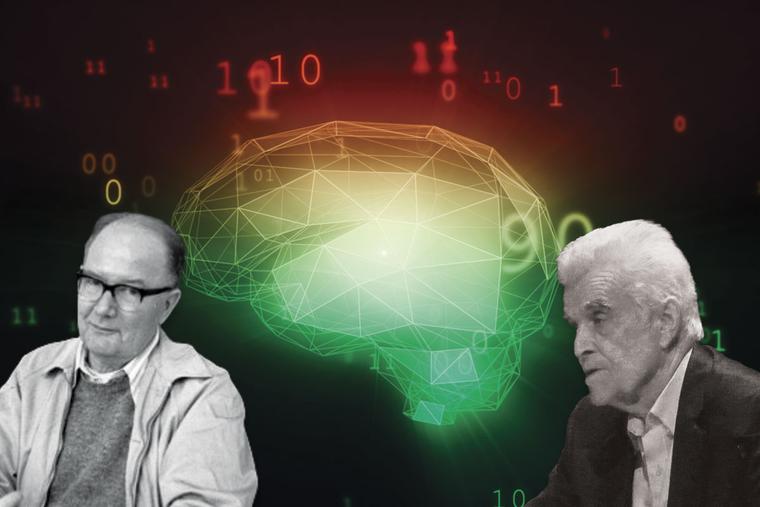
Today’s giants of Silicon Valley, like Elon Musk and Sam Altman, have become household names and are treated by many as oracles of humanity’s future. But as Catholic tech leaders and thinkers continue to grapple with the rise of artificial intelligence (AI), two lesser-known guides have emerged as pivotal players in the conversation — despite never having seen AI firsthand: Jesuit Father Bernard Lonergan and French philosopher René Girard.
Both Lonergan and Girard died well before the 2022 launch of ChatGPT — in 1984 and 2015, respectively. But both figures are proving to be influential in Catholic assessments of AI precisely because they addressed perennial questions about what it means to be human, from the nature of thinking to why and how we desire, which are being reexamined amid the rise of human-imitating AI.
Taylor Black, for instance, a devout Catholic who has a major hand in shaping Microsoft’s AI, cites Lonergan’s framework frequently for describing how human beings think and understand as a guide for developing what are known as metacognitive strategies — “thinking about our thinking” — which he says are vital for AI creators and practitioners to develop, providing them the tools to separate the incredibly clever performance that machines can now achieve from the actual interior life of a human being.
Girard’s thought on the nature of desire, meanwhile, has taken on a life of its own in Silicon Valley, in large part thanks to the venture capitalist Peter Thiel, a Protestant Christian, who frequently invokes Girard when discussing innovation. But several Catholics cite Girard and his theory of “mimetic desire,” too, especially when thinking through the danger of allowing AI to shape human desires.
Lonergan and Girard are already important players in Catholic conversations about AI. But with Pope Leo XIV set to release an AI-focused encyclical on May 25, their stature could be about to receive an even bigger boost.
It’s by no means certain, but devotees of Lonergan and Girard told the Register that they hope to see both thinkers cited in the encyclical as part of what is expected to be the Church’s most fulsome guidance yet on this controversial technology.
Lonergan’s ‘Insight’
Bernard Lonergan (1904-1984), a Jesuit priest from Canada, spent his career applying and extending the thought of St. Thomas Aquinas to his modern 20th-century context, producing in his masterwork Insight a detailed analysis of how human beings come to know things.
Lonergan’s insight about human knowing recognized that it follows four steps:
- Experience — Our senses are presented with phenomena.
- Understanding — the moment of insight, the “why” and “how” that makes sense of experience.
- Judgment — the critical questions: Is it really so? Have we truly understood?
- Decision — And now what? What do we do with this knowledge?
Steven Umbrello, managing director of the Institute for Ethics and Emerging Technologies at the University of Turin, explained that Lonergan is “unusually precise” among contemporary thinkers in analyzing the operations by which a subject comes to know.
“What this gives us is a disciplined way to ask whether we are looking at understanding and judgment, or at something that only resembles them,” said Umbrello, who has written a new book that examines AI using Lonergan’s theories.
Lonergan’s mode of analysis has become a valuable diagnostic tool for claims about AI’s abilities — and for continuing to maintain an appreciation for what is uniquely human.
When AI is examined on a careful Lonerganian analysis, Umbrello said, it becomes clear that AI can extend experience for humans and even simulate understanding by offering statistically relevant answers. But AI cannot judge, and it cannot truly decide, nor “wonder,” the way humans can.
Jennifer Sanders, the Mooney Professor in Catholic Studies at Saint Louis University, told the Register that it has been gratifying for Lonergan scholars to see how his ideas are reaching a wider audience as part of the response to the relatively new phenomenon of AI. While not exactly obscure, the Canadian philosopher was certainly not as widely known before the current AI moment, overshadowed by other 20th-century Jesuits like the controversial Father Karl Rahner.
“[Lonergan] is, I think, the Catholic thinker more than anybody who can help us clearly think through with the Church not just ethical uses of AI, but what is AI doing when it’s performing its intelligent processes, and what are human beings doing? — and how are those different,” said Sanders.
Umbrello is careful to note, however, that Lonergan’s framework should not be treated as a simple conversation stopper or “litmus test” for AI.
“It is too easy to say that AI lacks judgment and, therefore, the case is closed,” Umbrello said. “A more careful use, and I think the better use, is to say that Lonergan clarifies what judgment is, then forces a precise question about whether any machine architecture could instantiate something formally comparable. That is a harder discussion, but it is the honest one.”
The practical takeaway for Catholics engaging with AI is clear: When AI produces answers, the human must always execute judgment — precisely the activity which, on Lonergan’s account, the machine cannot do for itself.
Girard’s ‘Mimetic Desire’
The AI-related contribution of René Girard (1923–2015), a French-born philosopher who held various academic appointments in the United States and ended his career at Stanford University, has less to do with thinking than with wanting. Girard proposed that human desire is not linear and spontaneous but is instead “mimetic” — it arises from copying others.
In terms of his theory’s application to AI, Thiel is perhaps Girard’s most well-known disciple, having studied under him at Stanford. Girardian vocabulary has become common currency in certain tech circles in discussions of how to build successful products; or, conversely, describing the “anti-mimetic” tech founder, that is, someone who is unlike anybody else and sets the agenda in terms of what other people ought to desire.
But Luke Burgis, a professor at The Catholic University of America who has written extensively on Girard and desire, told the Register that the reading of Girard he sees in Silicon Valley is often superficial, applying the philosopher’s theory of mimetic desire to competition in the tech industry but less to the technology itself.
“[Girard] would have been somewhat mortified at the lack of understanding about what AI really is … everything [the models] produce is borrowed, and it’s mimetic at the deepest level,” Burgis said, referring to large language models (LLM) that produce new text largely by drawing upon already written materials.
For his part, Burgis calls AI “the perfect Girardian creature.” It possesses no biological orientation, no instinctual needs, no original starting point. It is trained on what Burgis describes as “the entire archive of human imitation” — the vast digital record of human expression, envy and preference. It does not think for itself, but, rather, mirrors human mimicry at the deepest level.
And when users turn to AI chatbots to ask where they should live, what career they should pursue, or how to resolve a moral crisis, they are allowing the machine to mediate their deepest longings, Burgis continued.
“AI has become a model of desire,” Burgis warned, “but it’s a model unlike the models of the past, which were usually individual people that we either admired or were important to us for some reason. The AI is this amalgamation of millions of inputs and pieces of data, and it’s unclear why it’s recommending certain things to us in the first place. And that seems to me very dangerous.”
Similar to Lonergan’s theories, Girard’s theory of desire is also used by Catholic scholars in evaluating claims about AI’s similarities and differences to humans. For instance, in his essay “Girard Does Not Compute: A Girardian Criticism of AI,” Immaculata University’s Dominic Pigneri argues that AI programs are incapable of truly imitating others in the Girardian sense because they are neither social nor embodied and cannot entertain nonrational thoughts the way humans can.
Pigneri’s essay is part of the 2025 collection called Desiring Machines: Mimetic Theory and Artificial Intelligence in Technology, Philosophy, Film, and Fiction. Co-edited by Thomas Ryba, the former theologian-in-residence at Purdue University’s Catholic student center, the volume underscores how important Girard’s thought has become to ongoing critiques of AI.
Burgis stressed that a true reading of Girard — one which acknowledges that he was a Catholic — points to the only answer: Christ himself.
Unlike human models who compete for limited resources and status, Christ is a Divine Person who offers Himself completely. Unlike humans, who are made in God’s image, AIs are made in the image of humans — even if they could have desires, where would those desires point to? Burgis said he hopes that more people working in tech come to recognize this.
“What is the purpose of desire?” Burgis asked rhetorically. “We desire the beatific vision. We desire to be in communion with God. That’s just not the kind of discussion that you really hear in Silicon Valley.”
Aides for AI Engagement
For all their differences in method and focus, Girard and Lonergan point to a similar conclusion — there are attributes of human cognition and psychology that a machine cannot replicate or experience.
For Lonergan, the restless human drive to understand, to “wonder,” is the signature of a creature made by and for God — and the same goes for the God-pointing desire described by Girard.
In an age when machines can both mimic human understanding and curate our desires, Catholics would do well to remember these Catholic thinkers’ insights. Whether or not Girard and Lonergan end up being cited in Pope Leo’s AI encyclical, they are already shaping the conversation about AI among tech-savvy Catholics — and seem poised to continue to do so.
- Keywords:
- artificial intelligence