Meta Oversight Leader Warns of ‘New Threats to Human Dignity’ From Big Tech
Notre Dame’s Paolo Carozza argues that Big Tech’s influence is reshaping how we understand the human person — and says the Church must help recover a deeper vision of human dignity.
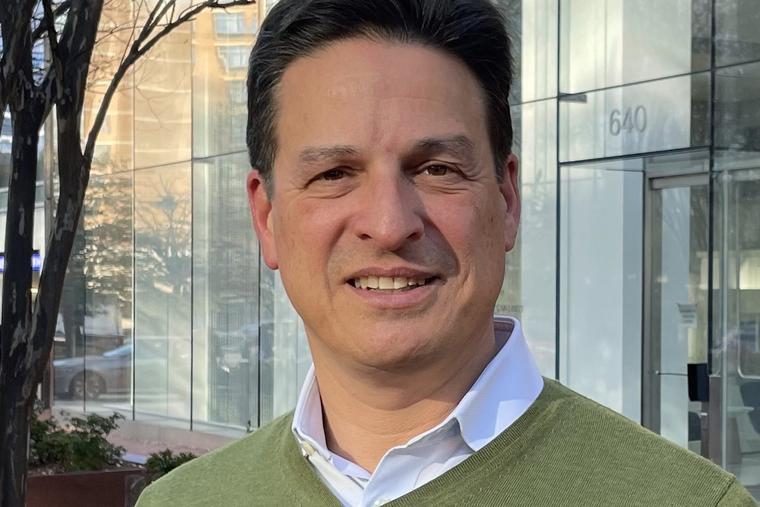
WASHINGTON — Paolo Carozza, a Notre Dame law professor and leading international human-rights expert, has long grappled with the threat to human dignity — earning him the notice of Pope Francis, who tapped him for a lifetime appointment to the Vatican’s Pontifical Academy of Social Sciences.
Today, as co-chair of Meta’s Oversight Board — created by CEO Mark Zuckerberg in 2018 to help restore public trust amid accusations of disinformation and censorship — Carozza has turned his attention to the challenges of the digital age, both in his role as a watchdog for the tech giant and in his academic work.
This isn’t a career shift. According to Carozza, Meta — the parent company of Facebook, Instagram, WhatsApp and Threads — recruited him to serve on its oversight board because of his extensive background in international human rights.
Prior to his appointment at Meta in 2022, Carozza taught law and political science at Notre Dame, and served as a professor of law and political science, and as director of the university’s Kellogg Institute for International Studies. He served as the United States’ member of the European Commission for Democracy through Law (the Venice Commission) where he advised Ukraine on reforming its constitution, and as a member of the U.S. State Department’s Commission on Unalienable Rights. Carozza was also a member of the Inter-American Commission on Human Rights.
What’s more, for Carozza, the threat of untrammeled technological growth is a human rights issue.
“We’re seeing that technology is posing new kinds of threats to human dignity on a massive scale, and really concerning ones,” he told the Register while in Washington to meet with his fellow board members.
As more people wake up to the reality of these threats, Carozza argues, the moment has come to respond — much as past generations ultimately confronted atrocities like slavery or the Holocaust once the full scope of human suffering became undeniable.
“The experience of a violation of human dignity was so evident to us it helped to catalyze a new response, a new intervention in law and in policy and culture,” Carozza said.
Today, he said, a consensus across religious and ideological divides is growing that technology’s reach cannot continue unchecked.
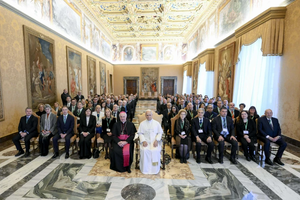
A sign of this meeting of minds, he said, came in October at a conference on AI put on by the Vatican’s Pontifical Academy of Social Sciences and organized in collaboration with the University of Notre Dame.
The conference took its name — “Digital Rerum Novarum: AI at the Service of Justice and Peace” — from Pope Leo XIV’s reference to Pope Leo XIII’s encyclical on Catholic social teaching.
“Pope Leo XIII, with the historic encyclical Rerum Novarum, addressed the social question in the context of the first great industrial revolution,” Leo XIV said at his first meeting with the College of Cardinals. “Today, the Church offers to all her treasure of social teaching in response to another industrial revolution and the developments of artificial intelligence.”
Carozza said he was heartened by the variety of participants who attended the conference, among them representatives of the technology sector, academia and politics.
“I think they were there because they’re hungering for something. I sensed an openness to what Pope Leo was going to be saying — a great curiosity,” Carozza said.
“They agreed to come and have a three-day meeting inside the walls of the Vatican, in which Catholic thought featured centrally, even though they’re not Catholic,” he said. “Precisely because implicitly, and sometimes explicitly, they all recognize that the Church has a really unique possibility to play a major role here in providing moral leadership.”
A multifaith gathering on AI held in Rome the following week, the Rome Summit on Ethics and Artificial Intelligence, was further evidence of a growing consensus, he said. Religious leaders signed a declaration outlining principles to guide the development of AI.
“People [are] united around a recognition that human well-being really requires us to be serious about what this technology is offering as well as threatening,” Carozza told the Register.
When asked what concerns him about technology, Carozza listed a litany of ills.
“The radical isolation of people, the complete replacement of human relationships, the disconnection from material reality, the fact that our children live in these mediated worlds where they lose connections to creation and to communion, and the way it fosters a culture that regards human limits as only things to be overcome,” he said.
The way technology “datafies everything” strips humans of their dignity, he explained.
“Every aspect of human life becomes a measurement, and human beings become just functional units of production rather than mysteries to be appreciated,” Carozza said.
“I think that poses new kinds of threats, in particular to vulnerable human beings — the weakest of us — those who are disabled, those who are less productive, those who are more marginalized.”
Preserving Freedom of Speech
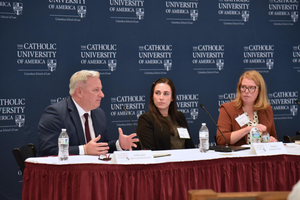
Carozza is one of 21 members of Meta’s Oversight Board, which acts as an independent check on the media company’s content-moderation decisions. If, for example, someone has a post removed from Meta’s social-media platforms Facebook or Instagram, and has exhausted all avenues of appeal, he or she can then ask the board to review Meta’s decision to remove the post.
The primary role of the board, as stated in its charter, is to protect freedom of expression. It also considers whether certain types of speech should be restricted, when that speech is “at odds with authenticity, safety, privacy, and dignity.”
Once the board selects cases to review, the case is assigned to a panel of five members who begin deliberations until they come to a consensus or, if that’s not possible, decide the outcome by majority vote.
The board’s make-up is diverse, in country of origin as well as in professional background. It includes the former prime minister of Denmark, Helle Thorning-Schmidt; Tawakkol Karman, a Yemeni journalist, human rights activist and Nobel Peace Prize laureate; and John Samples of the Cato Institute. Each member serves three-year terms for no more than a maximum of three terms. After selecting the board’s co-chairs, Meta handed over the responsibility for selecting new members to the board itself.
The Oversight Board regularly overturns Meta’s decisions to remove social-media posts. In 2023, for example, when the board reviewed the decision to take down three abortion-related posts that were said to be in violation of Meta’s “Violence and Incitement” policy.
The automated moderation processes that Meta used, Carozza said, which can be “very crude and clunky,” remove posts that threaten lethal violence.
“So, we went in and said, ‘No, you have to make sure that this is preserved so that there’s legitimate space for debate about this issue,’” he said.
In another instance, after a video showing the aftermath of a bloody massacre that left more than 40 people dead at a Catholic Church in southwest Nigeria in 2022 was removed from Instagram, the Oversight Board overturned that decision as well.
“Nigeria is experiencing an ongoing series of terrorist attacks and the Nigerian government has suppressed coverage of some of them, though it does not appear to have done so in relation to the June 5 attack. The Board agrees that in such contexts freedom of expression is particularly important,” the board said in its decision.
Carozza concedes that reviewing content-moderation decisions at Meta doesn’t address technology’s threats to human dignity. He told the Register that the board hopes to someday be given the purview to take on the platform’s use of personalized algorithms that deliver an endless, addictive supply of targeted social-media videos for individual users.
“We’re desperately trying to move more and more into that area,” he said.
“The problems that Facebook, Meta and social media, and then AI, pose are so vast. We deal with a tiny slice of it,” he said. “No one’s pretending that the Oversight Board is going to solve the major problems we’re all facing.”
“But, more and more, we’re starting to work in general on youth-safety and youth-protection issues. And so, gradually, we’re trying to get there,” he said.
Concerns for Humanity
While acknowledging that AI could be beneficial — through applications that advance medical discoveries or foster collaboration between people — Carozza is concerned about the way it is being misused.
“The problem is that, so often — it is already and promises ever more to be — replacing certain basic human functions, not enhancing them,” Carozza said.
“The more that we offload the basic human decision-making onto AI, judgment onto AI, basic capacity for critical thought and analysis onto AI — it changes us,” he said.
In the same way that the invention of the printing press resulted in the disappearance of the transmission of oral knowledge, AI can be expected to lead to an atrophying of critical-thinking skills, Carozza said.
“This goes back to the question of dignity,” he said. “Because in so far as the Church emphasizes that being created in the image of God means exercising reason and judgment and freedom, then that offloading onto machines of what are quintessentially human functions really does compromise our dignity.”
Pope Leo spoke to this concern during his conversation via video link with young Catholics at the National Catholic Youth Conference (NCYC) in Indianapolis on Nov. 21.
“Be careful that your use of AI does not limit your true human growth,” he said. “Use it in such a way that, if it disappeared tomorrow, you would still know how to think, create, and act on your own. Remember: AI can never replace the unique gift that you are to the world.”
To self-regulate his own use of AI, Carozza thinks before he considers asking tools like ChatGPT.
“I try very hard never to use not just AI, but any technology, without very consciously posing the question to myself, ‘What is it substituting for’?
“Is it something that is reducing or taking away some aspect of my capacity to do things that is important, or is it enhancing it? And that line isn’t always clear,” he said.
One thing about AI that “intensely” bothers him, he said, is when a bot takes on the characteristics of a human being.
“We need to always know when we’re interacting with technology, as opposed to interacting with humans, and that line is not being kept right now,” he said.
Besides the danger of people having romantic attachments to chatbots, he said, having a humanlike relationship with a bot could have a devastating effect on real human relationships.
“I think it degrades our understanding of the importance of sympathy, love, understanding, moral growth, doubt and uncertainty, all the things that machines aren’t capable of,” Carozza told the Register.
“The more we interact with machines that, while not being human, pretend to be human and imitate superficial aspects of our humanity, the more that we end up treating human beings like machines,” he said.
But what Carozza is most worried about, he said, is that we may have already lost another key aspect of our humanity.
“For decades, we’ve been living in a culture that has been progressively abandoning the human questions — what it means to live a good, rich human life,” he said.
“We can’t get the ethics right if we don’t get the ontology of what it means to be human right first,” he said.
A Collective Effort
So, what can we do to preserve our humanity from the threat of technology?
“I think there is an important role for law and public regulation, but it’s a minimal one,” Carozza said, adding that the government should “put the brakes on” artificial general intelligence (AGI) and regulate the use of AI-powered warfare.
But he thinks that civil society should play a much larger role in confronting the challenges presented by technology.
“I think more is needed than just a regulatory approach. We need a variety of social and civil-society interventions,” he said.
This is in keeping with Pope Leo’s statement that the burden of placing a check on technology is on all of us.
“Although responsibility for the ethical use of AI systems begins with those who develop, manage and oversee them, those who use them also share in this responsibility,” the Holy Father said in July, in a statement to the AI for Good Summit.
Carozza emphasized that the principle of subsidiarity, a foundation of Catholic social teaching which says that smaller or local institutions are better equipped than the government to protect human dignity and promote the common good, should be applied to questions raised by technology.
“There needs to be a much more robust dialogue at a subsidiary level and not just at the level of the national government,” he said. “I always insist, it should never be only the government,” Carozza said.
“It needs to be a collective social effort.”