Cardinal Merry del Val Biographer Says His Example Challenges Today’s Nationalisms
At the launch of his new book, professor Roberto de Mattei recalls Pope St. Pius X’s secretary of state who placed truth above party and nation.
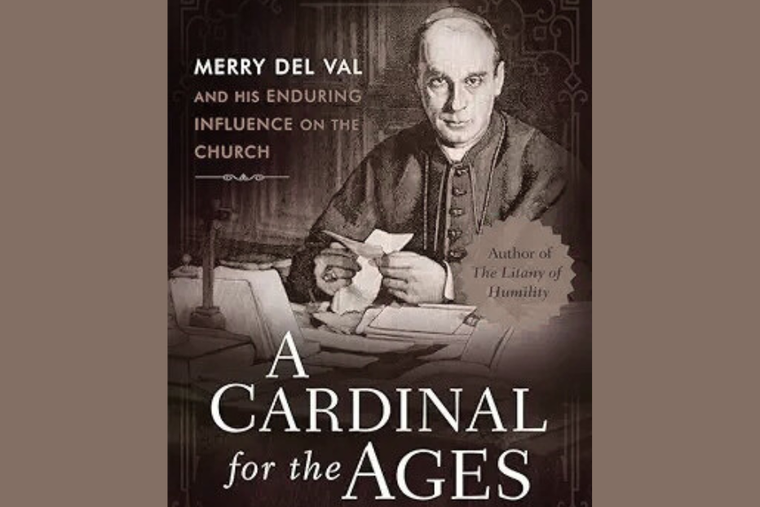
LONDON — Cardinal Rafael Merry del Val’s example of humility, statesmanship and a profoundly supernatural approach to public life reminds the faithful that the Church’s first allegiance is not to any nation or party, but to truth itself.
This was the key theme of Italian Church historian Roberto de Mattei at the Feb. 27 launch of the English edition of his biography A Cardinal for the Ages — Merry del Val and His Enduring Influence on the Church.
Speaking at the Brompton Oratory in London, de Mattei argued that the key to understanding Cardinal Merry del Val — the author of the famous Litany to Humility — is to recognize that he possessed the deeply Catholic concept of Romanitas, a Roman spirit that is at once universal, doctrinal, liturgical and profoundly supernatural.
De Mattei told the audience, which included Cardinal Vincent Nichols, the archbishop emeritus of Westminster, the apostolic nuncio to Great Britain, Archbishop Miguel Maury Buendía, and members of the Merry del Val family, that Cardinal Merry del Val — who served in the highest ranks of the Roman Curia at the turn of the 20th century — defied national labels.
“His blood was Spanish, England educated him, and Rome was the city in which he spent forty years of his life,” de Mattei said. “Yet Spaniards saw him as English, the English as Spanish, and Italians as a foreigner.” Only Romanitas, he suggested, resolves this paradox, the spiritual citizenship of the Catholic who can truly say with Cicero, civis Romanus sum (I am a Roman citizen), not as a political boast but as an ecclesial identity rooted in the See of Peter.
Speaking to the Register afterwards, de Mattei said that Romanitas is a reminder of the universal mission of the Church that is “superior to different nationalities.” At a time of excessive nationalism, he said Cardinal Merry del Val’s personality teaches the “real mission” of the Church is “not to be linked to a single nation or faction” but to be, above all, a “universal mission founded on the truth.” For this reason, he said, supporters of a “certain form” of ecumenism criticized him.
De Mattei told the gathering how the cardinal rose to the summit of the Roman Curia, becoming secretary of the conclave that elected Pope St. Pius X, secretary of state throughout Pius’ pontificate, and secretary to the Holy Office (the Pope was then the prefect of the doctrinal dicastery). Cardinal Merry del Val was “the very personification of the Roman Curia” whose competence, spirit of service, and human frailties he knew all too well, he said.
Apostolicae Curae Role
The cardinal played decisive roles in two papal documents that continue to have significant relevance today: Pope Leo XIII’s 1896 apostolic letter Apostolicae Curae on the nullity of Anglican orders, and Pius X’s 1907 anti-modernist encyclical Pascendi Dominici Gregis.
Servant of God Merry del Val, whose cause for canonization was begun in 1953, was a key contributor to Apostolicae Curae and, de Mattei notes in his biography, was most likely behind a famous ‘Prayer for England’ that appears at the end of the 1896 apostolic letter. De Mattei told the Register afterwards that given the state of the Anglican Communion today, he believes it has turned out to be “a prophetic document.” The cardinal, he said, “prayed daily for the conversion of England” and his figure could make “a great contribution” to the conversion of all the English-speaking peoples.
As archpriest of St. Peter’s Basilica for 16 years following the death of St. Pius X, Cardinal Merry del Val presided over liturgical celebrations “with scrupulous precision and incomparable dignity,” which “drew Romans and foreigners alike as to a singular event.” In his princely dignity, de Mattei said, “he embodied — against every form of egalitarianism — the splendor of the Roman Church.”
Cardinal Nichols confessed to not knowing much about the cardinal but was pleased to discover that he had studied for the priesthood at Ushaw College in the north of England which had had a long reputation for excellence until it closed in 2011. He was also interested in Cardinal Merry del Val’s role in the conclave, having participated in “a much more minor role” in last year’s papal election. “For me, it was a most remarkable experience, a genuine experience of how, through the sincere efforts of us human beings, the Holy Spirit can hint and work and bring us to an outcome which I believe is God-given and very blessed,” he said.
Archbishop Maury Buendía, who said his paternal grandmother knew the cardinal when she was young, said Cardinal Merry del Val “proved himself to be more than just a humble and capable administrator. He was, above all, a priest in love with his priesthood, who was close to everybody, from the nobility to the lowest of people, and who always showed himself to be an ambassador of Christ. It was these that truly made him a cardinal for the ages.”
Paul de Zulueta, a cousin of the cardinal, recalled Cardinal Merry del Val’s powerful intellect through which he earned two doctorates, a degree in canon law, and fluency in Spanish, Latin and Dutch. Writing as a boy to tell his mother he was top of his class in every subject and that he was “likely to remain so,” Zulueta joked: “So his litany, literally on humility, was to come a bit later.” But given his many qualities, he said he was, in the words of contemporary Catholic historian Felipe Fernández-Armesto, “the best pope we never had.”
Msgr. Phillip Whitmore, rector of St. James in Spanish Place, where Cardinal Rafael Merry del Val was baptized in its older church in 1865, highlighted key passages of de Mattei’s work — the first-ever in-depth study of the cardinal’s life. He called it a “scholarly biography” that offers a “fascinating glimpse into the life of the Church at the turn of the twentieth century, through the eyes of one of the key players in the Church of that time.”
Primacy of Interior Life
Concluding the event, Domingo Merry del Val, a great-nephew of the late cardinal who assisted de Mattei with the book, presented his great uncle as a man whose hidden interior life mattered more than his brilliant public career at the heart of the papacy. He recalled the cardinal had written on his tomb: “Da mihi animas, cetera tolle,” (Give me souls, take away the rest), insisting that “in these words we find the supreme purpose of his existence.”
Referring to the cardinal’s famous Litany of Humility, Domingo said it revealed a soul centered entirely on God’s will. “Whether we like something or not,” Cardinal Merry del Val once wrote, “is of no importance in itself. We must only seek the will of God.”
“Uncle Rafael,” as Domingo called him, rose meteorically through the Church’s diplomatic ranks to become a remarkably young secretary of state, yet “did not want to become pope; he did not consider himself worthy and did everything possible to avoid it.” His fear of honors, his desire to live as a simple priest among Rome’s poor, and his insistence on only seeking the will of God set him in radical contrast to the temptations to ambition and vanity that accompany high ecclesiastical office.
At the same time, Domingo showed how deeply Cardinal Merry del Val helped shape the papacy in the early twentieth century, even as he fled from personal advancement. He described his uncle’s decisive, if discreet, role in the conclave of 1903, and again in the elections of Benedict XV and Pius XI, while firmly refusing the papacy for himself in two conclaves where he was a leading candidate.
Loyal rather than domineering, he said he bound his life to that of Pius X — whom he considered a saint when Pius was still alive — in the great battle against modernism, and later continued to defend the purity of the faith at the Holy Office.
Domingo and de Mattei also mentioned the mystery surrounding Cardinal Merry del Val’s sudden and controversial death during what should have been a routine operation. Rumors have persisted of medical negligence, Masonic hostility and even murder.
“My father, who came to Rome for the funeral, with my grandfather and the cardinal's older brother, Uncle Alfonso, always told me that in Rome everyone openly said that Uncle Raphael had been murdered,” Domingo said. “But Uncle Alfonso, in agreement with the Pope, opposed opening a case: ‘No scandal can repair the damage caused to the family and the Church,’ and the matter was left there.”
But in Domingo’s telling of the cardinal’s story, Cardinal Merry del Val’s enduring legacy was not power but his spiritual teaching and the “need for spiritual humility — probably the most difficult of all virtues to attain.”
“We need more princes of the Church like Cardinal Rafael Merry del Val,” Domingo concluded. “In other words, we need men who seek sanctity rather than high office.”
- Keywords:
- cardinal merry del val
- pius x

Edward Pentin Edward Pentin is the Register’s Senior Contributor and EWTN News Vatican Analyst. He began reporting on the Pope and the Vatican with Vatican Radio before moving on to become the Rome correspondent for EWTN's National Catholic Register. He has also reported on the Holy See and the Catholic Church for a number of other publications including Newsweek, Newsmax, Zenit, The Catholic Herald, and The Holy Land Review, a Franciscan publication specializing in the Church and the Middle East. Edward is the author of The Next Pope: The Leading Cardinal Candidates (Sophia Institute Press, 2020) and The Rigging of a Vatican Synod? An Investigation into Alleged Manipulation at the Extraordinary Synod on the Family (Ignatius Press, 2015). Follow him on Twitter at @edwardpentin.