Who Is Bishop Michael Martin? 8 Things to Know About the Leader of the Charlotte Diocese
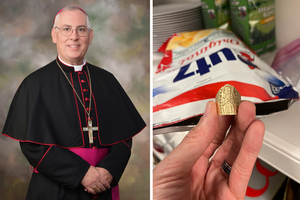
Before shepherding his diocese, Bishop Martin had previously spent a successful dozen years as the Catholic chaplain at North Carolina’s Duke University.

A leaked draft decree by Bishop Michael Martin of Charlotte, North Carolina, has drawn criticism on social media and elsewhere for its restrictive treatment of aspects of the Catholic liturgy, including the endorsement of a proposed ban on Latin responses and Mass parts in parish churches.
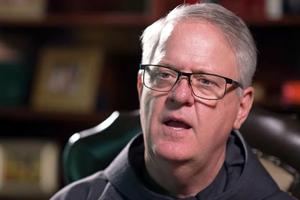
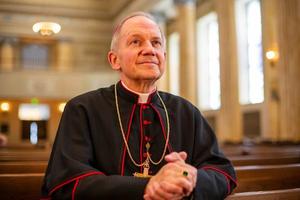
Bishop Martin, who is a Conventual Franciscan (OFM Conv.) of the Province of Our Lady of the Angels, took the helm of the Charlotte Diocese exactly one year ago, in late May 2024, after his predecessor, Bishop Peter Jugis, then 67, stepped down for health reasons after leading the growing diocese for two decades. Bishop Martin had previously spent a successful dozen years as the Catholic chaplain at North Carolina’s Duke University.
Here are eight things to know about Bishop Martin.
1. He recently restricted the traditional Latin Mass in his diocese — making him possibly the first bishop to do so after Pope Leo XIV’s election.
Bishop Martin, still relatively new to the diocese, stirred consternation in Charlotte and elsewhere last week when he issued an official decree restricting the traditional Latin Mass (TLM) to a single site, located in rural Mooresville, beginning on July 8. Bishop Jugis, his predecessor, had previously asked for and been granted an extension by the Vatican to allow the TLM to continue at four parish sites in the diocese, an extension due to expire this year.
The diocese has since said that the chapel where the TLM will be offered is undergoing a $700,000 renovation and is expected to serve about 1,000 worshippers a week.
Bishop Martin was by no means the first U.S. bishop to issue such a decree, which he and other bishops have described as an alignment with Pope Francis’ 2021 apostolic letter Traditionis Custodes; that letter directed bishops to designate one or more locations in which priests can celebrate the TLM, but specified that those locations could not be an existing parish church.
However, Bishop Martin does appear to be the first U.S. bishop to issue a decree related to Traditionis Custodes since the May 8 election of Pope Leo XIV — amid much speculation over what Pope Leo will do, and when, with the existing TLM restrictions his predecessor put in place.
2. His diocese has described the leaked document as an “early draft.”
A draft decree written by Bishop Martin and first reported on this week by the website Rorate Caeli contains numerous prospective norms for the celebration of the liturgy in Charlotte, including a diocesan ban on altar rails or kneelers for the distribution of Holy Communion.
Charlotte diocesan spokeswoman Liz Chandler told the Register on Wednesday that the leaked document was only a “starting point” for updates to liturgical norms in the diocese; an “early draft that has gone through considerable change over several months” and is still in discussion within the diocesan Office for Divine Worship and Presbyteral Council, the bishop’s group of priests who advise him on governance matters.
Any final changes, she said, will be shared through the diocese’s regular communications channels after the new norms have been “thoroughly reviewed in accord with the norms of the General Instruction of the Roman Missal and of the U.S. Conference of Catholic Bishops.”
3. He’s a Baltimore native who has worked extensively with students.
Born in Baltimore, Bishop Martin entered the Franciscan Order of Friars Minor Conventual and pronounced his solemn vows on Aug. 2, 1985. He was ordained a priest in 1989.
He was subsequently awarded a bachelor’s degree from St. Hyacinth College and Seminary in Granby, Massachusetts, and studied theology at the Pontifical Theological Faculty “San Bonaventura” in Rome, according to his curriculum vitae shared by the Vatican.
Following his ordination, he served as admissions director and teacher at St. Francis High School in Athol Springs, New York, until 1996, while also studying to earn a Master of Education degree from Boston College, graduating in 1993. He went on to serve as principal and then head of Archbishop Curley High School in Baltimore, until 2010.
That year, he was appointed director of the Duke University Catholic Center in Durham, North Carolina, part of the Diocese of Raleigh, a post where he served until 2022.
At a certain point during his tenure at Duke, he issued a policy, crafted in consultation with then-Raleigh Bishop Michael Burbidge’s Office of Liturgy, mandating standing as the appropriate posture at Mass “in all circumstances” when the congregation would normally kneel — a policy promulgated, he said, to promote unity of posture during Mass and due to the fact that Duke’s Catholic worship spaces lacked kneelers at the time.
In 2007, Bishop Martin was the recipient of the Pro Ecclesia et Pontifice award, an honor given to Catholics over age 45 with a history of long and distinguished service to the Church and to the office of the papacy, given by Pope Benedict XVI.
Bishop Martin also worked with Partners in Mission, a Boston-based consulting firm that partners with Catholic schools and institutions to advance the mission of Catholic education. In 2022, the Franciscans assigned him to ministry in the Archdiocese of Atlanta, where he served as pastor of Jonesboro’s St. Philip Benizi parish, The Charlotte Post reported. Archbishop Gregory Hartmayer of Atlanta is a fellow Conventual Franciscan.
4. He is well-regarded as a homilist.
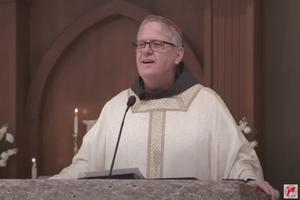
As a priest and bishop, he has gained a reputation as a strong homilist. Shortly after his ordination as bishop, on the Solemnity of Corpus Christi in June 2024, Bishop Martin preached on the Real Presence of Jesus in the Eucharist, a homily which was later printed in full in the Register.
“We live in a world that is so comfortable that we learn in the other direction: from sacrifice. And that’s not real presence. In this broken world, we need to run towards sacrifice. We need to be willing to shed our own blood, to give up what’s most important, so that we can participate in the saving blood of Jesus Christ,” Bishop Martin said at the June 2, 2024, outdoor Mass and Eucharistic procession, which attracted some 4,000 people to an outdoor amphitheater in Charlotte.
“That’s real presence. I’m really present to you when I’m willing to give my life for you. We’ve seen that in our parents; we’ve seen that in the saints. Don’t run away from sacrifice. The more you do, the more you’re not really present.”
He recently delivered the homily at Charlotte Catholic High School’s graduation on May 21.
5. Bishop Martin took over from longtime Charlotte Bishop Jugis after Jugis stepped down for health reasons.
Pope Francis appointed Bishop Martin, then 63, to lead the Charlotte Diocese, which encompasses much of the western half of the state, in April 2024. He was installed the next month, on May 30, 2024.
Bishop Jugis, who had been installed as bishop in 2003, stepped down well before the customary retirement age of 75 due to a “chronic but non-life-threatening kidney condition” that had made his ministry across the geographically large diocese difficult, the diocese said at the time.
6. The Diocese of Charlotte is growing.
Bishop Martin inherited — at least according to the diocese’ own statistics — a spiritually healthy local Church with many signs of growth. Spanning some 20,000 square miles across the mostly mountainous region of western North Carolina, the diocese welcomed 51 men into the seminary in 2024, the eighth-most total vocations out of all U.S. dioceses that year, according to the Official Catholic Directory.
In 2019, confirmations in the diocese topped 5,000 for the first time, while diocesan schools posted record enrollment of more than 8,000 students in 2023; and the overall number of Catholics, which includes a large Hispanic population, “more than doubled to an estimated 530,000” over Bishop Jugis’ 20-year tenure, reported the Catholic News Herald, the diocesan newspaper.
Bishop Jugis inaugurated a new diocesan seminary, St. Joseph College Seminary, in 2020. A new cathedral is also currently planned for the diocese.
7. Parts of the Charlotte Diocese were devastated last fall by Hurricane Helene.
Relatively swiftly following Bishop Martin’s installation as bishop, the area largely encompassing the Charlotte Diocese was ravaged by the rainfall and subsequent flooding of Hurricane Helene — which had weakened into a tropical storm by the time it reached the Charlotte Diocese, but still dumped feet of rain on many flooding-vulnerable rural mountainous areas.
Bishop Martin toured several of the most affected locations in his diocese, including Hendersonville and Swannanoa, seeking to offer spiritual and material aid and emphasizing the importance of Catholic parishes as “[loci] for healing.”
He later in October 2024 encouraged his parishes in affected areas to band together to create “sister” partnerships for mutual material aid and spiritual support over the next six months. He exhorted sibling parishes to hold second collections to help offset each others’ lost operating funds, offer monthly Holy Hours to pray for their sister parish, and check in with the parish regularly about the need for pastoral help or volunteers.
8. Bishop Martin met recently face-to-face with Pope Leo XIV — before Leo’s election as pope.
As reported by The Charlotte Observer, Bishop Martin had a nearly hour-long, one-on-one conversation with the future Pope Leo XIV, then-Cardinal Robert Prevost, in April of this year. Bishop Martin said Leo was “interested in me and what was happening in Charlotte,” adding that he “discussed some administrative matters” with the then-cardinal, who was then in charge of the Vatican dicastery that makes recommendations on the appointment of bishops.
- Keywords:
- bishop michael martin
- diocese of charlotte