Departure of Archbishop Paglia Marks End of Turbulent Chapter at John Paul II Institute
Pope Leo XIV’s appointment of Cardinal Baldassare Reina as the grand chancellor ushers in a new era for the institute that had been directed away from John Paul II’s magisterium during Pope Francis’ pontificate.

VATICAN CITY — Pope Leo XIV’s appointment this week of the vicar general of Rome as grand chancellor of the Pontifical John Paul II Theological Institute for Marriage and Family Sciences is being welcomed as a partial restoration of the institute’s original order almost a decade after Pope Francis controversially upended the academic body.
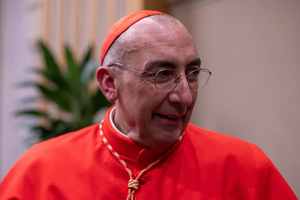
In a short statement Monday, the Vatican announced that Pope Leo had appointed Cardinal Baldassare Reina, 54, as the grand chancellor of the institute, replacing Archbishop Vincenzo Paglia who turned 80 on April 20 and whose departure had long been expected.
Cardinal Reina, who has served as vicar general of the Diocese of Rome since 2024, is already grand chancellor of the Pontifical Lateran University, the home of the John Paul II Institute.
Up until 2016, the grand chancellor of the John Paul II Institute was traditionally the vicar of Rome, maintaining a close institutional tie that had existed between the institute and the Lateran University since the institute was founded by Pope St. John Paul II in 1982.
But Pope Francis made an exception to this norm in 2016 by appointing Archbishop Paglia, who led sweeping and unpopular changes to the institute’s identity and mission.
The early appointment of Cardinal Reina in Leo’s reign is indicative of the Pope’s priority to correct those changes, but how much the cardinal will be able to restore the institute to its original form remains unclear.
Although bringing back the tradition of the vicar of Rome as grand chancellor restores the old order of the institute, the new statutes stipulate that the Pope no longer appoints the president, and this is likely to remain the case for the foreseeable future, sources say.
As a consequence, the institute will continue to be without the special closeness to the Pope that it enjoyed prior to Francis’ pontificate, which ensured that it could present the Church’s doctrine on marriage and family in accordance with the Church’s teaching.
As grand chancellor, Reina will nevertheless play a central role in the running of the institute, including overseeing fidelity to Catholic doctrine, proposing candidates for key positions, and liaising with the Dicastery for Culture and Education. In short, according to the statutes, he is the guarantor of the institute’s ecclesial direction and promoter of academic communion and unity.
Elevated to cardinal only last December, Cardinal Reina has shown support for the sanctity of life, most notably for the heroic pro-life witness of Chiara Corbella Petrillo, a young Rome-born laywoman who is being considered for sainthood. He also reportedly resisted the LGBTQ agenda.
But he does not appear to have a special focus on doctrine and formation, and he is not expected to reverse many of the changes at the institute, at least in the short term, especially as many of the new professors have tenure.
“Since Reina’s theological views are not public, we do not know if the institute will return to its original and extremely important function as a promoter of John Paul II’s vision of the human person in the context of marriage and the family,” said Professor Janet Smith, who taught moral theology at Sacred Heart Seminary in Detroit and came to the defense of the institute in 2019. But she added that she hopes the change in leadership will turn out to be “much more than a rectifying of an irregular procedural matter” and signals “the beginning of a full restoration of a redirected and misdirected institute.”
That redirection came into sharp focus when, under Archbishop Paglia, the institute was re-founded in 2017 through Pope Francis’ decree Summa Familiae Cura. The newly renamed Pontifical John Paul II Theological Institute for Marriage and Family Sciences was to be geared toward what Archbishop Paglia and his allies had described as a “new pastoral theology” that tended to the “concrete reality of situations.”
Emphasis on Sociology, Secular Anthropology
This new approach, which leaned heavily on sociology and secular anthropology, aimed to carry forward the moral teaching contained in Amoris Laetitia (The Joy of Love), Pope Francis’ 2016 apostolic exhortation on the synods on the family, and make it irreversible.
But the approach was criticized for diluting the institute’s doctrinal clarity and fidelity to the Church’s teaching.
Cardinal Carlo Caffarra, the founding president of the institute, had serious concerns about Amoris Laetitia, which he found incompatible with John Paul II’s teachings and the Church’s magisterium. The Italian cardinal, who was a signatory of the dubia that sought clarification of the document, died on Sept. 6, 2017; just days later, Pope Francis reconstituted the institute.
Archbishop Paglia justified the changes by emphasizing a desire to broaden the scope of the institute’s mission to include contemporary pastoral and social challenges. He argued that the reforms were intended to move the institute beyond addressing only specific ethical or legal conflicts and instead to articulate a more comprehensive anthropology.
He framed this as a response to the wishes of Pope Francis, who wanted the institute “to widen its scope of reflection,” ensuring it had the “tools to critically examine the theory and practice of science and technology as they interact with life, its meaning and its value.”
Problems intensified when new statutes came into force in 2019, resulting in the suspension of five master’s degree programs, along with the dismissal of respected tenured professors, none of whom was given advance notice, nor any recourse to challenge the decision.
The new statutes also centralized decision-making, reducing the role of faculty governance and academic freedom, which was seen as undermining the collegial and scholarly character of the institute.
In response, students and alumni of the academic body published an open letter in July 2019 expressing their “immense concern about the sudden publication of the new statutes and the new ordinance of studies of our Institute.”
A few months later, more than 200 professors, including prominent Catholic scholars Robert George, Scott Hahn, Janet Smith and Jane Adolphe added their voices in another open letter expressing their “great concern” about the dismissals and imploring that the institute’s leadership professors be reinstated.
The changes to the institute were not about renewal, expansion or even reform but rather about its dissolution and destruction, said professor Stanisław Grygiel, a close friend of Pope St. John Paul II who was among those dismissed as a lecturer.
The radical changes were the culmination of a shift in emphasis away from John Paul II’s moral theology during Pope Francis’ pontificate, seen for example in the sidelining of the institute’s professors at the 2014 Synod on the Family, and a clear disregard for John Paul’s 1993 encyclical on moral doctrine, Veritatis Splendor (The Splendor of Truth), in Francis’ magisterium.
‘Progressive’ Scholars
Jane Adolphe, professor of law at Ave Maria School of Law, told the Register May 21 that, just as had been predicted at the time, the dismissed staff were replaced by “progressive scholars” with dissenting views on homosexuality and contraception.
The new faculty staff included Msgr. Gilfredo Marengo and Father Maurizio Chiodi, who respectively expressed a willingness to revisit Humanae Vitae and questioned the Church’s doctrine on homosexuality and artificial contraception — in direct opposition to John Paul II’s teaching on moral theology which had been geared precisely to upholding the teaching of Humanae Vitae.
The then-leaders of the Institute also took the same dissenting line, including the then-president of the institute, Msgr. Pierangelo Sequeri, who had also been appointed by Archbishop Paglia. Msgr. Sequeri’s successor, Msgr. Philippe Bordeyne, also drew criticism as he advocated liturgical blessings for same-sex couples with some conditions. Archbishop Paglia himself was criticized for undermining the moral integrity of the institute by making statements incompatible with Church doctrine, especially regarding marriage and life issues.
“Pope Leo XIV should be thanked for removing Archbishop Paglia,” said Adolphe, while Smith said that the departure of Archbishop Paglia was “definitely welcome,” as he advocated for pastoral changes on sexual issues such as communion for those in irregular unions “that were not compatible with Church teaching.”
Smith added that many had hoped a “change in leadership” of the institute “should be one of Pope Leo XIV’s first actions” and that the academic institution needed “to be restored to its original vision since strengthening of the family is essential to reforming this lost world.”
“All depends now on Cardinal Reina,” a source close to the institute told the Register.
Some observers say the new grand chancellor may change the president in a year or so and that such a crucial replacement may then slowly work towards a reconfiguring of the institute. Adolphe would like to see the former dismissed professors reinstated and an investigation into the changes and new hires made under Archbishop Paglia.
But a revolution in reverse — the sudden dismissal of Archbishop Paglia’s hires and rehiring of those he dismissed — is not expected, according to some insiders, partly because it would be seen as unjust as the actions of 2019, but also because it would be viewed as too much of a move against his predecessor.
Cardinal Reina’s arrival may, however, lead professors with more liberal leanings to become more moderate in their public stances, and the institute’s public events more in line with the Pope’s direction, without the need for direct intervention.
Observers say this would not point to significant changes in the short term, but it likely would mark the beginning of the end of what was widely seen as a highly tumultuous and destructive period that ran contrary to the mission and ideals of the institute Pope St. John Paul II founded nearly 43 years ago.
- Keywords:
- paglia
- john paul ii instititute
- humanae vitae

Edward Pentin Edward Pentin is the Register’s Senior Contributor and EWTN News Vatican Analyst. He began reporting on the Pope and the Vatican with Vatican Radio before moving on to become the Rome correspondent for EWTN's National Catholic Register. He has also reported on the Holy See and the Catholic Church for a number of other publications including Newsweek, Newsmax, Zenit, The Catholic Herald, and The Holy Land Review, a Franciscan publication specializing in the Church and the Middle East. Edward is the author of The Next Pope: The Leading Cardinal Candidates (Sophia Institute Press, 2020) and The Rigging of a Vatican Synod? An Investigation into Alleged Manipulation at the Extraordinary Synod on the Family (Ignatius Press, 2015). Follow him on Twitter at @edwardpentin.