No, AI Doesn’t Have a Soul: The Catholic Understanding of Its Role in Human Society
College professor-philosopher seeks the truth about the mind, soul and personhood in a new podcast series about artificial intelligence.
Could computer programs ever come to truly think and understand? Can artificial intelligence (AI) possess a “mind” the way humans do and, by extension, ever be described as a “person” with a soul?
If you ask some of the leading creators and proponents of AI products, at least some of them would answer “Yes” to these questions — a “Yes” that, if true, would raise other far-reaching and potentially dangerous ideas: Should AI programs be given rights? Should they be considered as equal in dignity to humans, or even obeyed as our superiors?!
For Michael Augros, a philosopher and professor at Thomas Aquinas College, the answer to the question “Can AI truly think and understand?” — and, by extension, “Does AI have a soul?” — is a resounding “No.”
But Augros doesn’t simply answer in the negative and leave it at that — he shows his work in the form of a new 10-part, multi-hour podcast series entitled The Mind and the Machine, produced by the college. In the podcast, episodes of which are being released serially, Augros explains in detail what it means, philosophically, to “think and understand” — and why he believes AI will never be capable of doing so.
“The Catholic faith doesn't really make room for the idea that these are really living, thinking, sentient beings the way we are,” Augros told the Register. “The Catholic position has to be that they’re not. I just think we’re deceived by appearances, to some extent, if we start thinking that they are.”
While carefully explaining the technical aspects of AI in addition to offering exhaustive philosophical analysis from a Catholic perspective, Augros draws on the thought of St. Thomas Aquinas, his college’s namesake and one of the greatest Catholic philosophical minds of all time, as well as Aristotle. Through the insights of these and other philosophical giants, Augros establishes a rigorous framework for examining claims that AI is a person.
Augros spoke with the Register about the podcast series, which is available for free on YouTube and podcast platforms, and why he believes AI does not — and can never — have a soul.
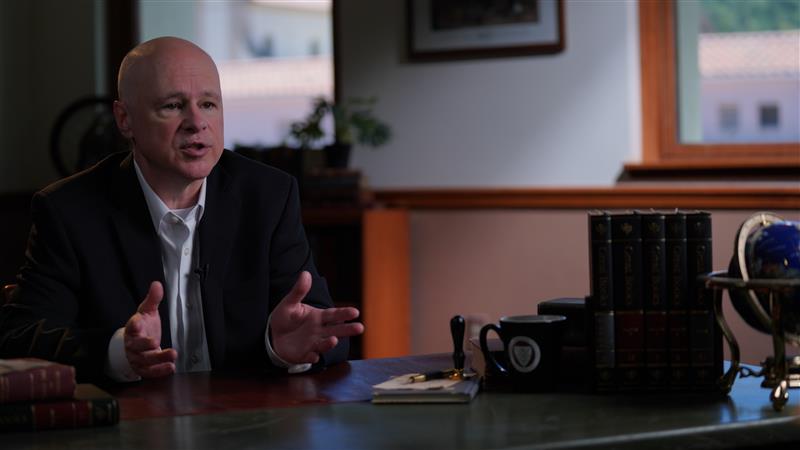
This interview has been edited for length and clarity.
What is the question that you aim to tackle in this series?
The series is focused on a broad question about artificial intelligence, which is: whether any AI, in principle, could ever truly think and understand in the same sense in which we do.
Most of my experience with these machines is that they're incredibly useful and super impressive. And I can sympathize with people who think, “Man, this thing, it understands. It really seems to.”
But it’s not performing acts of understanding, as such. It’s actually not even simulating acts of understanding. Instead, it’s generating what for us would be effects of understanding, like speech, compositions, music compositions, things of that sort; directed movement if it’s attached to robotics. Those things, for us, would be the result of our understanding. For [AI], it’s the result of these purely mechanical calculations that don’t generate any awareness within the machine itself.
And really, it is amazing that they can do what they do, given that they’re just machines. That they can produce the results that we see is just astonishing. But on the other hand, we’re training them on human data, things that we wrote, that are intelligible. And the architecture of these things is designed by intelligent human beings, who are imitating the network that we have in our own brains in a very broad way.
Human intelligence is just being built into these things, in all kinds of ways. So it shouldn’t be too surprising, just on very general principles, that it can be helpful to our understanding things. It’s almost like looking at a thesaurus and being shocked that thesaurus knows so many more words than I do. The thesaurus doesn’t actually know anything, and yet it’s really helpful to me in coming to know things and in expressing myself and so on. So these [AI] tools are just that, but on mega-steroids.
Who is your podcast series for?
Anybody who’s interested in the question [of whether AI has a soul], including undergrads, graduate students, philosophers, people who are in the technical world but have a philosophical interest in these things. Basically, in general, anybody who’s willing to put in some time and some effort in drawing distinctions and is open-minded about another approach to the world of nature that’s not restricted to what we’re told about it through the lens of modern science.
Why should people care whether AI has a soul? Isn’t it enough to know what AI can do and how it can be useful?
I think everybody should be thinking about this to some degree. It’s not just a problem for philosophers or AI experts, because AI is here to influence and affect absolutely everybody. It’s everybody’s problem, so to speak. And part of being an educated person now means having an educated stance on this.
It doesn’t mean going out and becoming an expert or reading tons of philosophy stuff. It doesn’t even mean watching my video series. But it does mean having reflectively and maybe prayerfully thought about this question and having a considered opinion that’s well-informed by those who are wise — by the Church, for example.
In the series, you make the distinction between a computer program that’s incredibly capable — able to do tasks even better than us humans — versus a being that can truly “think and understand.” Can you talk about the dangers you see in anthropomorphizing our AIs?
Really, we have three dangers. One of them is AI being used for bad purposes by those who know how to use it, whether it’s Big Tech or criminals. Another danger is AI itself getting out of control and really causing problems. And then the third problem is just as a society, all over the world, people not being educated enough in what AI is and what a human being is to understand the difference and to understand what the right role is for AI in life. I think that’s already happening in a small way with kids using ChatGPT to cheat.
These kinds of considerations are things that were vaguely gestured toward in C.S. Lewis’ Abolition of Man. He foresaw that the real danger is not so much being taken over by our technology; really, it’s a way for other human beings to control other human beings. I think that’s certainly true here, in the case of Big Tech.
What do you feel that you, as a Catholic philosopher, specifically bring to this analysis that a philosopher with a different religious worldview might not?
The Catholic faith has become the heir to a rich “philosophy of nature.”
There were pre-Socratic philosophers who talked about nature, but it’s in Aristotle where you really first started to get some wisdom about nature … a general understanding of the natural world, what a soul is, how nature causes things, very general things that were deeply wise and really perennial, timelessly true.
That has largely been washed away by a more secular approach, which is very more fascinated by a modern, scientific approach to nature. And they’re both quite necessary — the modern scientific approach, and the more philosophical approach of Aristotle. They’re not opposed to each other. But because modern science is so powerful at developing technologies that make lots of money, that make big differences to human life and so on in a practical way, that’s where all the money goes, and that’s where all the attention goes. We’ve drifted away from the philosophy of nature.
But it’s remained strong in Catholic tradition, chiefly because of St. Thomas Aquinas. We have an attachment to him, for obvious reasons. We go to him for help and for answers, and we hold him in high regard. And Aquinas points us to Aristotle if we want to develop a wisdom about nature.
What’s special about the “Catholic angle” [on this kind of AI analysis] is that Catholics take seriously the philosophy of nature that comes down to us from these older thinkers; we don’t dismiss it. … [It’s another] way of thinking about human beings, about souls, about machines that really can’t be gotten anywhere else.
That’s one of the things that interested me in talking about this AI question. It seemed to me that the principles of the philosophy of nature — that only Catholic philosophers seem to be heir to in any serious way — had a lot of principles to offer that really could shed light on some of the most fundamental questions about AI.
Do you think your conclusion — that AI has no soul — should make us as humans appreciate our God-given soul all the more?
Yeah, I think that’s true. If [AIs] did have souls, I think it would follow that we should talk about baptizing them.
The Catholic faith doesn’t really make room for the idea that these are really living, thinking, sentient beings the way we are. The Catholic position has to be that they’re not. I just think we’re deceived by appearances, to some extent, if we start thinking that they are.
- Keywords:
- human dignity
- artificial intelligence
- human society
- thomas aquinas college
- st. thomas aquinas
- aristotle
- ai