Mary Harrington on Feminism, Motherhood, and the Myths of Progress
The acclaimed British author discusses the controversies surrounding the very term ‘feminism’ and the deeper meaning of the ‘reactionary feminism’ she advocates.

British writer Mary Harrington has emerged as one of the most thought-provoking feminist critics of our time, precisely because she questions the very assumptions that modern feminism holds most dear.
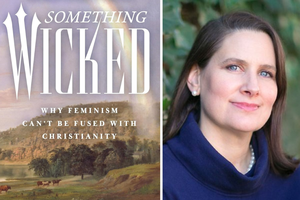
Indeed, in her acclaimed 2023 book Feminism Against Progress, Harrington challenges the idea that female empowerment must come at the cost of rejecting biological reality, motherhood and traditional roles. Her central argument is simple but radical: What we call “progress” has often disempowered women by detaching them from the very things that once gave their lives coherence and dignity.
Speaking from outside the Church but with deep respect for its intellectual tradition, Harrington explores how the contraceptive revolution, abortion, and biotechnologies like surrogacy have not liberated women so much as subjected them to new forms of marginalization and commodification. In her view, these societal shifts have pushed women’s bodies to the front lines of a transhumanist ideology that is not only anti-maternal, but ultimately anti-human.
In this conversation with the Register, Harrington reflects on the philosophical roots of feminism, the ideological fault lines redrawn by gender ideology, and the recent striking convergence between feminist dissidents and Catholic thinkers.
In your manifesto Feminism Against Progress, you argue that many aspects of modern “progress” have disempowered women by severing them from traditional roles and natural realities. What do you mean by that?
The book came about as the result of realizing I had lost faith in the liberal notion of “progress.” But I still valued feminism, in the sense of believing that women’s political interests are sometimes distinct from those of men. But feminism is often held up as central evidence of progress! I set out to resolve this contradiction by rereading the history of the women’s movement as one of technological change, beginning with the impact of the Industrial Revolution on family life. In premodern times, most women worked, in the context of subsistence households and combined with caring for children. But the Industrial Revolution removed much everyday work from the home, which introduced new conflicts for mothers between economic participation and caring for dependents. The women’s movement emerged in response to these tensions.
How could classic feminism be anti-progress in essence?
Beginning with the Industrial Revolution, the women’s movement expressed two distinct themes: the care and freedom. The feminists of care defended women’s somewhat reduced role as caregivers in private domestic households by celebrating women’s “sphere” in education, homemaking, care — giving and moral matters. (This is what is usually meant by “traditional gender roles” and is ironically distinctively modern!) The feminists of freedom called for women’s entry into the new market economy on the same terms as men. But women’s embodied sex differences will always structurally disadvantage us in an economy of strict equality, a difficulty that drove the next feminist tech transition within women’s bodies themselves: the contraceptive pill and legalization of abortion.
Most of what is referred to as “classic feminism,” i.e., the second wave, relies structurally on this technologization of women’s bodies and especially our fertility. I argue that this moment ended feminism proper, with the victory of freedom over care, and signaled the beginning of a movement that calls itself feminist but is more properly “biolibertarian” and dedicated to the abolition of sex as such and, beyond that, to technological control of human nature.
What about the term “feminism” itself? Isn’t it, as born out of revolutionary movements, inherently constructivist? Is there such a thing as good or bad feminism?
There’s no doubt that feminism emerges in tandem with the solvent power of technology and the onward march of the market. But I think we need to exercise some caution in attributing causality. My critique is, far more broadly, of the technological turn inward to reengineering (and hence, implicitly, also commodifying) human bodies and souls. Inasmuch as feminism supports this turn, it is anti-women, indeed anti-human. But feminists also challenge this trajectory, as for example movements against gender ideology and surrogacy.
How is this “reactionary feminism” you advocate articulated?
Reactionary feminism begins from the truth that sex differences are real, irreducible and politically important — and also the reality that we need one another. There is no final victory of one sex over another, and we must learn to live together. What that means in practice varies, depending on the technological and cultural environment. To be a reactionary feminist is to ground the way you live in recognition both of what makes us human together — and also in the distinct embodied capabilities and vulnerabilities of women, understood as powers and not merely as a problem to be solved with technology.
Neo-feminism and practices like surrogacy have disrupted traditional political divides. The clash between J.K. Rowling and neofeminists over transgender issues is particularly emblematic. What do you think of these new unlikely alliances between traditional feminists and conservative or Christian groups?
What I call in the book “biolibertarianism” is more commonly known as “transhumanism” — a program to master human nature using technology. The pill and abortion were the first mainstream transhumanist technologies, aiming not to restore normal health but to interrupt it in the name of individual freedom. Since the 1960s it has become increasingly clear that women’s bodies are the front line for transhumanism, and for women this is a two-edged sword: It brings great freedom to a few and new kinds of exploitation to many more.
The interests of feminists and Christians converge in challenging transhumanism, albeit for divergent reasons. Christian objections to transhumanism are grounded in imago dei and a broadly Thomist understanding of human nature, where feminists are often ambivalent about these concepts — especially where they seem implicitly to constrain women’s social roles. But I think the anti-feminist horrors enabled by transhuman experimentation have driven more intellectually honest feminists to confront the limits of tech-enabled egalitarianism — and is thus effecting a backswing toward realism about irreducible sex differences.
Though not a professed Christian, you’ve expressed spiritual curiosity, particularly in your critique of secular modernism. How might religious traditions, especially Catholicism, help women reclaim a deeper sense of identity in a culture that often marginalizes or commodifies them?
I think in its haste to denounce those forms of misogyny that claim their ground in the Bible (and these do exist), the women’s movement sometimes fails to appreciate the fact that we owe to Christianity our belief that women are people at all. Specifically as regards women and motherhood, I find the Catholic tradition of Marian [devotion] profoundly rich and moving: It is so rare to see that form of love not just depicted but venerated. At a more intellectual level, I have discovered more recently that many arguments I long struggled to articulate, especially concerning human nature and our normative form, become quite straightforward once you have Scholastic metaphysics to hand.
How should we understand motherhood and domestic life not as a burden or fallback, but as a true vocation? And how can society make that visible again?
The idea that women have one universal set of interests is itself often weaponized on behalf of the market. In our developed-world context, though, I think there is some scope for hope in the growth of remote work. For a sex realist, too, it’s important to be more open about how, for women who want to be mothers, the adult life journey is often much less linear than for childless women and for men. Many mothers end up having not one career but three, depending on life stages and caring obligations. And this should be celebrated too! Whether in our bodies or our social relations, we must move on from fearing or seeking to “disrupt” what is normal. We can also acknowledge and value what is normal and everyday as itself a source of liberation.
- Keywords:
- feminism
- motherhood
- dignity of women