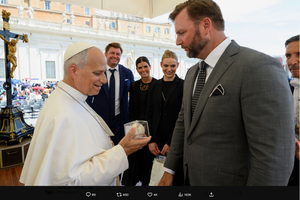
Palestinian Ambassador Urges: ‘Please Do Not Forget the Holy Land’
As Pope Leo XIV continues diplomatic outreach in the region, Palestinian officials hope Jubilee-year energy will help revive pilgrim flows and support local Christians.
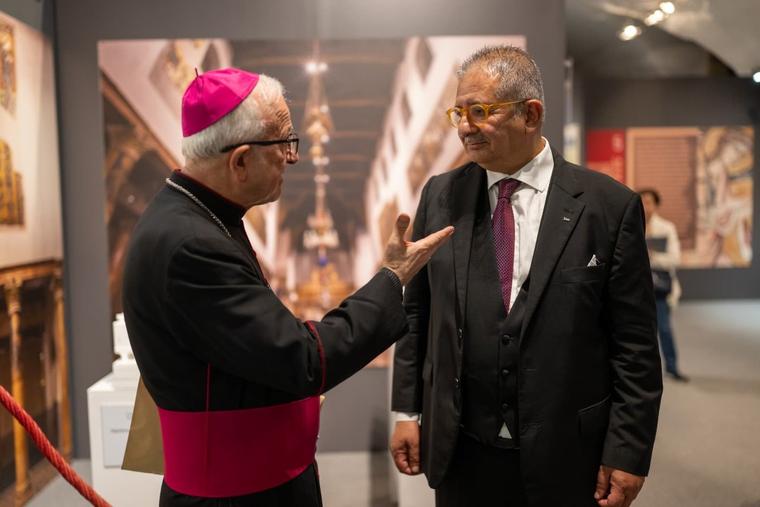
After he met with Pope Leo XIV on Nov. 6, Palestinian President Mahmoud Abbas went to the Church of San Salvatore in Lauro to preview the exhibition “Bethlehem Reborn.” The exhibition showcases the Palestinian State-sponsored efforts to renovate the Basilica of the Nativity in Bethlehem, a complex project that lasted about 10 years.
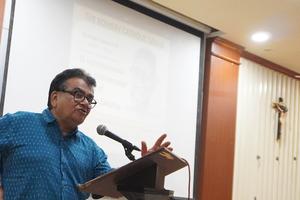
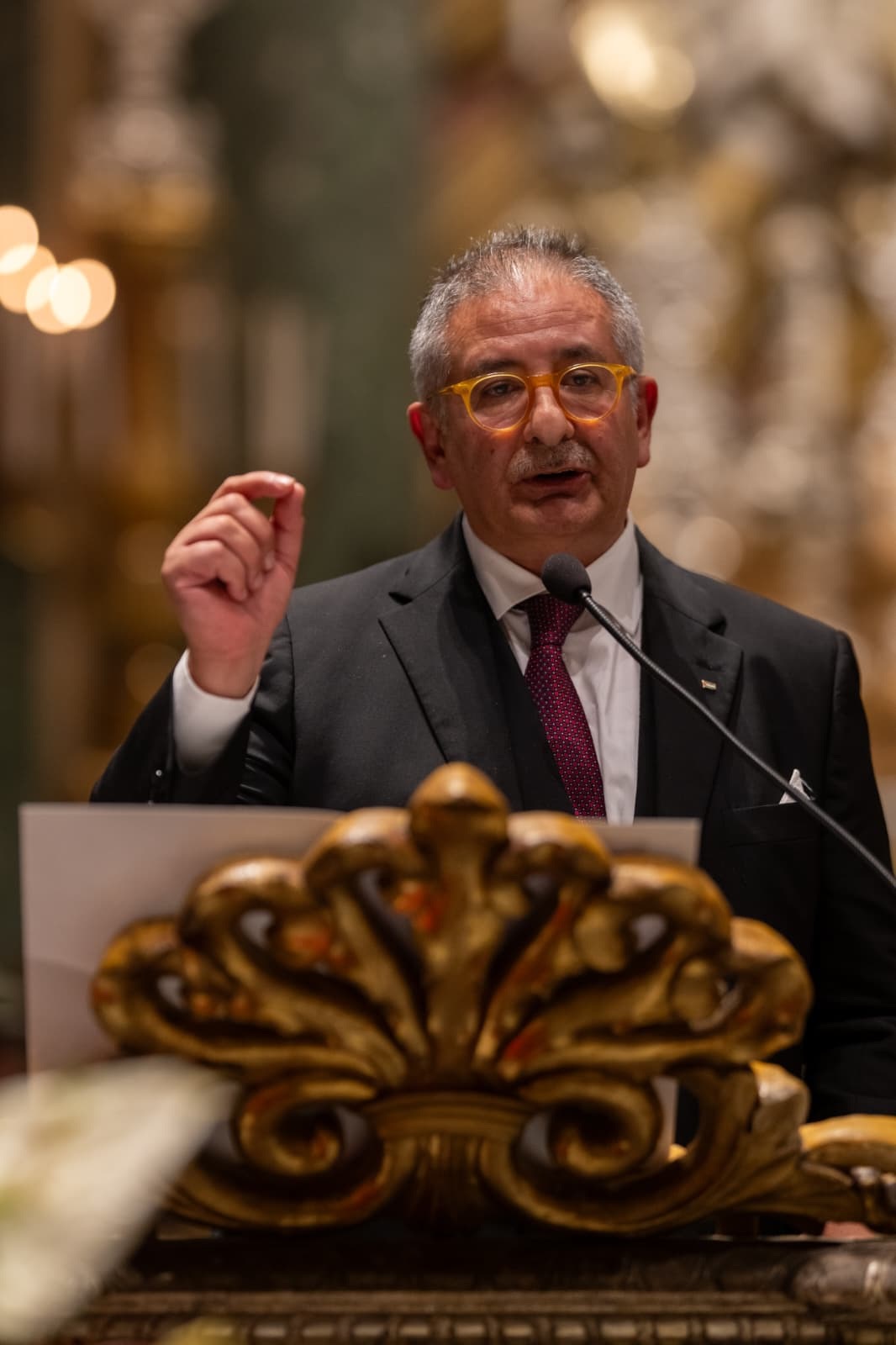
Issa Kassissieh, who has been the Palestinian ambassador to the Holy See since 2013, spoke at the inauguration of the exhibition and highlighted how symbolic it is that the exhibition is being held in Rome while “a fragile ceasefire” gives hope for peace.
In an exclusive interview with the Register, Kassissieh explains that he hopes the exhibition will serve as a bridge between the Holy See and the Holy Land. He invites pilgrims to return to the holy sites and to bring life back to places that have been somewhat abandoned because of the ongoing conflict.
Ambassador Kassissieh also speaks about his hopes for peace, Palestinian-Holy See relations, and his expectations for the Middle East.
The Embassy of Palestine to the Holy See just launched this exhibition on the restoration of the Nativity Basilica in Bethlehem. What is the message you want to convey with this exhibition?
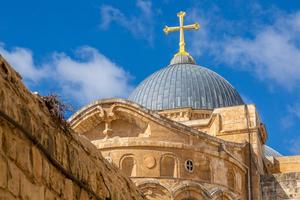
My message is to remind the world of the cradle of Christianity: it is the Holy Land. Jesus was born in a grotto in Bethlehem. In the meantime, we are celebrating the Jubilee year in Rome. I see tens of thousands of people coming to Rome, while Bethlehem is empty of pilgrims, and the Holy Sepulchre in Jerusalem is empty too. This makes me a little uncomfortable. I understand that we have been living through very difficult times over the last two years. There was a war in Gaza. However, I know for a fact that the late Pope Francis issued a papal decree on the occasion of the Jubilee 2025, asking the faithful to make a pilgrimage to the Church of the Holy Sepulchre, the Nativity church and the Annunciation church as holy shrines to visit for indulgences. I believe, as part of His Holiness' legacy, his message should be heard.
So what are your expectations?
As we approach Christmas, I would like authorities and organizations such as the Opera Romana Pellegrinaggi to seriously consider linking the end of the Jubilee year with the Holy Land by offering pilgrimage packages for the faithful to visit Terra Sancta, to ensure the bond between the Vatican and the Holy Land. This bond would pass on a message of unity, hope and peace for our people.
Why is it so important?
The main business in Bethlehem is tourism and pilgrimages, and those in charge are mainly Christians. We cannot allow the Nativity church to turn into a monument. We need to look at the “living stones” — the Christians of the Middle East. We are the living stones. We are the guardians. And we need to give hope to our people, and to encourage them to stay as witnesses to the footsteps of our Lord Jesus Christ
Do you have any numbers on Christians leaving their land?
We do not have exact figures. However, I heard from our priests that in the last two years, more than 200 families have left.
Palestinian Christians in the Holy Land are few in number, and they suffer from the political instability and the economic stagnation, coupled with … unjust … policies by the Israeli Ministry of Interior with regard to the issue of the family reunification applications, the granting of visas to priests, and the revocation of the residency identity cards under different pretexts — thus weakening the beauty of the mosaic of the holy city of Jerusalem.
All these negative elements are pushing families to seek other places where they can find stability, opportunities, hope and protection for their children. With unemployment figures high, there is despair, especially in the last two years with the war in Gaza.
There is now a ceasefire, though it is very fragile. Do you think it will help bring pilgrims back to Bethlehem or Jerusalem?
The ceasefire is essential. I can understand the personal security of each individual, but I think the truce gave us a glimpse of hope that tourism is back, that pilgrimage is back. This year, for the first time in two years, we will light the Christmas tree and celebrate the Christmas season. And on this occasion, we would invite the faithful to come to the Holy Land as a sign of solidarity and unity in faith.
Item 18 of President Trump’s peace plan speaks about fostering interreligious dialogue. What do you think is the purpose of this point?
The interfaith dialogue is essential, as it promotes better understanding and leads to cooperation toward building the bridges of peace and respect for each other. It should serve as a crucial tool to reduce tensions, build trust and find common ground for coexistence, especially among the three monotheistic religions. Bear in mind that the holy city of Jerusalem is the spiritual center for the three religions.
In this context, the religious leaders have a responsibility to back up any initiatives and efforts toward justice and peace based on international legitimacy. But to have a constructive and fruitful dialogue, basic principles should be established — the most important of which is that we are all, as humans, equal before God. And that no one claims that he holds the absolute right at the expense of others’ rights.
In our area, there can’t be an interfaith dialogue while there is an oppressor and an oppressed, and while you have one party who has full access to their holy sites and others are denied this basic right. Military permits are required to reach your holy shrine, and checkpoints and barriers are erected separating families from each other as well [as] the holy shrines. And the examples are many. Again, the basic principle of fruitful interfaith dialogue is that we are all equal, and that we accept and respect each other’s beliefs.
What is the reason for restoring the Nativity Basilica?
The basilica is a heritage for humanity. And we have a responsibility as a civil authority toward the well-being of the Church. The church was in a difficult situation structurally. The three Churches that hold rights in the church according to the Status Quo agreement — namely the Greek Orthodox Patriarchate, the Custody of the Holy Land and the Armenian Orthodox Patriarchate — showed genuine support for the process of the restoration of the church.
You know well that Christianity has emanated from where Baby Jesus gave the message of peace and love for the whole world. And furthermore, by rehabilitating the church, which is considered the jewel of our heritage, we encourage more tourism to the country.
How do you see the relations with the Holy See?
The Holy See has always supported Palestine, even before signing the Basic Agreement in February 2000. For the record, St. John Paul II was one of the first world leaders to meet with the late President Yasser Arafat. The same St. John Paul II visited the Holy Land in 2000 and was received in Bethlehem during the Jubilee of 2000.
However, when we speak about the bilateral relations, legally, we refer to the basic agreement the PLO signed with the Holy See, on which the June 2015 bilateral Comprehensive Agreement was concluded.
The Holy See recognized the Palestinian State, while the agreement grants the Catholic Church in Palestine full autonomy to run its affairs based on the basic law. In other words, the Catholic Church is framed as an autonomous legal entity, enabling it to prosper and strengthen its presence through its institutions in the State of Palestine. In return, the Holy See recognized the State of Palestine on the borders of 1967.
The agreement focused on Jerusalem, declaring that an equitable solution for the issue of Jerusalem, based on international resolutions, is fundamental for a just and lasting peace in the Middle East.
It is worth mentioning here that the Holy See was one of the first states within the European continent to recognize the State of Palestine, thus showing a visionary approach.
We must remember that President Mahmoud Abbas met more than seven times with the late Pope Francis, and that was a profound proof of the special relations between Palestine and the Holy See. There was the prayer for peace in the Vatican Gardens in 2014 led by Pope Francis, and in the presence of President Mahmoud Abbas and in the presence of the late President Shimon Peres. The audience of our president with Leo XIV on Nov 6, 2025, is considered the continuation of the spirit and legacy of the bilateral relations between the two sides.
So, what's next for the relations?
We will continue building the relations between Palestine and the Holy See for the sake of peace and tranquility in our area. The Holy See also has special responsibility toward the Holy Land and its Holy shrines. We are also engaged in preserving the Christian heritage of Jerusalem. The patriarchs and heads of Churches of Jerusalem have recently issued many statements calling for support as they face serious challenges, mainly policies of exclusivity, thereby disrupting the equilibrium in the holy city of Jerusalem.
The Christian denominations in the Holy Land should not feel that they are marginalized and that their appeals and voices are not heard. The Holy See, with other world churches, should have a say in all of this to preserve the very existence of Christianity.
How do you see the role of Palestine in the Middle East scenario? How will things unfold with the Abraham Accords?
Palestine has always supported the U.N. resolutions related to the Palestinian question. Those resolutions should have been carried out. At this moment, we strategically adhere to the vision of the two-state formula based on relevant U.N. resolutions and, furthermore, to the Arab Peace Initiative, which serves as a solid foundation for a comprehensive and durable peace in the Middle East. In brief, you cannot have a durable peace in the region while marginalizing one of the main actors.
So, what do you advocate?
There should be a clear roadmap with a clear timeframe that would get us to the endgame: a Palestinian independent state to live side by side with the State of Israel in peace, mutual respect and tranquility. We cannot talk about the Abraham Accords if we are not tackling the roots of the issue in the Middle East, which is the Palestinian question. In this regard, the moderate forces should come together to defeat the forces of evil and extremism, and to ensure that right must prevail and not might.
With the situation in Gaza, will there be a Mass of the Nativity? What do you know?
I do not doubt that His Beatitude the Orthodox Patriarch Theophilos and His Eminence Cardinal Pierbattista Pizzaballa, the Latin Patriarch of Jerusalem, will go to Gaza to greet our denominations and celebrate with them Christmas Mass, if the Israeli authorities allow them in.
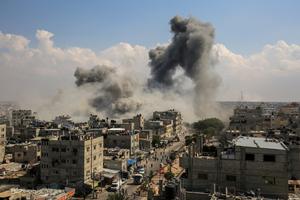
As we are preparing the ground for the celebrations of Christmas, we must not forget about the people who are still suffering in Gaza. The whole purpose of bringing the exhibition of “Bethlehem Reborn: The Wonders of the Nativity” to Rome was to shed light on the Holy Land. The suffering is tremendous there, and it is the duty of the good people to do their utmost to shift the zone of war into a zone of peace.
So, what do you think will happen?
We are frankly relying very much on Trump’s peace plan and the discreet diplomacy of the Holy See. At this moment, there is an international effort to de-escalate the situation and to shift the dynamics toward the stabilization of the region to start a credible peace process. The popes — both Leo XIV and Francis — have spoken often about the situation in the Middle East. They have stressed that wars are a defeat for humanity, and both have repeatedly called for a ceasefire and the resumption of the negotiations.
Let us hope that the visit of Pope Leo XIV to Lebanon will fulfill its purpose — and that the Holy Land will be the next station for his pilgrimage.