Armenian Archbishop Decries International ‘Indifference’ to His People’s Plight
Archbishop Vrtanes Abrahamyan of Artsakh said the Christian world is particularly silent towards the world’s oldest Christian nation.
Editor’s Note: The Register’s Europe correspondent visited Armenia Sept. 20-26, 2025, with the U.S. advocacy organization Save Armenia as part of a delegation working to highlight the existential challenges facing the world’s oldest Christian nation. This series examines how Armenia, still reeling from its recent war with Azerbaijan and caught between regional instability and expansionist pressures, struggles to secure its survival and spiritual heritage.
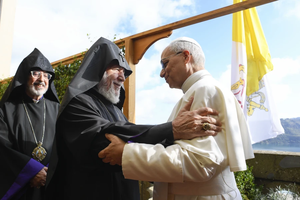
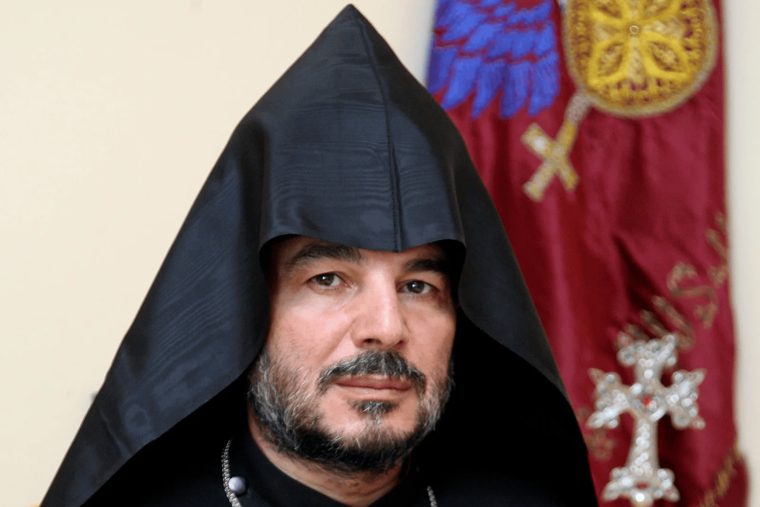
YEREVAN, Armenia — Archbishop Vrtanes Abrahamyan has become one of the most visible witnesses of the ordeal of the Armenian people of Nagorno-Karabakh.
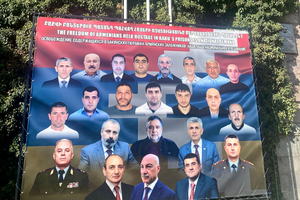
Displaced in 2023 along with the community he served, and now a refugee in Yerevan, his testimony reveals the lingering scars of a conflict that, for his people, remains unresolved.
Two years have passed since Azerbaijan’s latest attack on Nagorno-Karabakh — a disputed enclave also known as Artsakh in the South Caucasus and historically populated by Armenians — which ended with Azerbaijan regaining full control of the territory.
The dispute had flared repeatedly since the early 1990s, when the Armenian population declared its independence and sought unity with Armenia. A new war in 2020 killed more than 7,000 and forced tens of thousands from their homes.
In 2023, a months-long blockade of the Lachin corridor — the only road linking the enclave to Armenia — was followed by a swift offensive that emptied Nagorno-Karabakh of its Armenian residents. Around 120,000 people fled in less than a week, an exodus widely described as ethnic cleansing.
For Archbishop Abrahamyan, primate of the Armenian Apostolic Church for the Diocese of Artsakh since 2021, the peace treaty recently signed in Washington only deepened his people’s sense of injustice, dampening their hope of return to their historic land.
A People Torn From Their Roots
In an interview with the Register during a trip Sept. 21-25 promoted by the U.S. advocacy organization Save Armenia, he recalled, his face tense and his eyes moist with emotion, the moment when his entire community was forced to abandon their homes.
“One day, troops came suddenly and drove us out from our ancestral land, our connections, our heart,” the archbishop said. “And an entire people was displaced.”
More than 350 historic settlements were scattered chaotically across Armenia. Families accustomed to strong communal bonds were left in unfamiliar villages.
“They felt lost, abandoned,” he said. “If only some effort had been made to preserve communities together, they could have supported one another in this ordeal. Instead, they lost not only their homes, but also their friendships, their integrity, their landmarks.”
This attachment to community has deep roots, stretching back centuries. The Armenian presence in Artsakh goes back to antiquity, with villages and parishes rooted in traditions more than 1,000 years old.
In 1921, the Soviet Union handed Nagorno-Karabakh to Azerbaijan. From then on, the enclave endured decades of isolation, not only physical but also spiritual.
“Artsakh was the only region in the entire Soviet Union without a functioning Church,” Archbishop Abrahamyan explained. Paradoxically, this isolation also preserved authenticity: Dialect, traditions and Christian faith survived intact. “These are immovable treasures. If our dialect is lost, if communities vanish, we lose our whole identity.”
Heritage Erasure and Hope of Return
Today, Armenia is engaged in a peace process with Azerbaijan that would definitively renounce Artsakh. Archbishop Abrahamyan looks with deep suspicion at this agreement brokered by U.S. President Donald Trump in August 2025. While it promises Armenia security guarantees and economic opportunities — and may temporarily ease the pressure on a country in a precarious position — it also cements Azerbaijan’s gains and rules out any possibility of return for the communities of Artsakh.
For the archbishop, it represents a deal imposed under pressure, detached from the reality of his people’s suffering.
“I do not believe in that agreement, but I still believe that justice will prevail and that we will go home eventually.” His faith in return is unwavering. He has even begun developing a documentary project titled Return. “Justice will take its own way, but darkness cannot overcome the light,” he said.
The prelate emphasized that his diocese is also collecting the testimonies of displaced Artsakh Armenians. “Every single one says: ‘I want to return.’ That is the only message. ‘Return’ must be written in big letters everywhere.”
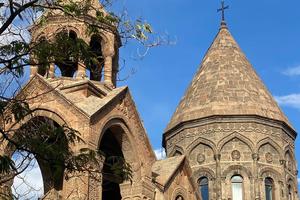
Meanwhile, Armenian heritage in Artsakh is being systematically erased or converted into mosques. Archbishop Abrahamyan pointed to the demolition of newly built churches and monuments, or the appropriation of Armenian sites as “Caucasian Albanian” — a narrative built around the Udi community, a small Christian minority of Albanese origin in Azerbaijan. By linking Armenian monuments to this group, leadership in Baku (the capital of Azerbaijan) seeks to rebrand them as part of its own national heritage.
The primate recalled how Azerbaijani President Ilham Aliyev himself called for erasing Armenian inscriptions from churches, acting with complete impunity. He noted that such behavior is facilitated by the international community’s focus on the war in Ukraine and by Europe’s dependence on Azerbaijani gas as leverage against Russia.
Christians’ Culpable Indifference
As his people are still trying to process its deep trauma, what troubles the archbishop the most is how little the Christian world seems to care.
“Indifference is the greatest form of persecution,” Archbishop Abrahamyan said. “Churches in Europe are closing, not because of attacks, but because Christians do not attend. I have seen seminaries in Italy where there are no native vocations — only immigrants. Meanwhile, Islam grows younger, more dynamic. Streets overflow for Friday prayers. And Christians ask, ‘Why?’ If Christians in Europe, Moscow, Rome or London feel nothing for Artsakh, then Christian brotherhood is just an empty word.”
Archbishop Abrahamyan’s appeal is clear: “Raise awareness; pressure governments; write; organize international pilgrimages in Artsakh; speak; pray.”
“Indifference is literally the eighth deadly sin,” he added. “If great powers speak of justice, they must act when Armenians need them.” He cited Switzerland’s Parliament, which recently adopted a peace initiative that calls for the safe and unimpeded return of Armenians to Nagorno-Karabakh. “If more countries acted, a chain effect could show that the world still cares. But too many remain silent.”
The archbishop concluded by stressing that memory itself is a form of active resistance. The project he is leading to gather testimonies is meant to ensure that the ordeal of his people is not forgotten and that their cry is echoed throughout the world.
“If we stop speaking about Artsakh,” he said, “the world will definitively forget about us. Keeping memory alive is the first step toward justice.”