Pope Leo XIV Loves Baseball — Will He Name Its Patron Saint?
The White Sox-loving Pope may be poised to canonize a Catholic priest with deep ties to America’s pastime who could be 'a conduit of grace in the dugout.'

Baseball doesn’t have an official patron saint, a holy man or woman recognized by the Catholic Church as an especially potent intercessor for a particular place, group or activity.
But Pope Leo XIV, a lifelong Chicago White Sox fan who, as Pope, has sported the South Side club’s trademark black-and-white ballcap and joined in a “White Sox” chant in St. Peter’s Square, may have a chance to take a swing at it.
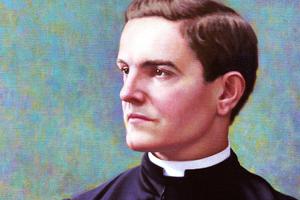
Because on the list of “blesseds” Pope Leo will be paying attention to for possible elevation to sainthood is another American Catholic associated with the grand old game: Blessed Father Michael McGivney.
Blessed McGivney (1852-1890) is most well-known as the founder of the Knights of Columbus, the Catholic fraternal organization that he started in New Haven, Connecticut, in 1882. But the parish priest, who was beatified on Oct. 31, 2020, is also closely linked to the game of baseball — as both a player and a promoter.
Although there are several bases to be rounded before Blessed McGivney could become the Church’s official intercessor in the outfield, people close to the game like longtime Major League Baseball lay chaplain Ray McKenna are pulling for him to be recognized as the sport’s spiritual patron.
“[It] would be a most welcome blessing for baseball and all its players, coaches and fans — past, present and future,” said McKenna, president and founder of Catholic Athletes for Christ.
Baseball and Blessedness
Blessed McGivney’s association with baseball has a lot to do with where and when he came of age. The future priest was born in 1852 in Connecticut, just 7 years after the Knickerbocker Base Ball Club had codified the modern form of the sport over in neighboring New York.
Like many other young men his age, Blessed McGivney played baseball growing up. Not only that, he was reportedly pretty good at it. The historian Douglas Brinkley, principal author of the Knights founder’s biography, Parish Priest, described him as “a naturally talented ballplayer.”
The blessed’s prowess on the field even shows up in a May 20, 1872, box score. While attending Our Lady of Angels Seminary at Niagara University, McGivney started in a game between Connecticut and New York seminarians. He played left field, batted cleanup, and scored three times in a victory for the Charter Oaks club, where he also served as vice president.
As a parish priest at St. Mary’s in New Haven and St. Thomas in Thomaston, Connecticut, Blessed McGivney organized baseball games at parish picnics. His biography also suggests that he might have been the third-base coach for the Knights of Columbus council team at St. Thomas.
“It’s safe to say baseball followed Blessed McGivney, and he wasn’t merely a casual observer, but may have seen a deeper value to the game,” said Andrew Fowler, communications specialist at the Connecticut-based Yankee Institute for Public Policy, who has written about the American blessed’s connection with baseball.
Fowler said that Blessed McGivney saw baseball as “a means of building fraternity and community” — so, perhaps unsurprisingly, the organization he founded continued to be involved in baseball even after his death.
As Fowler previously reported, the Knights formed clubs and leagues across the country in the 1890s. At the start of the 20th century, Chicago’s league was recognized as the biggest, with 42 teams and five divisions.
Furthermore, the Knights used baseball to support their charitable works. In the 1920s and 30s, they tapped big-league player and council member Babe Ruth to hold exhibition games around the country, with proceeds going toward those in need. More recently, Knights of Columbus councils in the Archdiocese of Detroit raised about $65,000 in June 2024 to build a Little League field for athletes with special needs, appropriately dubbed “McGivney Field.”
The Knights of Columbus, who are the principal promoters of Blessed McGivney’s canonization cause, declined to comment for this story.
Fowler previously wrote that the organization Blessed McGivney founded was big on promoting baseball in part because the game helped an immigrant Catholic population assimilate to life in the U.S.
“It made Catholics part of the patriotic American experience,” Fowler wrote. “Plus, as Father McGivney saw, it was also fun.”
Becoming Baseball’s Patron Saint
Blessed Michael McGivney may have the baseball bona fides to be the game’s patron saint. But to make it home, two things need to happen.
First, he needs to be canonized. On that front, the baseball-playing American priest is “on deck”: Blessed McGivney needs one more miracle attributed to his intercession to be approved by the Vatican before he can be declared a saint.
Second, after being canonized, then-St. Michael McGivney would need to be officially recognized by the Church as a patron saint in connection with the sport.
According to Kathleen Sprows Cummings, a University of Notre Dame historian and author of A Saint of Our Own: How the Quest for a Holy Hero Helped Catholics Become American, there are three typical ways a saint becomes a patron.
The first is a “grassroots” approach, as devotion to a specific saint for a particular need becomes so widespread that he or she becomes a de facto patron. For instance, St. Joseph is recognized as the patron saint of carpenters, despite the Church never making any official declaration to that effect.
A middle option is that a saint’s patronage is promoted by authorities in the saint’s homeland, typically bishops but sometimes government figures. This happened, for instance, in Spain in the 1600s, when King Phillip III successfully petitioned the Vatican to officially recognize St. Teresa of Ávila as co-patroness of the country, alongside St. James the Greater.
Finally, the pope himself can simply declare a particular saint to be a patron. Examples of this include Pope Pius XII’s 1950 declaration of St. Frances Xavier Cabrini as the patron saint of immigrants, or Pope St. John Paul II’s 1999 recognition of St. Edith Stein as co-patroness of Europe.
Cummings noted that the Vatican department that oversees consideration of patron saints isn’t the Dicastery for the Causes of Saints, but is instead the Dicastery for Divine Worship and the Discipline of the Sacraments. As the author of A Saint of Our Own explained, canonization and patronage are “two entirely separate processes.”
According to Cummings, patronage doesn’t change anything about the saint. Instead, it changes the relationship between him or her and the faithful, giving the People of God “another intercessor, another person to imitate, another point of connection.”
“The whole purpose of saints is to bring the faithful closer to God, and patronage is another avenue to do that,” she said, describing being recognized as a patron as an “amplification” of the visibility a saint receives when he or she is canonized.
An Impactful Patron
Having a dedicated patron saint for a single sport like baseball might seem overly specific — but it’s not unprecedented. St. Luigi Scrosoppi, a 19th-century Italian priest who encouraged children at the schools and orphanages he founded to engage in sports, was named the patron saint of soccer in 2010 by two European bishops with support from a Vatican congregation.
If Pope Leo XIV does look for a potential patron saint of baseball, which WorldAtlas reports has 500 million fans concentrated in North America, Central America and East Asia, there may be additional contenders.
St. Rita of Cascia is regarded by some as an unofficial patroness based on her role in the 2002 movie The Rookie, which tells the true story of a 35-year-old pitcher starting a professional career and making it to big leagues while relying on her intercession.
Additionally, rumors have swirled that Hall of Fame MLB player and serious Catholic Roberto Clemente might one day be considered for sainthood. If the longtime Pittsburgh Pirate, who used his fame to help the poor and died in a 1972 plane crash while bringing aid to victims of an earthquake in Nicaragua, ever did become a saint, he’d seemingly be a shoo-in for the position.
But Fowler believes that Blessed McGivney is the clear favorite, given that, unlike St. Rita, he played baseball, and, unlike Clemente, he already has an active cause of canonization.
And he thinks that, as the patron saint of baseball, Blessed McGivney could serve as “a conduit of grace in the dugout.”
For example, he noted that having a spiritual patron like Blessed McGivney whom baseball players could turn to could help counteract the prevalence of superstition in the sport.
“Why not instead of ballplayers finding resolve in a lucky rabbit’s foot or by wearing the same socks, the Church gives players both young and old a model of saintly life, of someone who entrusted themselves fully to God?” he asked rhetorically.
Cummings added that having a potential patron saint like Blessed McGivney for fans and players to invoke could help Catholics see a deeper connection between holiness and every aspect of their lives.
“It shows that anything can be sanctified. Even going to a baseball game.”
This piece was updated after posting.
- Keywords:
- blessed Michael McGivney
- baseball
- 'pope leo xiv'