A Little Italian Mountain Town and the Old Church Organ My Grandparents Heard
Guarcino: Nestled in the sub-Apennines and rich in history and quality of life.

I stepped out of a taxi cab on a brisk, partly sunny day in Guarcino, Italy, and found myself in front of a structure I had seen so many times in photos, La Chiesa di San Michele Arcangelo (The Church of St. Michael the Archangel).
I thought of my grandfather, Paolo Tagliaferri (1898- 1975), a bronze foundry hoisting engineer at Gorham Manufacturing in Providence, Rhode Island, who immigrated from Guarcino to Ellis Island in 1912. I asked a kind gentleman, “Signore, per favore, dove si trova la strada per la Chiesa Collegiata di San Nicola?” He directed me to follow Via del Monastero, incidentally, the street where my paternal grandmother was born. I walked between the stone dwellings until the street opened onto La Piazza San Nicola. Facing me was the Collegiate Church of St. Nicholas.
It had taken five years to return to the borgo (village), as the pandemic was raging for some of those years, and now I was standing again in the beautiful piazza where my grandparents and great-grandparents traversed.
Were the angels singing upon my return? I thought as much, but mostly I was aware of myself, from head to toe, visiting the place that occupied my thoughts and emotions for a very long time.
I was invited into the church by the sacristan, Stefano, and was greeted by Mayor Urbano Restante. While attending my first Mass in Guarcino, the accomplished organist Tarcisio Ciavardini played beautiful hymns on an organ that was marginally operable, a testament to his great skill. Organist Ciavardini invited me to see the organ up close, so I climbed the wrought-iron spiral staircase to see the lovely instrument.
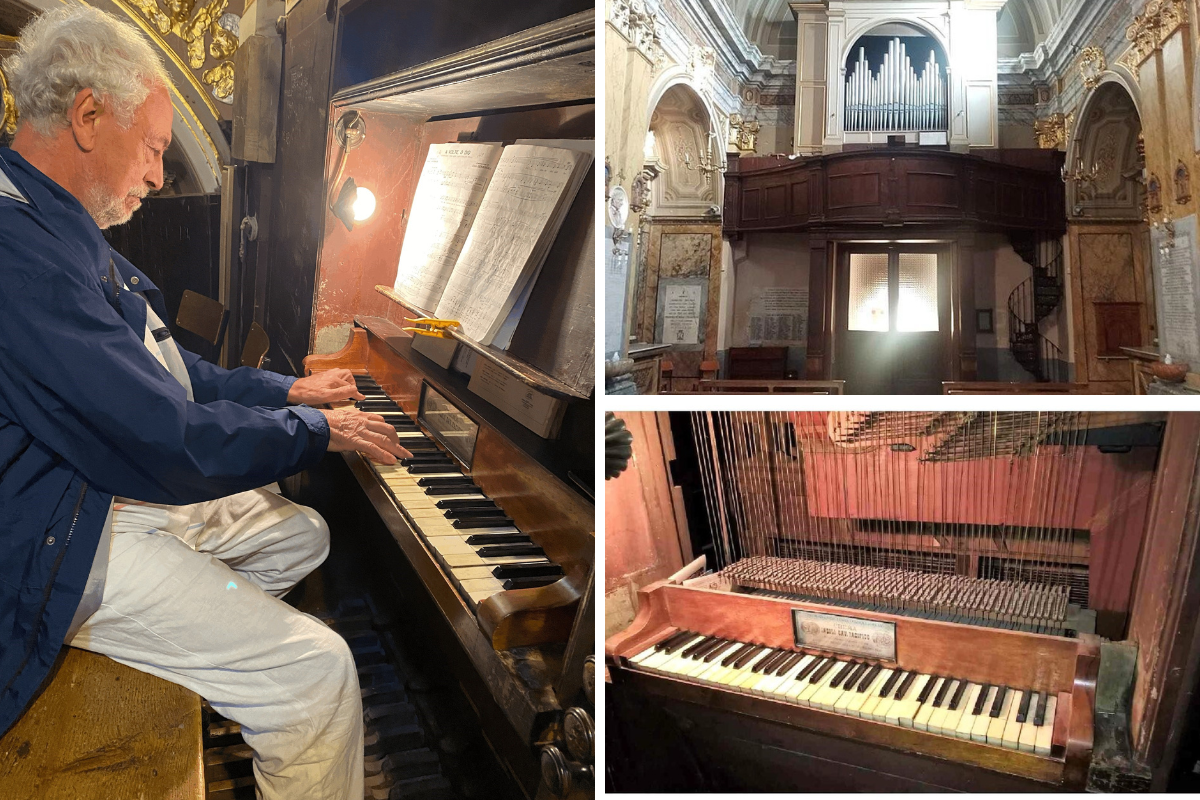
It seemed ancient by my American sensibilities; all the wooden surfaces of the choir loft were worn from decades of devoted use. There was a concave cure to the floor of the loft. However, the spiritual dimension of the space was so palpably spiritual that I really didn’t want to leave.
I thought of my grandparents and great-grandparents sitting in the pews below. How many times had they heard the organ’s wonderful music for the parishioners and visitors in its heyday?

Nestled in the Mountains, Connected to St. Benedict
My ancestral hometown is in the Province of Frosinone, just 43 miles east of Rome. Home to 1,560 people, Guarcino is nestled in the Ernici Mountains, 2,051 feet above sea level, part of the sub-Apennines of Lazio.
When residents of the borgo immigrated to the United States, many settled in the Silver Lake section of Providence.
Founded in the eighth-century B.C., Guarcino was called Varcenum, home of the Hernici, an Italic people of ancient Italy. The Hernici were allied with Rome during the early years of the Roman Republic, and after the fall of the Western Roman Empire, it was a free commune and later a fief of the Papal States.
The historical center dates from the Middle Ages, although remnants of older structures remain, fortifications that served to protect the people during the Barbarian invasions. Stone from the Ernici Mountains was used to construct the dwelling places and pedestrian walkways; the narrow, winding medieval streets are for people only.
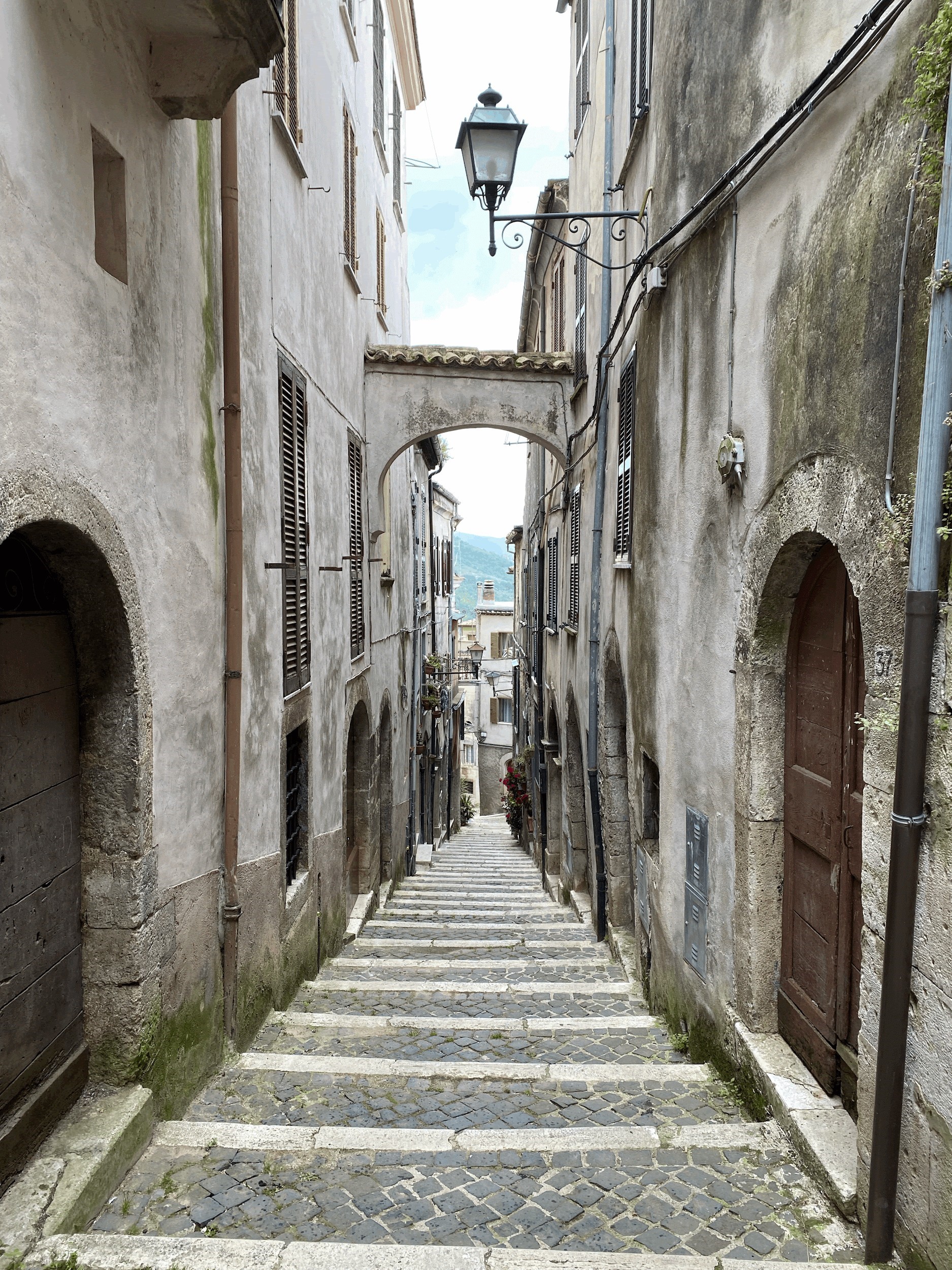
As water flows continuously from the mountains, Guarcino is home to Acqua Filette, whose water has been bottled and distributed in Italy since 1894, and a paper-making company, Cartiere di Guarcino. The town produces local foods, including prosciutto and other cured meats, cheeses, amaretti and star cookies, pies and gelato.
Guarcino is an unofficial stage on the Cammino di San Benedetto or “The Way of St. Benedict.”
The 186-mile pilgrimage route begins in St. Benedict’s birthplace of Norcia in the province of Perugia, Umbria, and ends in Monte Casino in Frosinone, Lazio, at the magnificent Abbey of St. Benedict or L’Abbazia di S. Benedetto, the site in which St. Benedict wrote his monastic rule. A 16-stage itinerary follows the footsteps of St. Benedict of Norcia, which unites the three most important Benedictine places, including Norcia, his birthplace, and Subiaco, where he lived for more than 30 years and founded numerous monasteries.
The pilgrimage ends in Monte Cassino, where St. Benedict spent the last part of his life and where he wrote his impactful Rule. The Way passes through the Sibillini and Apennine Mountains of central Italy and through many small towns, naturalized paths and exquisite landscapes.
Plans for Restoration
San Nicola’s organ was expertly crafted in Bologna in 1890 in the organ factory of Pacifico Inzoli (1843-1910), who went on to construct over 400 organs, and upon his death, the work continued with his sons, Lorenzo and Giuseppe.
The factory is still in existence today, in the town of Ombriano di Crema in Lombardy, a city renowned for its artisan workshops producing and restoring organs.
The organ’s elegant Neoclassical-style enclosure frames the façade. It is made up of 27 tin pipes of eight feet in height and distributed in three spans. The keyboard has 58 keys; the diatonic keys are covered in bone, with a flat and coated front panel, and the chromatic keys are made of ebony.
The original pedal set is stretched out, has 18 pedals plus two accessories. The mechanics are of the traditional type, with the keys “back”; they have forged iron bolts tied in brass on spruce boards. Noteworthy are the written main rules for the correct use of the instrument, signed by Inzoli. The people of Guarcino aspire to restore the organ. A serious and complete restoration is necessary, and the repair must be entrusted solely and exclusively to organ workshops with proven experience in the field of restoration, as all the original material is present in the organ; and it is the only instrument of this type present in the province, a type linked to an important era of 19th-century Italianorgan-making.
In 2020, two proposals were obtained from highly reputable companies, one an organ repair and restoration firm, with the other firm specializing in both restoration and construction of organs — both quotes exceeded $70,000; and since several years have passed since the proposals were written, it is expected the cost of the restoration will increase by at least 35%. The organ will be disassembled in all its parts, duly packed and transported to the restoration laboratory for the needed repairs and restoration. The citizens of Guarcino launched a campaign to raise funds for the project, including reaching out to the Italian diaspora.
In fall 2024, the Diocese of Anagni-Alatri received an anonymous gift from an American; this allowed for some minor repairs to the organ. In September 2024, the Cristoforo Colombo Loggia #2413 of the Sons and Daughters of Italy, in Warwick, Rhode Island, established an organ restoration fund, with an official launch pending. The organ restoration program is part of Progetto Guarcino 2025, an arts, culture and economic development plan for the town. Two weeks after my visit last June, a letter from Mayor Restante arrived in my inbox, requesting my assistance to restore the San Nicola organ.
“What you have heard is only a small part of the possibilities that our organ would have if it were restored: in fact, only thanks to the skill of the organist are we still able to extract notes,” the mayor wrote.
“As you will be able to see from the descriptions of the organ made by the companies that proposed its restoration, it is an exceptionally sophisticated instrument, built by the most famous Italian factory of the 19th century, which is still operational. Try to imagine the glorious sound of that instrument when it was at the height of its possibilities: it is the sound that many people from Guarcino at the end of the 19th century and the first years of the 20th century also heard before leaving their country behind to seek fortune in America. These are many of your grandparents, whose ears heard that sound in the most important moments of their lives, their baptism, their first communion, someone’s wedding. For us Guarcinesi people we have carried the melodies emanating from the organ within us for generations, at every religious function the music of the organ has always accompanied us; every time it is played masterfully by the Ciavardini family it touches us sentimentally, in Sunday masses, but also above all in wedding ceremonies, but also unfortunately for the passing away of our fellow citizens.”
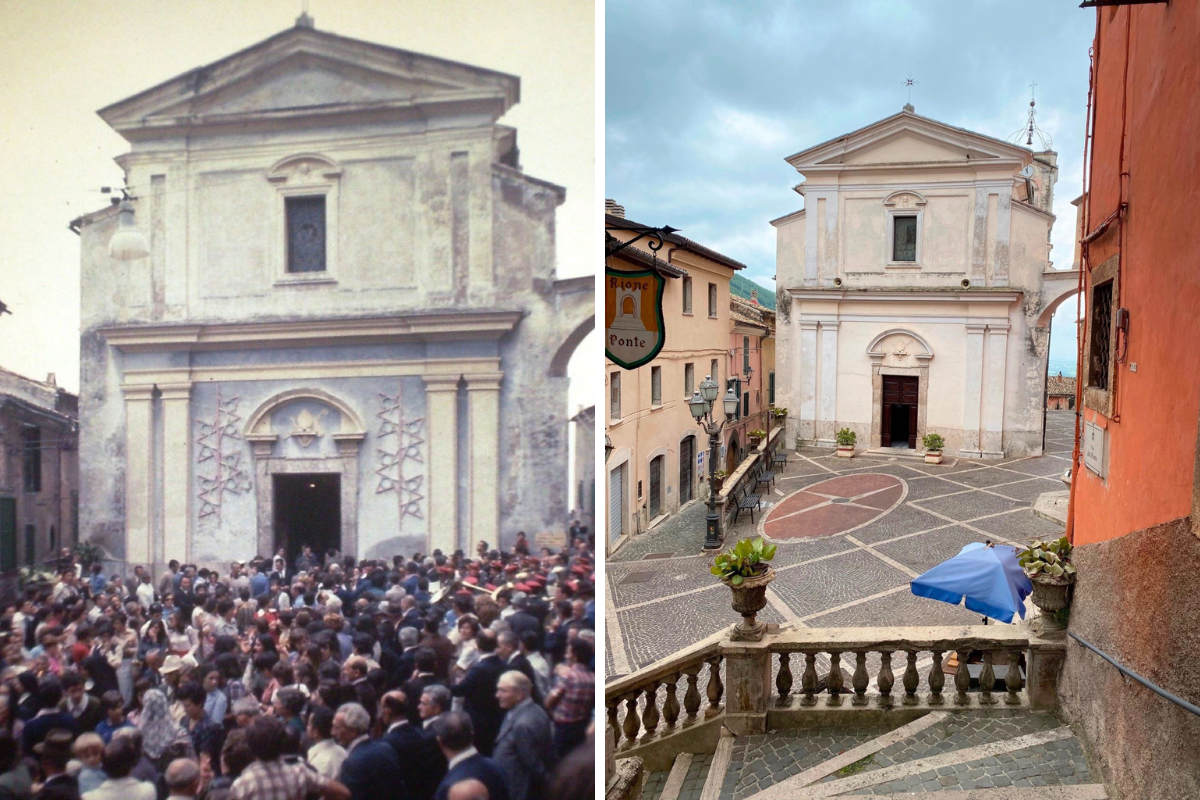
I thought back to my visit and how I wondered how anyone could ever document all the silent prayers whispered by the Guarcinesi while the music played, especially during the solemn feast days of St. Nicholas, St. Agnello, St. Rocco and St. Bartholomew and high holidays, such as Christmas, Easter and Pentecost — indeed, the townspeople in my grandparents’ town “carried the melodies.”
Robin Tagliaferri is currently the director of development at St. Patrick Academy, an urban Catholic high school in Providence, Rhode Island, and has a background in museum education and the visual arts. She serves on the steering committee, the Partners and Friends, for Progetto Guarcino 2025 and a member of the Cristoforo Colombo Loggia. For more information on Progetto Guarcino 2025 and/or the organ restoration project, contact [email protected].
- Keywords:
- italy
- sacred music
- Italian