Eucharist Mocked on TV, Targeted by Protesters — How Should Catholics Respond?
As Eucharistic pilgrims face hecklers and streaming shows mock the Real Presence, Catholics are urged to respond not with outrage, but with reverence — and reparation.

In recent days the Eucharist has drawn mockery on television and condemnations from bullhorn-wielding activists during public processions — evidence of animus against the Catholic teaching of the real presence of Jesus Christ in the Blessed Sacrament.
A recent episode of an Apple TV+ show that features a man and a woman breaking into a church and irreverently consuming Hosts before beginning a sexual encounter has drawn calls for Apple to take the episode down from the streaming platform.
A more recent episode of an HBO Max show that shows the lead character receiving Communion irreverently and later splashing Precious Blood on a priest has drawn less attention.
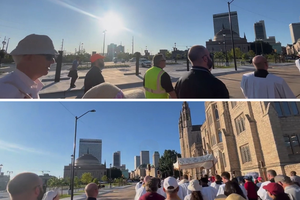
Meanwhile, Catholics walking in the current National Eucharistic Pilgrimage to Los Angeles have encountered loud harangues from protesters who claim the Eucharist isn’t real.
The types of opposition differ in approach and motivation — the Protestant protesters call the Eucharist idolatry, while the creators of the television episodes seek to denigrate belief in the Eucharist.
But the target is the same: the Catholic teaching that when a priest consecrates bread and wine at Mass they become the actual body and blood of Jesus Christ.
“When people begin to grasp what Catholics believe about the Eucharist, its status cannot really be ignored,” said Msgr. Roger Landry, the national director of The Pontifical Mission Societies of the United States, who traveled the entirety of one of last year’s Eucharistic pilgrimage routes as the lone priest to serve as a “perpetual pilgrim” for the groundbreaking event.
“Desecration is the ultimate form of rebellion,” he added, “and often flows from an inner darkness that refuses to believe in the light.”
Action, Reaction and Reparation
The Apple TV+ show, which has received the most attention of the recent public attacks on the Eucharist, has drawn calls for organized opposition — and also calls for acts of reparation by Catholics.
Last week, CatholicVote, a lay advocacy organization, sent a letter to Tim Cook, Apple’s chief executive officer, urging him “to remove this blasphemous episode” from the Apple TV+ platform and asking for a meeting “to discuss how Apple can foster true diversity and tolerance by ensuring its content is respectful of the religious practices of Catholics.”
The Register contacted Apple for comment but hadn’t heard back before publication of this story.
Catholic writer Anthony DeStefano told the Register by email that Catholics “must protest sacrilege.”
“This is not the time for politeness. We are not the Church Mute. We are the Church Militant — and that means we engage the battle. Spiritually, yes — but also publicly, culturally and unapologetically,” said DeStefano, author of The Miracle Book: A Simple Guide to Asking for the Impossible (Sophia Institute Press), which is due out later this month.
Marina Frattaroli, a law clerk in New York City who served as a perpetual pilgrim along with Mgsr. Landry on the eastern Seton Route of the National Eucharistic Pilgrimage last year, suggested the television show creators are treating Catholicism differently from other religions.
“Would they comedically depict the desecration of a Torah scroll or the vandalism of a mosque?” she asked.
“These would be rightly condemned. But the Eucharist — which Catholics believe is not just holy, but Holiness Himself — is sadly fair game to be used as a cheap prop in a storyline,” Frattaroli told the Register by email. “It is an unfortunate byproduct of a culture that no longer knows what to worship, or how beautiful and sacred true worship can be.”
In addition to the television attacks, the currently-underway 3,300-mile 2025 National Eucharistic Pilgrimage has encountered anti-Eucharist protests in Oklahoma and Texas from members of a Protestant church using bullhorns during the past week or so.
Franciscan Father Joseph Mary Wolfe, the chaplain of EWTN and a member of the Franciscan Missionaries of the Eternal Word, told the Register that he witnessed an anti-Eucharist protest in late May in Dubuque in his native Iowa while participating in the pilgrimage.
“We experienced this in the arrival of the Blessed Sacrament, a man with just a loud, loudspeaker just disrupted the whole procession and everything that was happening out there,” Father Wolfe told the Register.
“We were just encouraged to pray for him, not to engage him, not to confront him in any way, and just to carry on the procession, to sing our hymns, and I think even more robustly,” he said. “People were singing as a way to bear testimony to our love for the Blessed Sacrament.”
Streaming Shows — Reader Beware
Catholic teaching on the Eucharist comes under a microscope in Season 1, Episode 6 of the Apple TV+ show Your Friends & Neighbors, a crime drama billed as a dark comedy.
In it, the main character, played by Jon Hamm (who starred in the AMC series Mad Men), is depicted as opening a tabernacle, taking out a ciborium, and bringing it to his ex-wife (played by Amanda Peet) while she is sitting in a middle pew.
He takes off the top of the ciborium and says, “Crackers, for your jam.”
The woman puts a wafer into a jar of jam she had earlier stolen from a store and eats it.
After some dialogue about their past and current situations in life, the woman playfully slaps the man, and he responds, “Hey, you know what?” — and then holds up a wafer the way a Eucharistic minister might and says, in a sardonic tone, “This is the body of Christ. You be careful.”
After some chitchat about their mutual infidelities, the woman at one point says, “Now that you say that, I feel a lot less guilty.”
“In that case,” the man says, moving his hand to the woman’s mouth so that she receives a second wafer on her tongue, “I absolve you,” and makes the Sign of the Cross with his right hand — the way a priest might during confession.
The couple then embrace and begin a sexual encounter on a pew bench, interrupted by a priest whose presence makes them flee from the church.
At 3 minutes and 51 seconds, the church scene takes up more than 10% of the running time of the episode (which is 36 minutes 3 seconds).
Hamm, the star of the show, was initially raised as a Catholic but stopped going to church when his mother died when he was 10, according to an October 2008 profile in GQ.
The program, Your Friends & Neighbors, was the 57th most popular show online as of Monday morning, according to Television Stats, which tracks viewership. The creator of the show, Jonathan Tropper, told an interviewer in April that the show has been renewed for a second season.
Catholic clerics and commentators contacted by the Register were incensed by the scandal.
“Apple TV has produced a vicious mockery of Catholics and their faith. ‘Entertainment’ that consists of a man stealing the Holy Eucharist and giving it to a woman to use as a snack cracker reveals a mindset of hatred and venomous contempt of God, the Catholic Church, and all Catholics,” said Father Gerald Murray, a canon lawyer, pastor of St. Joseph Church on Manhattan’s Upper East Side, and a frequent commentator on EWTN (the parent company of the Register).
“Whoever wrote the script is well versed in Catholic teaching, and this outrage is clearly an intentional attack on the Church,” Father Murray told the Register by email.
Father Robert Sirico told the Register he finds the scene offensive — and also, at times, silly. The communion wafers in the scene, for instance, are individually wrapped in cellophane, something he has never seen in a Catholic church. The tabernacle door is unlocked while being unattended, which is against Church rules.
A wide shot of the front interior of the church in the scene reveals the sanctuary has no altar and no tabernacle. One online commentator who provided side-by-side a photo of the church and a still image from the show suggested last week that the scene was shot at the First Presbyterian Church of the City of New York, in Greenwich Village, which often hosts film productions, noting that the images match. The Register contacted the church by telephone and email but did not hear back by publication of this story.
The errant details in the scene suggest a limited understanding of Catholic practices, Father Sirico said — though the intent is clear.
“It is true that Christianity is an easy mark in Hollywood. The Church still has symbolic power. And the Eucharist is fascinating,” Father Sirico, co-founder and emeritus president of The Acton Institute for the Study of Religion and Liberty, a think tank that promotes free markets within a Judeo-Christian framework, told the Register.
“In a way, it’s an acknowledgment that Jesus said he would draw all men to himself,” Father Sirico said, alluding to John 12:32. “They want to attack Christ, and so they attack the Eucharist.”
The Apple TV+ show isn’t alone in satirizing the Eucharist. The anti-Catholic main character in the HBO Max television show Hacks mocks the Eucharist during a baptismal Mass, which includes portions of the liturgy, including “Lord, I am not worthy to receive you.”
The character (played by Jean Smart) presents herself for Communion even though she isn’t a believer, and later receives both species (under the appearances of bread and wine) irreverently, building up to splashing the Precious Blood all over the front of the vestments of a priest while struggling over the chalice with an extraordinary minister of Communion.
Hacks was the 35th most popular online television show as of Monday morning, according to Television Stats.
Making light of the Eucharist has an unholy origin but demonstrates its power, Msgr. Charles Pope, pastor of Holy Comforter-St. Cyprian Church in Washington, D.C., told the Register.
“Satan loves to mock what is holy. Unwittingly and indirectly he highlights the truth of our teaching,” said Msgr. Pope, author of The Hell There Is: An Exploration of an Often-Rejected Doctrine of the Church (March 2025), by email. “Few if any seek out a Methodist host, or a host from any other denomination. Satan wants to destroy what is real, and this Our Blessed Sacrament is gloriously real.”
Bishops: Shocking, But Not Surprising
Bishops contacted by the Register likewise condemned the recent attacks on the Eucharist.
San Antonio Archbishop Gustavo García-Siller said both types of attacks — on television and in the streets — anguish Catholics, and are signs of disturbance in American society.
“It is deeply distressing to witness renewed attacks recently on the foundation of our faith. The mocking of the Body of Christ on the Apple TV+ program by two well-known actors and increasingly vocal counter protests to the National Eucharistic Pilgrimage, currently traveling through Texas, are disturbing and a reflection of the harsh level of discourse in our country at this time,” Archbishop García-Siller told the Register by email. “There are many people who are hurting, and there is the temptation to lash out when in pain, especially at institutions which are the foundation of society.”
Bishop Scott Bullock, who leads the Diocese of Rapid City, South Dakota, told the Register that what he called the “blasphemous portrayal of irreverence” in the Apple TV+ show stems from the culture wars going on in the United States, which provoke a reaction from some against what he called “the strong stances of our Catholic faith on certain hot-button issues,” which he said “leads some to consider the Catholic Church as an ‘opponent.’”
“One of the basest rhetorical techniques that can be employed with persons with whom one might disagree is to attack the person rather than their position. I suspect that a negative reaction like this one to the Eucharist is an implicit recognition of how important and sacred the Eucharist is to Catholics, with attacks on it as an attempt to attack something precious to one's cultural adversary,” Bishop Bullock said by email.
Miami Archbishop Thomas Wenski said public opposition to the Eucharist shouldn’t shock Catholics, since Jesus also drew opposition.
“As Catholics, of course, we believe that Jesus is truly present — Body and Blood, Soul and Divinity — in the Blessed Sacrament. So just as Jesus drew various reactions during his public ministry on earth, it should come as no surprise that he in his Sacramental Presence would draw various reactions — adoration and worship by some, lukewarmness or indifference by others and outright scorn and hatred by still others,” Archbishop Wenski said by email.
Bishop Thomas Paprocki, who leads the Diocese of Springfield, Illinois, noted that St. Paul said in Galatians 6:7: “Make no mistake: God is not mocked, for a person will reap only what he sows.”
“This is just another example in the ongoing instances of the worldly culture attacking the Catholic Church. I will call this scene for what it is. It is evil. It is Satan doing his work through the false lens of ‘art,’” Bishop Paprocki said.
“But, at the same time, let’s remember that Satan spends his time attacking what is true and holy. In other words, he knows the Catholic Church is the one, true Church, and the Eucharist is Jesus, truly present, Body, Blood, Soul, and Divinity. So, in that sense, when you see Satan attacking the Church, such as this scene, it verifies that what the Church teaches and does, especially the celebration of the Holy Mass and absolving sins, is saving souls,” Bishop Paprocki said by email.
“So, keep going to Mass, keep going to Confession, keep receiving the Eucharist, and keep glorifying God,” he added. “Jesus has already won.”
How to Make Reparation
Several commentators contacted by the Register said Catholics can and should make acts of reparation for the recent attacks on the Eucharist.
The Catechism of the Catholic Church calls on Catholics to try to “repair the harm” of sin with “prayer, an offering, works of mercy, service of neighbor, voluntary self-denial, sacrifices, and above all the patient acceptance of the cross we must bear” (1459).
“Prayers of reparation are a language of love. They are a way to say, ‘Jesus, I love you, and I am sorry for what has been done against you,’” Frattaroli said.
DeStefano recommended Eucharistic adoration, Rosaries, fasting, penance, and public prayer.
“Reparation is not weakness. It is warfare,” DeStefano said. “When the Eucharist is mocked, we don’t wring our hands — we go to our knees. Not in defeat, but in defiance. We kneel before the tabernacle to say: You are still Lord. You are still holy. You are still worthy of all honor and love.”
Bishop Peter Libasci, who leads the Diocese of Manchester, New Hampshire, told the Register the proper reaction to attacks on the Eucharist isn’t outrage so much as imitation of Jesus.
He pointed out that the first people ever to reject the Eucharist were the first people who heard about it, in the Gospel of John, Chapter 6.
“Rather than rail against this and so many other humiliations, slaps in the face, mocking and ridicule of Our Blessed Lord and us disciples who follow Him resolutely, I will now and always will recall the abuse Our Lord took when He declared His flesh to be real food and His blood real drink,” Bishop Libasci said in a written statement.
“Many left Him then and there,” he continued. “Yet the response to Jesus when He asked His disciples if they would leave Him too, was, ‘Lord, to whom shall we go? You have the words of everlasting life.’”