Miracles of St. Sharbel: American Devotion Grows Ahead of Pope Leo XIV’s Lebanon Journey
Many Catholic churches in the United States offer monthly St. Sharbel healing Masses.
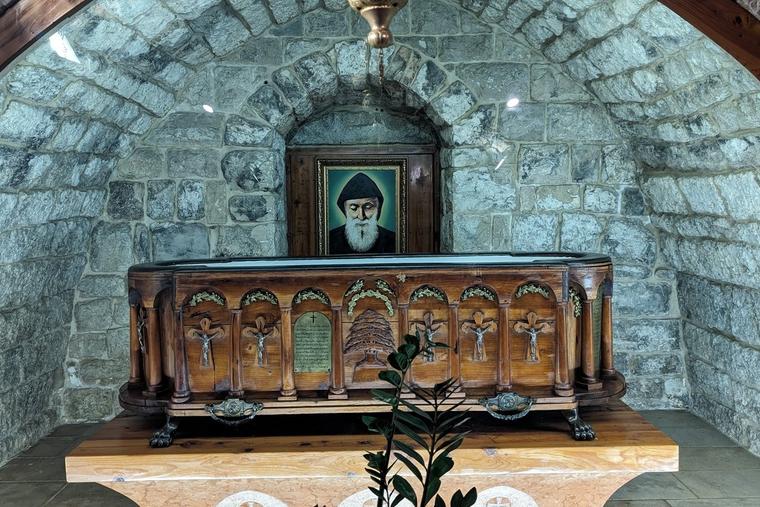
On his first apostolic journey abroad, Pope Leo XIV will travel to Lebanon, where he will visit the tomb of St. Sharbel, the 19th-century Maronite monk and hermit who is revered for his piety and a remarkable number of reported miracles attributed to his intercession.
In honoring St. Sharbel, the Pope draws attention to a growing worldwide devotion to the Maronite saint — including in the United States, where organizations dedicated to promoting his devotion report an increased interest in the saint that is not limited to members of the Maronite Church.
In 1977, St. Sharbel was canonized by Pope Paul VI, becoming the first monk of the Lebanese Maronite Order to be recognized as a saint by the Catholic Church. The Maronite Church is in full Communion with the pope and the Church of Rome. Although he lived a solitary life as a hermit, Sharbel’s reputation for holiness has continued to spread, fueled in part by his reputation as a miracle-maker.
At the Monastery of St. Maron in Annaya, Lebanon, where St. Sharbel lived until his death on Christmas Eve in 1898, the monks have documented more than 30,000 miracles, according to Bishop Gregory Mansour, who heads one of the two Maronite eparchies in the U.S., the Eparchy of St. Maron in Brooklyn.
“But that’s just a drop in the bucket. There’s many more than that,” Bishop Mansour told the Register, adding that he hears of miraculous healings attributed to Sharbel’s intercession “all the time.”
“I don’t document them, because I’d be doing that all day long. So, I say, ‘Thank you, Lord. Thank you, Sharbel.’ And I go on,” Bishop Mansour said.
St. Sharbel was born Yousef Antoun Makhlouf on May 8, 1828, in the village of Bekaakafra in North Lebanon. After joining the Lebanese Maronite Order as a young man, St. Sharbel was ordained a priest in 1859 and lived for 16 years at the Annaya monastery before becoming a hermit.
For the next 23 years until his death, he lived a life of devotion to the Holy Eucharist. He is said to have celebrated Mass each day at noon and would spend eight to 10 hours praying before and after receiving Communion.
Months after he died, according to an account published by his monastery, a light was reported to have shone from his tomb. The saint’s body was exhumed and found to be free from signs of decay. It is said to have remained in this state until 1965, the year of his beatification.
News of Sharbel’s incorrupt body immediately began to draw pilgrims to his tomb, where, to this day, the faithful come to venerate the saint. In 1950, the Annaya monastery began documenting miracle healings reported by those who had prayed for the saint’s intercession.
In many of the reported miracles, Sharbel is said to have performed “surgery.” That was the case with Eskandar Obeid, a Lebanese ironmonger who in 1937 lost sight in one eye but who was cured by Sharbel, leading to the saint’s beatification. Sharbel appeared to Obeid in two dreams: In the first, he told him to go to the monastery to pray; and in the second, the monk told him, “You’ll feel agonizing pain, but you’ll be cured.”
Even the photograph used in his beatification and canonization — displayed at his tomb and printed on prayer cards — is regarded by his devotees as miraculous, because there is no evidence that anyone ever photographed Sharbel during his lifetime.
According to accounts, in 1950, a group of Maronite monks from Scranton, Pennsylvania, made a pilgrimage to St. Sharbel’s tomb and had their picture taken outside the Annaya monastery. After the film was developed, they noticed a bearded man standing among them. When no one could recall seeing such a person that day, they asked the monastery if anyone had recognized the unidentified figure. Several monks who had known St. Sharbel identified him as the mysterious man in the photograph.
While devotion to Sharbel is common among those raised in the Maronite Christian faith, the vast majority of whom can trace their ancestry to Lebanon or Syria, in recent years, many Catholics are claiming a devotion to the hermit saint.
The Maronite Church in the United States, in turn, has begun promoting a devotion to St. Sharbel as a way to draw Maronites deeper into their own faith, and also attract those outside of it. In 2023, Bishop Mansour opened the St. Sharbel Spiritual Life Center in Pittsburgh, which holds retreats and workshops open to people of all faiths. The center, which has a first-class relic of St. Sharbel, offers a liturgy of healing and hope.
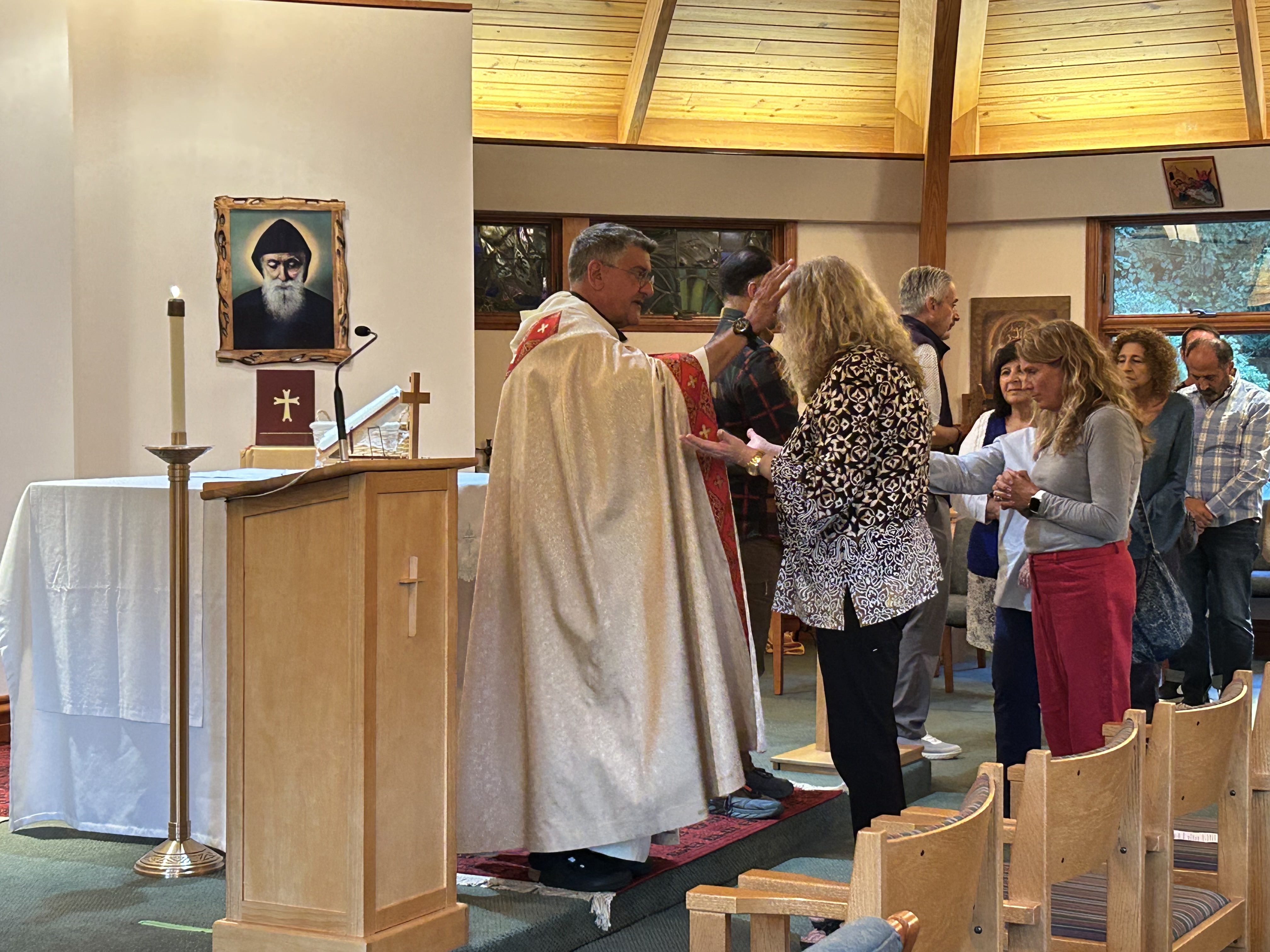
Dr. Anne Borik, director of the center, said that many people come to the center to revere Sharbel’s relic and receive holy oil that has touched the relic.
“A lot of miracles have occurred due to the intercession of St. Sharbel, using these beautiful sacramentals,” Borik told the Register.
Borik, an internal medicine and general physician living in Phoenix, was tapped by Bishop Mansour to head the center after she had witnessed a healing miracle attributed to St. Sharbel during the U.S. tour of St. Sharbel’s relics on the 50th anniversary of his beatification in 2016.
At that time, Dafne Gutierrez, a mother of five who was declared legally blind in 2014 didn’t know much about St. Sharbel but was encouraged by a sister-in-law to visit St. Joseph’s Maronite church in Phoenix and pray before the relics.
“She prayed, went to confession, and was blessed with the holy oil, and really begged God to heal her. And that night, when she went home, she started experiencing severe pain in her eyes,” Borik said.
Within 48 hours, her vision was completely restored. The ophthalmologist she visited performed a mapping of her optic disc and found no sign of disease or injury. Father Wissam Akiki, the pastor at the parish, asked Borik to investigate the healing in her capacity as a physician.
“I took [Gutierrez] to three other neuro-ophthalmologists, and there was no explanation. This was just a very powerful testimony to God’s power of faith through St. Sharbel’s prayers and intercession,” Borik said.
The experience changed the way she practiced medicine, she told the Register.
“As a medical physician, I would keep my faith aside, but when this happened, I really started to see and recognize the importance of bringing prayer to the bedside — the importance of really integrating health and holiness and spirituality,” she said. “I think that’s why Bishop Gregory asked me to be the director of the center, because we really want to move that direction, to incorporate the devotion to our Blessed Mother and the Holy Eucharist, which is really what St. Sharbel is about.”
Borik also started a prayer group with a devotion to St. Sharbel, called the St. Sharbel Global Prayer Net, using the free Mighty Networks app. People from all over the world, she said, pray the St. Sharbel chaplet and Rosary together live.
“The stories of conversions of family members that they are praying for is a powerful testimony. It’s great — I’d like to welcome anybody that wants to join us to learn more about this great saint,” she said.
Around the world, organizations have formed to introduce people to St. Sharbel, including in the United States. Ghassan Touma, the director of the Family of St. Sharbel, USA, told the Register that the mission of his organization is to spread devotion to St. Sharbel and “give some exposure to the Eastern spirituality of the Catholic Church.”
In 2016, his organization built a shrine to St. Sharbel at the National Shrine Grotto at Mount St. Mary’s University in Emmitsburg, Maryland.
“From there on, we gave the bookshop books, novenas, prayer cards and other information to sell and to give away. Then we started little by little on the internet, website, social media, YouTube channels. We are open to communication with whoever wants to, especially through emails,” he said. His organization’s website features a series of YouTube videos about St. Sharbel, including testimonies from those who have reported miracles attributed to St. Sharbel.
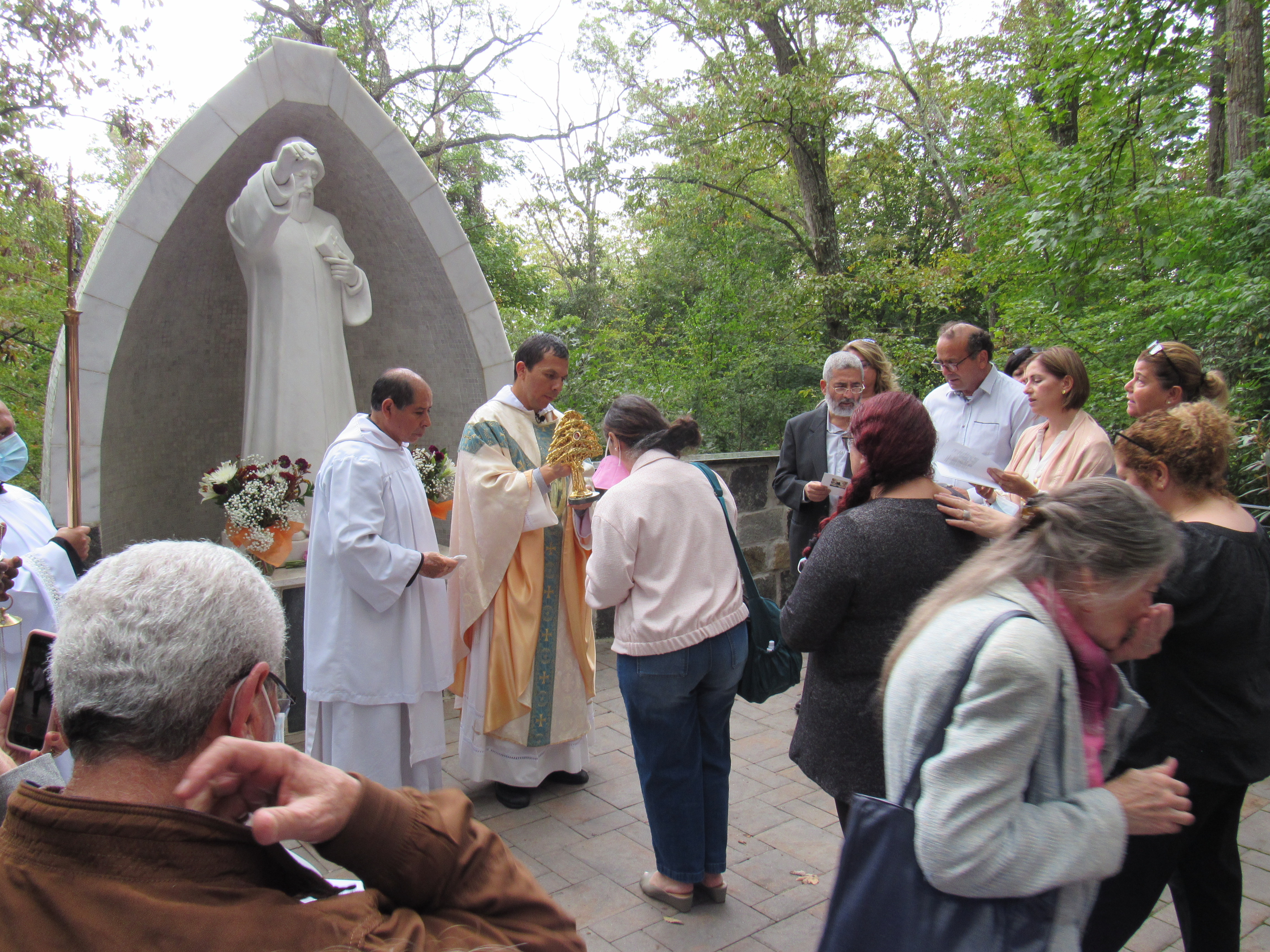
And in the last 10 years, he said, he’s seen a dramatic increase in devotion to St. Sharbel among Maronites and non-Maronites alike. The literature he leaves at the shrine in Emmitsburg and his local Catholic church needs to be replenished regularly. He receives daily emails from people seeking to learn more about the saint. For those who request it, he sends them books or even oil from St. Sharbel’s tomb at the Annaya monastery. Each year, he explained, Sharbel’s bones are soaked in olive oil, which is then used as a sacramental.
Many Catholic churches in the United States, he said, such St. Joseph’s in the Diocese of Brooklyn, offer monthly St. Sharbel healing Masses. The practice commemorates a reported miracle that took place in 1993, when Nohad El Shami, a Lebanese mother of 12 who was partially paralyzed due to a stroke, experienced healing — another reported “surgery” that left scars — attributed to Sharbel’s intercession. Afterward, in a dream, Sharbel asked her to return to the monastery on the 22nd of every month to go to Mass and offer thanksgiving for her healing. For this reason, many devotions dedicated to Sharbel take place on the 22nd day of each month.
St. Sharbel also has a prominent spot in one of the best-known Catholic churches in the United States, St. Patrick’s Cathedral in New York City. In 2017, the Chapel of St. Sharbel was dedicated there, with New York Cardinal Timothy Dolan and Cardinal Bechara Peter Rai, the Maronite patriarch of Antioch and all the East, in attendance.
Bishop A. Elias Zaidan, who leads the other Maronite eparchy in the U.S., the Eparchy of Our Lady of Lebanon in Los Angeles, told the Register that St. Sharbel, in performing these miracles and interceding in lives of those who pray for him, is drawing people all over the world of all faiths to Christ.
“It’s not just in Lebanon, and it’s not only Christians; it’s Muslims [too],” Bishop Zaidan said. He believes that God is using the hermit saint for a particular purpose.
“I think St. Sharbel calls us to encounter God through prayer. I think that’s the message of St. Sharbel: to believe and live that faith in deep prayer with the Lord,” Bishop Zaidan said.
“I’m hoping anyone who’s cured is invited to have that special relationship with God in so many ways. I’m imagining if I have a miracle in my life, I cannot live the way I was before. I have to be grateful.”
Editor’s Note: An earlier version of this story incorrectly stated that St. Sharbel was the first Eastern Christian recognized as a saint by the Catholic Church. In fact, he was the first monk of the Lebanese Maronite Order to be canonized.
- Keywords:
- st. sharbel
- lebanon