The Exit Interview: A ‘Missionary’ Nuncio Departs After a Decade in D.C.
‘We talk to everyone — even the Department of War,’ Cardinal Christophe Pierre says in an exclusive interview about his tenure as the Pope’s man in Washington.
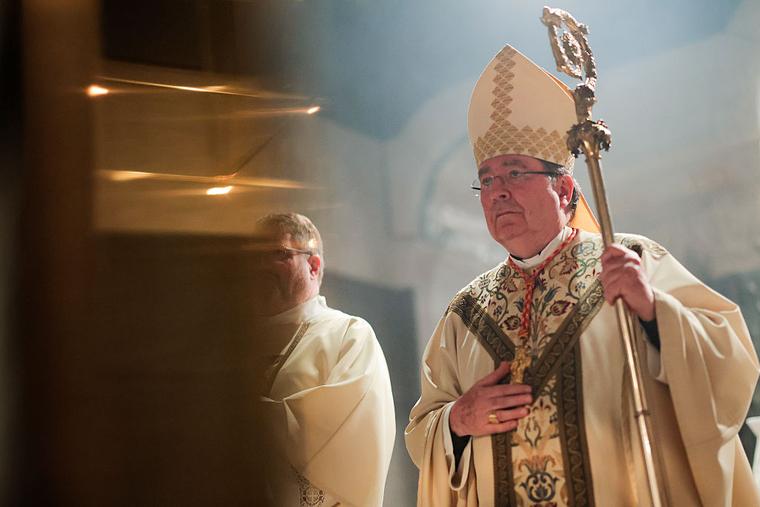
WASHINGTON — As a working Vatican diplomat for close to 50 years, Cardinal Christophe Pierre sat through hundreds of meetings on six continents. So, the fact that he met with U.S. officials at the Department of War in late January (eight days before his 80th birthday) was, in his view, just another “day in the life” of a busy international envoy.
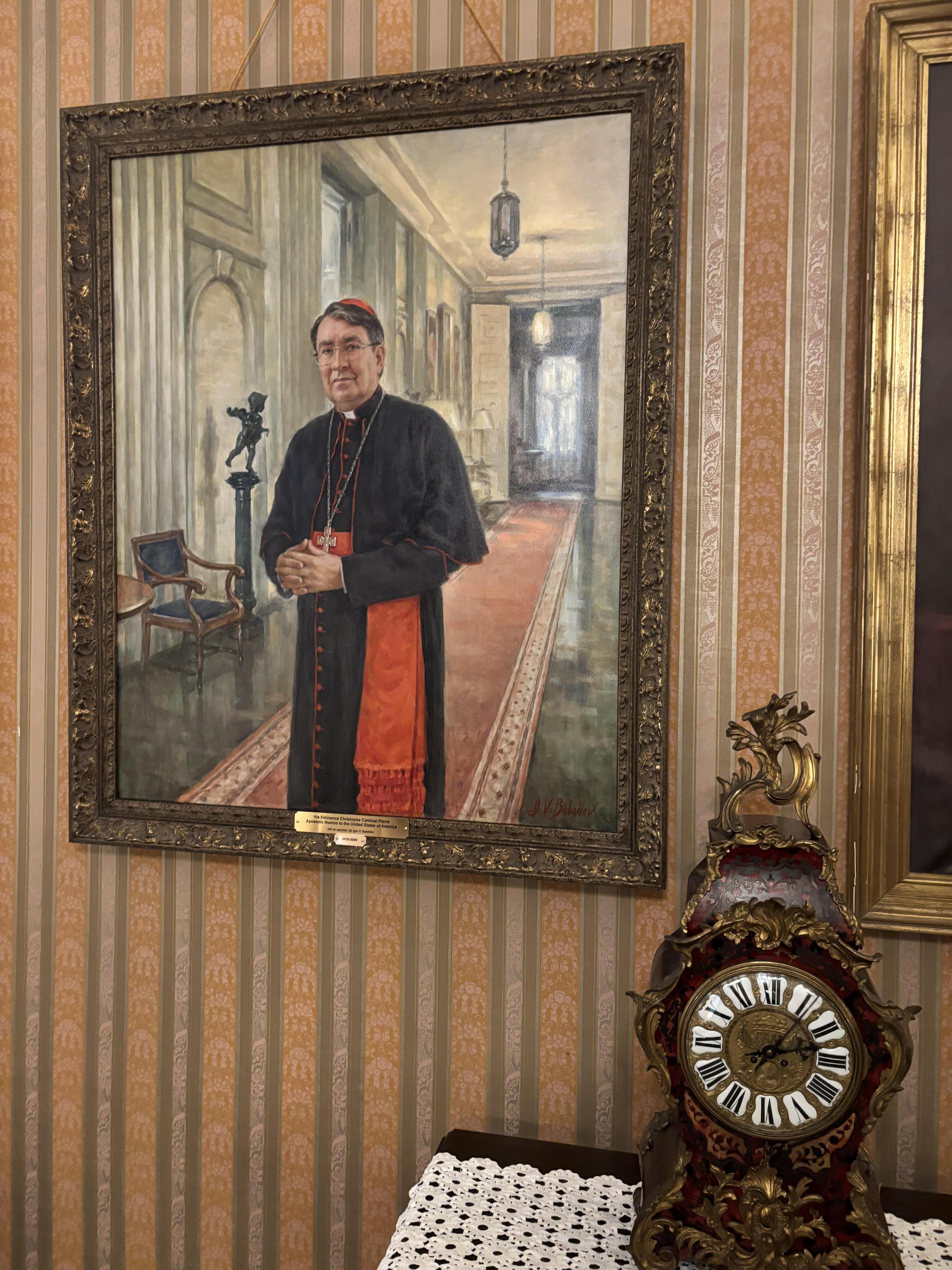
“That’s what we do — we talk to everyone — even with the Department of War!” Cardinal Pierre exclaimed in conversations with the Register as he prepared a move to Rome from the Holy See’s nunciature, the 1937 purpose-built mansion standing across the street from Vice President J.D. Vance’s residence.
Uninterested in spending much time on an event the French-born cardinal considers exaggerated in significance, Cardinal Pierre did confirm that the “frank” discussion with Elbridge Colby, undersecretary of defense for policy, revealed clear differences in this administration’s worldview and the Holy See’s outlook. It also demonstrated, he thinks, a break with past American policy when diplomatic matters were handled by the State Department, not the War Department.
A Half-Century on the Frontlines
Ranging in conversation between nations and papacies (his first assignment, to New Zealand, came under Pope Paul VI), chuckling often, Cardinal Pierre exemplifies the extraordinary dedication of the Church’s priest-diplomats. A list of countries where he served only begins to suggest his wide experience: Mozambique, Zimbabwe, Cuba, Brazil, Switzerland, Haiti, Uganda, Mexico, and finally, the U.S.
Diverse tasks included campaigning in Uganda for abstinence education against a vice president’s promotion of condom use as the only way to stop AIDS; taking charge of the nunciature in Burundi after the nuncio was murdered; managing the laicization of Haiti’s Jean-Bertrand Aristide, elected president of his country as a Catholic priest; negotiating successfully the inclusion of religious freedom into Mexico’s constitution; and managing the unprecedented demand by his predecessor, Archbishop Carlo Viganò, that Pope Francis resign.
Since he arrived in Washington in 2016, the archbishop has worked simultaneously with the U.S. bishops — both as individuals in their dioceses and through the U.S. Conference of Catholic Bishops (USCCB); with the full range of Catholic institutions, especially universities; and as the pope’s main interlocutor with the U.S. government. It’s a huge job, especially because Cardinal Pierre decided he should crisscross the country, to see the Church in its reality. One of a nuncio’s most important duties is to help the Holy Father select new bishops, which requires understanding what they face on the ground.
“Just one day after arriving at the nunciature from Mexico, where I was a nuncio for nine years, I took a flight to Orange County, California, to assist at my first plenary of bishops. So, I was never the typical Washington tourist,” he told me. “D.C. has been a place between travels. As soon as I arrived back in D.C., I was planning my next trip.”
The now-retired nuncio plans to take up residence in Rome and will continue to take on special diplomatic assignments from the Pope. Asked what he will remember most fondly of his time in America, Cardinal Pierre quickly responded, “I certainly enjoyed the people — the hospitality and generosity of the people. As representative of the pope, I was in touch with a lot of Catholics — 20% of the population! I’ve been to most of the dioceses. Four or five times to Alaska. Hawaii. I enjoyed the snow. I enjoyed California. I enjoyed Florida! I’ve been to Phoenix.”
“The beauty!” he enthused. “The diversity of the country!”
What the cardinal enjoyed about the nunciature was its atmosphere of quiet and contemplation. Surrounded by forest, the backyard attracts deer and raccoons. He also appreciated the city’s museums. But mainly, Cardinal Pierre focused on his central task, which was, for most of his tenure, “To explain Pope Francis to the U.S. and the U.S. to Pope Francis.”
Unpacking Aparecida and the Continent of Hope
When Cardinal Pierre arrived, he was surprised that American Church leadership was unfamiliar with the Aparecida concluding document produced by Latin American bishops in 2007. It calls for a more mission-oriented Church dedicated to evangelizing the world; Pope Francis was its lead editor. Many of the themes found in Francis’ first papal exhortation, Evangelii Gaudium, can be traced back to Aparecida.
According to Cardinal Pierre, to understand the importance of Aparecida, one must see it in the context of the Second Vatican Council. “The history of the Church is made of some 20 great councils and in the last century, the great event, the event of the Spirit, is Vatican II,” he explained.
“Since the early 1960s, the bishops of South America — remember Pope Paul VI called it the continent of hope — these bishops implemented the Second Vatican Council by organizing five big meetings. Aparecida was the fifth one. It occurred after the fall of the Berlin Wall and the end of the imposition of this strange and terrible ideology, Marxism,” he said.
“At Aparecida, the bishops looked at the breakdown in the transmission of faith and values, the fragmentation of society, modernism, postmodernism, etcetera. Phenomena which have been analyzed by many philosophers and observers. So, the bishops said, now we need to start again and of course to start again from Christ, to evangelize this new world.”
The cardinal calls this event “a turning point of this century.”
He believes the Holy Spirit inspired the South American bishops, gathered at the continent’s most popular pilgrimage site, the Cathedral Basilica of the National Shrine of Our Lady Aparecida in Aparecida, Brazil. Through the election of Pope Francis, the insights from Aparecida entered the universal Church especially in the text of Evangelii Gaudium. And this Spirit is still working today, in Cardinal Pierre’s view.
“This is why, personally,” he summarized, “I made one of the purposes of my mission in the U.S., to share what I perceived about Pope Francis and Aparecida with the bishops of the United States.”
Cardinal Pierre was beginning his tenure as nuncio to Mexico in 2007, when Jorge Bergoglio was archbishop of Buenos Aires. “Pope Francis was a prophet, speaking about what it means to be Church in a changing era, a change of epoch. He offered a diagnosis and focused on the ways to evangelize today. For me this has been fascinating.”
The cardinal sees Pope Leo XIV carrying forward the Spirit expressed in 2007. “When you read and listen to the Holy Father, he is in total continuity with what Francis began. Each week, he speaks about Vatican II and the next consistory will be a discussion of Evangelii Gaudium. You see!”
“Pope Leo is first and foremost a Latino bishop,” laughed Pierre. “A bishop born in America but a Latino bishop and when you say that you know, you say everything about Pope Leo, but you also say everything about America! Sometimes people don’t want to recognize it.”
Cardinal Pierre describes both Francis and Leo as prophets. Why? “A prophet is the one who speaks about the Gospel. Pope Leo does not want to become a politician. He said so explicitly. The prophet is the one who in the world today, announces the good news of the Gospel,” he explained.
“A prophet must have good vision and he must be courageous, and he must be also able to dialogue with the world today. To propose the presence of Christ and Gospel values to the world today — this is what Pope Leo does, in a very precise, very kind, and convincing way.”
Does Cardinal Pierre believe the U.S. bishops now understand the value of Aparecida, a statement now almost 20 years old?
“In the world, nothing is perfect, but I would say yes,” he responded solemnly. “I don’t want to be the advocate of just one document. What is important is that when I hear my brother bishops defending the poor, defending the migrants, defending human life, standing against the death penalty, I’m happy because I believe the bishops are following Jesus, and I thank God for that.”
Ideology vs. Reality in the American Church
Cardinal Pierre has not always been complimentary toward the American bishops. Some 10 years ago, he was known to criticize the American Catholic Church for excessive ideology. Asked if that was his diagnosis of Church leadership in 2016, the cardinal explained that first, one must understand why ideology is problematic.
“The danger of ideology is that it is very polarizing because you become the owner of an idea and you want to impose it and you forget aspects of reality,” he explained.
Reality is more important than ideas, he reminds me. “It is much simpler to manage an ideology because you become the owner of the ideology and you think that those who do not agree with you should be forgotten or ignored or defeated. This is what happens all over the world, but it is also a danger within the Church.”
He continued, “In some ways, Catholicism in the U.S. became a kind of political party, defending values, and they did it well, but it became a kind of political fight. To be Catholic meant defending values. Pope Francis looked at this situation and said, ‘Be careful. As a Church, we are not just defending values, even if they are good values.’”
In this assessment, U.S. Catholic leadership became identified with the pro-life movement as an ideology, which meant other priorities were forgotten. The risk is that this focus contributes to a culture war.
Cardinal Pierre summarized, “For many years this cultural war took over and created divisions. Inevitably, the attitude grows, If you are not with me, you are against me.”
And now? “The bishops are more united today, looking at many aspects of reality. When you function in ideology you are divided,” he said.
Asked what he came to admire about the American Church, Cardinal Pierre emphasizes how productive and giving the Church is. “When you look at what Catholics have done, building incredible churches, thriving parishes, universities, hospitals — it is fantastic! The beauty of Catholicism in America, for more than 200 years, is this generosity. There’s a positive influence of the Church everywhere.
“I don’t know any other country where the contributions of Catholic people to the country are so dramatic. And you know the courage … when you think that Americans are immigrants. They come from somewhere else. And these people have been able to transform their own country by their own efforts, and they continue to do so,” he said.
Cardinal Pierre singled out the Catholic focus on education. “I was made a doctor at Notre Dame University. What a wonderful campus. We have nearly 200 Catholic universities. It’s a wonder!”
He observed, “American culture became the culture of dreams and the people who came here came to free themselves. The American dream is almost a religion, deeply marked by Protestantism. Catholics invested especially in education so they could be part of the American dream, while remaining deeply rooted in faith.”
The Mystery of Schism and the Call to Peace
No honest interview can avoid painful topics. For the nuncio, his tenure’s most difficult passage was the scandal provoked by his predecessor, Archbishop Viganò, who called for the pope’s resignation in 2018.
Responding to the question of why Viganò went into schism, which led to his excommunication in 2024: “I have not spoken much about that because I am still puzzled by the attitude of my brother, because he is still my brother [bishop],” the cardinal said. “I’ve known him for a long time. I respect him but I have been puzzled. I cannot understand.”
“You know, this is the mystery in life, now that I’m near the end of my life, at age 80,” the French prelate mused. “I have been confronted by many kinds of mystery but the biggest mystery involves human beings. Of course you know, no one is perfect. But I have not understood the position of this, my brother. So, I don’t want to elaborate more about that but certainly it has been troubling for me.”
Cardinal Pierre added that, like the saint from his home region, St. Thérèse of Lisieux, from Normandy, he considers the Church his home. “She used to say, ‘My mother the Church’ and I say the same. I have served five popes during my life. I’ve always seen the work of God in the Church.”
Cardinal Pierre received his red hat at the same time as Archbishop Pierbattista Pizzaballa and Archbishop Robert Prevost. Historically, few nuncios have been created cardinals, but Francis honored several nuncios with this honor, especially those who were missionaries in dangerous or challenging circumstances. I asked the cardinal if Francis considered him to be a bishop serving in the U.S. as a missionary land.
“I don’t know why I was made a cardinal,” he responded. “It was exceptional. I had a good relationship with Pope Francis. I’ve believed strongly in the importance of this pope. He certainly gave a lot of attention to the U.S. Typically, South Americans, especially the elite, they pay a lot of attention to North America, what’s going on there — not the contrary. North America should pay more attention to what is happening in South America. I was so privileged to live in both places. To me, Pope Leo is more Latin than American.”
U.S. Foreign Policy
Returning to the here and now, I asked the nuncio what caused officials from the Department of War to summon him to meet on Jan. 22. “It was definitely related to Pope Leo’s speech to the diplomats when he said, ‘War is back in vogue and a zeal for war is spreading.’”
Cardinal Pierre added, “Pope Leo’s main emphasis has been peace. The first word he used from the balcony after his election was ‘peace.’ He has been constant in that theme.”
According to the nuncio, the Holy See is very concerned that the Trump administration’s foreign policy approach turns away from policies advocated since World War II — policies that helped create the United Nations. “We found several disturbing things in the U.S. National Security Strategy released late last year,” said Cardinal Pierre. “It extols the Law of Force, not the force of law. It leaves little room for constructive multilateralism, while the pope continues the classical conception of diplomacy.”
He continued with emotion, “The real history of America is that it built institutions for dialogue. But now you say no to dialogue? You destroy people then offer to engage in dialogue after that? It will never happen. Trump wants to isolate America and make America great against the others. Before, America became great with the others. And this is why America became great—with the others.”
Cardinal Pierre pointed out that the Pope did not initiate a discussion of “just war,” but others evoked this Catholic concept. Rather, “Leo just said: No to war.”
“The current war in Iran can’t be considered a just war,” explained the diplomat, “because it is not a defensive war. You don’t go to war to negotiate. You go to negotiate to avoid war.”
"What has happened lately, with the pope mentioned almost every day by the president, demonstrates that people are discovering the pope in a positive way because what he says makes sense."
He concluded, "Ironically, the president’s attacks boost the positive image of Pope Leo and the Catholic Church." --