Where Hope Never Dies: Roman Underground Cemetery Welcomes Jubilee Pilgrims
The underground cemeteries, nearly 2,000 years old, hold some of the earliest evidence of Christian faith, belief in the dignity of the human body, and hope in eternal life.

ROME — Beneath the bustling streets of Rome stretches a vast but hidden network of maze-like tunnels: ancient catacombs where the first Christians gathered in secret and buried their dead.
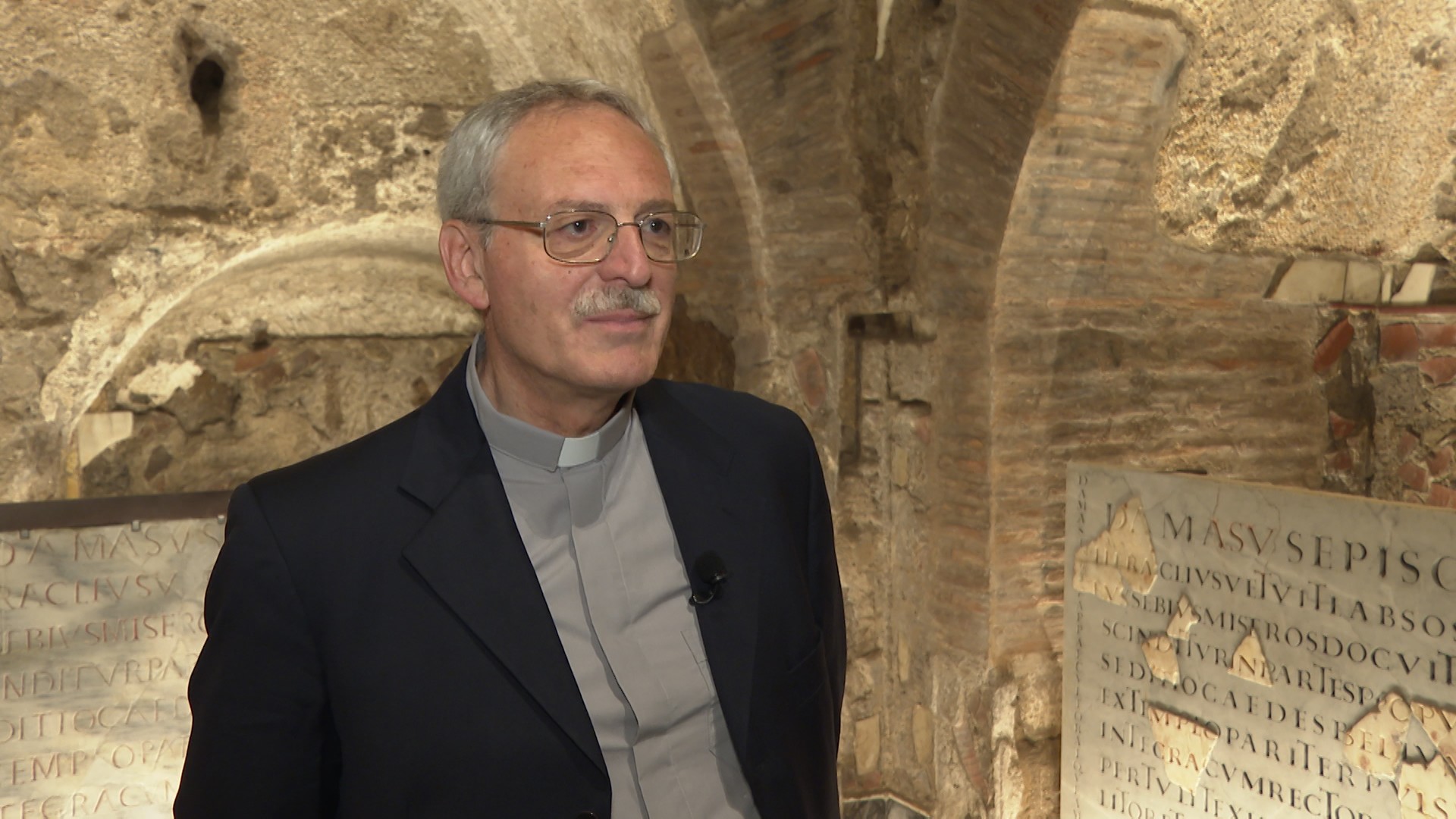
The Catacombs of St. Callixtus, named after the deacon appointed by Pope Zephyrinus to oversee the cemetery, date back to the second century and are often considered “the largest burial complex of Christian Rome and the first communal cemetery of the Church of Rome,” Msgr. Pasquale Iacobone, president of the Pontifical Commission for Sacred Archeology, told the Register.
“Pope Zephyrinus, at a time when the Christian community was growing, wanted to provide a cemetery where the faithful could still feel part of the community — even in the passage from death to eternal life,” Msgr. Iacobone explained to the Register.
“He asked the deacon Callixtus to organize this cemetery,” Msgr. Iacobone added. “Callixtus later became pope, succeeding Zephyrinus, and it is his name that remained associated with the cemetery.”
Secret Tombs of Popes and Martyrs
In the underground cemetery, Msgr. Iacobone continued, “we don’t only find thousands of burials of the faithful, but also martyrs and, most notably, nine popes from the third century buried in the ‘Crypt of the Popes.’”
This period represents one of the most dangerous in papal history. From Pope Pontian’s five-year reign (230-235) to Pope Dionysius’ nine years (259-268), most of these successors of St. Peter, like Anterus, Fabian, Cornelius, Lucius, Stephen and Sixtus II held office for only one to four years — a stark contrast to modern papal reigns.
Two of them, Popes Pontian and Fabian, carry the Greek abbreviation “MPT” for “Martyr.”
Certain tombs, such as the one of Pope Sixtus II, were given a “special honor and embellished with inscriptions, the so-called Damasian inscriptions,” Msgr. Iacobone said. “These are brief, simple verses that tell the story of the person buried there.”
The following inscription honoring Sixtus II was placed on his tomb by Pope Damasus I:
“… I, buried here, taught as Pastor the Word of God; when suddenly the soldiers rushed in and dragged me from the chair. The faithful offered their necks to the sword, but as soon as the Pastor saw the ones who wished to rob him of the palm (of martyrdom) he was the first to offer himself and his own head, not tolerating that the (pagan) frenzy should harm the others. Christ, who gives recompense, made manifest the Pastor’s merit, preserving unharmed the flock.”

Seven other popes, including Pope Caius (283-296) and Pope Eusebius (309-310), finding no spaces in that crypt, were entombed in private cubicles nearby.
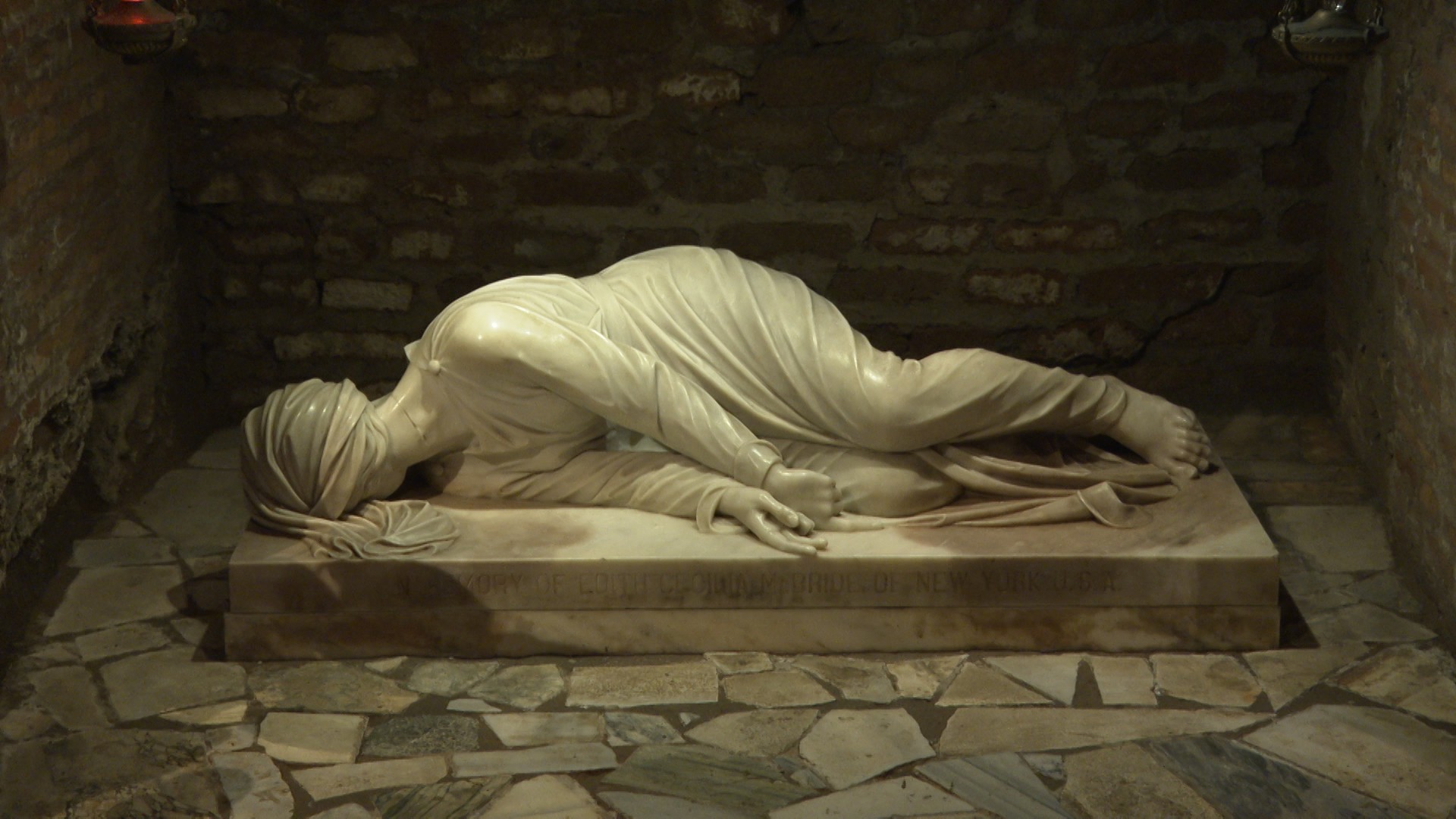
The catacombs also house the tomb of St. Cecilia, the patron saint of musicians, whose remains were discovered here in 821 by Pope Paschal I and found incorrupt in the same position as when she was martyred, before being transferred to the Basilica of St. Cecilia in Trastevere.
Rediscovering the Catacombs Centuries Later
Over time, especially after the legalization of Christianity in the Roman Empire, catacombs were gradually forgotten.
It wasn’t until 1849 that Italian archeologist Giovanni Battista de Rossi rediscovered the lost 12-mile-long Catacombs of St. Callixtus — believed to once have held the remains of approximately half a million people — under a vineyard along the Via Appia Antica, one of the oldest and most important Roman roads.
They also discovered “extraordinary architecture for its time,” Msgr. Iacobone said, describing the elaborate funeral chapels covered in “frescoes, stucco, mosaics, marble, inscriptions — all of which tell us about the life of the early Christian community, how they viewed life and death.”
Beyond belief in eternal life, Msgr. Iacobone explained, the catacombs also testify to the Christian belief in the dignity of the human body. With the arrival of Christianity, the practice of cremating bodies “shifted to burial, with the whole body laid to rest awaiting the resurrection.”
“Cemeteries mean dormitories,” Msgr. Iacobone noted, “because one sleeps there waiting for the resurrection.”
An Ongoing Discovery
Three years after rediscovering the ancient catacombs, Pope Pius XI founded the Pontifical Commission for Sacred Archeology to oversee excavations in the Roman catacombs and other early Christian sites, as well as to preserve artifacts uncovered in the process.
More than 60 catacombs have been discovered to this day in Rome. While they stretch for hundreds of kilometers beneath the city and contain tens of thousands of tombs, Msgr. Iacobone explained that only a portion of each has been fully explored and mapped. The full extent of the catacombs is likely much larger than what is currently accessible or known.
For this reason, the work of the Pontifical Institute of Christian Archaeology, established in Pope Pius XI’s motu proprio I Primitivi Cemeteri — to train new archaeologists, to study, protect and preserve the entire funerary heritage of the Christian community of Rome and of Italy — continues to this day.
Lately, frescoes and inscriptions “obscured by layers of grime over time” in different cubicles have been restored, thanks to laser technology, Msgr. Iacobone said, thus restoring “the dignity, the beauty, and an idea of the magnificence and solemnity that this cubicle dedicated to a martyred pope must once have conveyed.”
A Place of Hope
“We have countless pilgrims and visitors who, for the first time, are able to come into contact with the testimonies of the early Christian community, with the first martyrs, the first popes,” Msgr. Iacobone said.
Unable to profess their faith openly during the brutal persecution of the early Church, Christians created a sacred vocabulary of symbols, depicted on the walls of the catacombs and carved on the marble slabs that sealed the tombs for pilgrims and faithful to see.
Some of those symbols are depictions of the Good Shepherd, with a lamb around his shoulders representing Christ and the soul which he has saved; the “Orante,” a figure in a posture of prayer with raised arms; and the fish: a pictorial representation of the Greek word Ichthys, which was itself used as an acronym for Iēsoûs Khrīstós, Theoû Huiós, Sōtḗr, meaning “Jesus Christ, God’s Son, Savior.”
Some other symbols are the Alpha and the Omega; the anchor, a symbol of hope and steadfastness in the face of persecution and adversity; and the phoenix: a symbol of the Resurrection and of Jesus Christ himself. The dove holding an olive branch symbolizes the soul that reached divine peace.
The aim is that the accounts of saintly lives and the symbols of eternal life found in the dark underground catacombs will inspire pilgrims and visitors during this Holy Year.
Especially during the jubilee, whose theme is hope, “one simply must come here,” Msgr. Iacobone encouraged, “because everything in this place speaks of hope.”
“Nothing speaks of death; there is no dark, heavy or depressing view of life, but, rather, a vision full of hope and trust. Everything here points toward dreaming of paradise, toward embracing the passage that Christ has opened for us.”
WATCH ON EWTN
- Keywords:
- catholic cemetery
- catacombs
- st. callixtus
- praying for the dead
- faithful departed
- 2025 jubilee



![‘The Holy See has made clear that the clergy of the Society [of St. Pius X] are now to be regarded as schismatic,’ Bishop Frank Caggiano said in a statement.](https://publisher-ncreg.s3.us-east-2.amazonaws.com/pb-ncregister/swp/hv9hms/media/2026070617078_0ab6902d-8c02-4eac-aba4-1ec174e52618.png "‘The Holy See has made clear that the clergy of the Society [of St. Pius X] are now to be regarded as schismatic,’ Bishop Frank Caggiano said in a statement.")