Boldly Faithful: Star Trek Reveals Captain Pike Is a Christian
COMMENTARY: Surprising Christian references in ‘Star Trek: Strange New Worlds’ spark reflection on the enduring witness of belief in an increasingly secular age.

I rarely watch television. Since the end of appointment viewing and the advent of reality TV, politically correct sitcoms and preachy, politically charged dramas, there certainly have been periods over the last number of years that produced few watchable, memorable or edifying programs.
One of the few shows I find time to watch is Star Trek: Strange New Worlds.
I’ve been a Trekker since I was a kid. Star Trek was the best kind of escapism, providing a hopeful vision of a future when people of all races explored the galaxy together, reaching out to new worlds and civilizations with the aid of fantastic technology that helped us live better lives.
Recently, there was an interesting exchange on the series between the Capt. Christopher Pike of the Enterprise and his love interest, Federation starship Capt. Marie Batel. In some banter between the two following a harrowing encounter with a destructive reptilian species called the Gorn, Pike reveals that he was once an altar boy.
A 23rd-century starship captain admitting he at one time served during a Catholic Mass or a Christian religious service was unexpected, but I didn't think that much of it — until the third episode of the season. Batel was fighting for her life in the Enterprise sick bay when Pike uttered six words with tears in his eyes:
“Our Father, who art in heaven…”
I stopped the program, hit the reverse button on the remote and watched it again, just to be sure I was seeing and hearing it correctly.
While Pike's prayer was interrupted by Batel regaining consciousness, his words were unmistakable. It was the prayer given to the world by Christ himself. An altar boy in his youth, who turns to the Lord’s Prayer in his moment of need. Christopher Pike is undoubtedly a Christian.
Given the fact that he used the term “altar boy” as opposed to “acolyte” it can be inferred that he is Catholic, but that debate is only tangential.
If so, however, he is a member of a Church that had survived the relentless assaults from the secular left, threats from within, World War III, the Eugenics Wars, extraordinary advances in technology, and the discovery of life on other planets.
What an uplifting and courageous statement for the show to make.
While many in the U.S. want a godless, moral relativist future where subjective truth is the only guardrail for our reality, Star Trek largely presents clarity about right and wrong, freedom and oppression, good vs. evil. Religion, however, was a much more complicated subject matter for the show.
Star Trek didn't have a problem with other species having religions and gods. In fact, many of the races in Trek lore are openly religious. But Star Trek’s creator, Gene Roddenberry, was a fervent atheist. Humans, in Roddenberry's view, were to have grown out of their superstitions and unscientific, irrational faith in a supreme being.
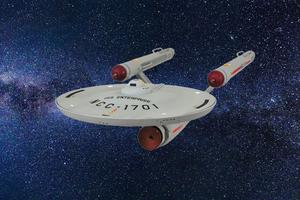
Likely much to Roddenberry’s chagrin, Star Trek: The Original Series did make some reference to faith in God having survived humanity’s tumultuous future. There was a chapel on board the Enterprise. During the episode “Who Mourns for Adonais," Captain Kirk quips, “Mankind has no need for gods. We find the one quite adequate.”
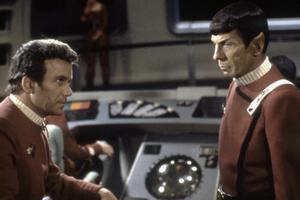
Then there was “Bread and Circuses,” the Enterprise’s visit to planet 892-IV, a 20th-century mirror of Earth's ancient Roman Empire, complete with its violent oppression of a religious minority committed to “total love and total brotherhood.” Kirk and Spock referred to them as “sun worshipers.” At the end of the episode, Lt. Uhura set them straight:
Mr. Spock, all of you. I've been monitoring some of their old-style radio waves. The Empire spokesman trying to ridicule their religion. But he couldn't. Don't you understand? It's not the sun up in the sky. It's the Son of God.
Fascinated, Kirk, with his wry smile, would reply, “Caesar and Christ. They had them both. And the word is spreading only now.”
It’s a scene that can still make your eyes water.
Later Trek series, however, distanced themselves from human religion. Star Trek: Discovery hit bottom as a hopelessly woke ode to intersectionality, alternative lifestyles, over-emotionalism and secularism, brimming with pretentious agenda-driven dialogue that matched the worst fads of our time. This was far more than the 23rd-century crew sporting the beehive hairdos and miniskirts of the 1960s. The preachy series seemed designed for secular leftists.
That is what made Capt. Pike’s expression of faith so wonderful. Star Trek has always been a reflection of our times and incorporated prominent themes of our culture.
The Register reported earlier this year that some dioceses in the United States are seeing up to 70% increases in conversions and entry into the Church — a trend driven by young people. Articles about a resurgence of faith abound.
Venerable Archbishop Fulton Sheen warned nearly 75 years ago about the dangers of secular society and the normalization of not just atheism but a militant rejection of God. Just look at the data. It’s hard to argue that, as secularist forces have pushed us farther from biblical truth, humanity has suffered from a rot and decay that reaches into the very soul of billions of people.
Last week, Pope Leo XIV addressed 1 million young Catholics from around the world, gathered outside Rome. He told them they have the ability to chart a course for a brighter future for humanity through faith. While technology has its place in our world, the Pope said, it cannot supplant or endanger human dignity.
Since the COVID lockdowns, which led to a steep decline in church attendance, recent reports have consistently shown that more people, especially younger ones, are returning to church. Having watched their digital world, dominated by cold technology, give rise to addiction, loneliness, anger, depression and rudderless lives, they have begun a new quest for meaning.
The idea that our faith and our Church would survive well into Star Trek’s 23rd century, when men travel faster than light to the far reaches of the galaxy, is a rare comfort, because it validates the trends we pray will continue.
Maybe even in Hollywood, every once in a while, there is some recognition that the greatest of all treks is the incredible human adventure we’re on together in the search for the real final frontier — the power and grace of our God with whom we hope to make our eternal home.
- Keywords:
- star trek
- science fiction
- catholic faith