The Scopes Trial, Cardinal Schönborn, and the Enduring Quest for Intelligent Design
COMMENTARY: Is life in this world a random product of meaningless non-causes? Or is it guided by divine Providence?
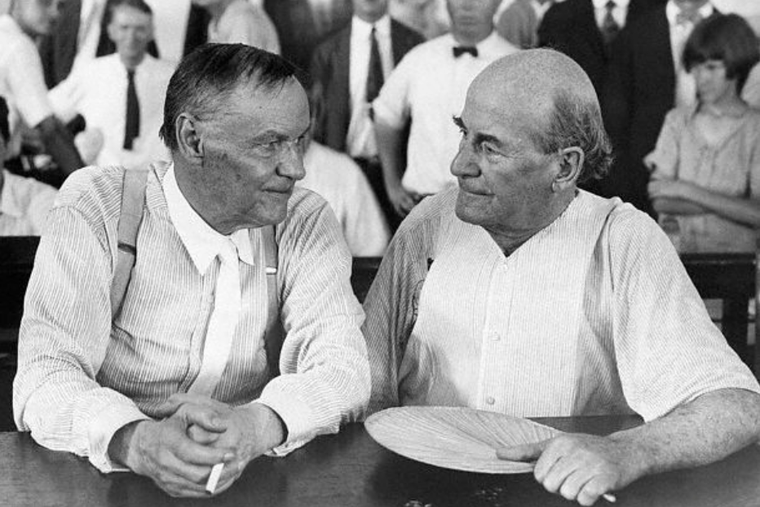
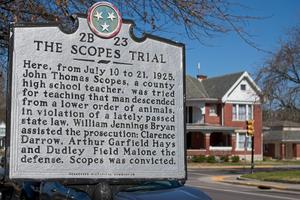
Exactly a century ago, national attention was focused on a Tennessee courthouse. It was truly — with apologies to O.J. Simpson some 70 years later — the “trial of the century.”
In July 1925, it seemed that the very Word of God was in the dock, in the apparently contesting accounts of origins offered by the Bible and Darwin’s theory of evolution. Even today, the legacy of the “Scopes Monkey Trial” lives.
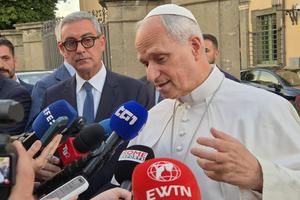
Twenty years ago this month, Cardinal Christoph Schönborn stirred up an intense controversy with a column in The New York Times, “Finding Design in Nature.” He challenged “randomness” in what he called the “neo-Darwinian sense — an unguided, unplanned process of random variation.”
The July 2005 op-ed garnered much attention because Cardinal Schönborn — retired just this year as the archbishop of Vienna — was then the leading theological light in the College of Cardinals, and a protégé of Cardinal Joseph Ratzinger, elected Pope Benedict XVI just a few months beforehand in April 2005. The two of them had worked closely together on the Catechism of the Catholic Church, perhaps the most important project of Pope St. John Paul II’s long pontificate.
“We are not some casual and meaningless product of evolution,” Pope Benedict preached in his inaugural homily. “Each of us is the result of a thought of God. Each of us is willed, each of us is loved, each of us is necessary.”
Was Benedict, interpreted by Cardinal Schönborn, walking back the Catholic Church’s openness to evolutionary theory, perhaps even embracing creationism? The firestorm that followed considered that a live possibility, and the Viennese cardinal came in for severe criticism.
The centennial of the “Scopes Monkey Trial” this month — it concluded on July 21, 1925 — provides the context for how Christians, especially American Christians, think about how they should think about evolution. That played out 20 years ago in the Schönborn controversy.
The sweltering summer of 1925 brought two of the nation’s leading orators to a Tennessee courtroom. On trial was schoolteacher John Scopes, charged under state law with violating the prohibition on teaching evolution in public schools. Clarence Darrow was the counsel for the defense, while William Jennings Bryan argued for the state.
In a stunning climax, Darrow called Bryan as a witness to testify on the biblical view of origins, and dramatically eviscerated him. The movie version, Inherit the Wind (1960), kept the memory of the “trial of the century” fresh.
Scopes was convicted and fined, with the fine overturned on appeal. But the dominant memory American culture preserved from Scopes was that enlightened people followed science, and religious fundamentalists were strange, even a bit kooky. That cultural legacy informed the 2005 reaction to Cardinal Schönborn. Could it be, nearly 150 years after Darwin’s Origin of Species, that Catholicism’s leading scholar-bishop was a bit kooky himself, to say nothing of Pope Benedict XVI and maybe the Catholic Church as a whole?
That charge was implausible against Pope Benedict or Cardinal Schönborn, but many Catholic scholars were eager to distance themselves nonetheless.
Embracing evolution as consistent with the faith was an indicator of being on the right side of faith-and-science disputes, a badge of membership in the world of enlightened, even progressive, religion. If the scholarly Cardinal Schönborn appeared to be taking the side of the spluttering Bryan, better to declare oneself for Darwin as dramatized by Darrow.
Cardinal Schönborn likely did not appreciate how much the legacy of the Scopes trial had shaped, if not the scientific and philosophical debate about evolution, then its cultural impact.
Yet the fundamental question he raised remains a critical one for theology and philosophy. Is life in this world a random product of meaningless non-causes? Or is it guided by divine Providence, or at least by some intelligent and intelligible design?
Cardinal Schönborn argued that randomness outside of God’s providence was theologically inadmissible and philosophically suspect. Only so much can be done in a newspaper column, so Stephen Barr offered critical clarifications in First Things later that year.
Randomness in science simply means “uncorrelated.” It means there is no direct obersable cause to the effect, Barr wrote. His example: Children observe the license plates of various states on the highway. The sequence is random; no one plate is correlated with the next. But each car is driven by a causal agent with a destination in mind; each has his own story, his own purpose. It is both random and part of a design.
An important recent book by Oratorian Father Martin Hilbert of the Toronto Oratory, The Catholic Case for Intelligent Design, makes a bolder claim, namely that Darwinian materialism is not only weak on the theology and philosophy, but on the science, too. An engineer by training who did his scholarly work in the philosophy of science, Father Hilbert advances the debate from 2005 by arguing the scientific case against Darwinian randomness.
Father Hilbert argues that causality — design, to use the more loaded term — is written deep into nature, and the best science demonstrates that. Who did the writing is a different question, but from disputes over authorship it does not follow that there was no author at all. Hilbert is not the fiery orator that Bryan was, but he would have won the argument with Darrow.
In other areas, the worlds of intelligent faith and honest science have drawn closer together. In 1925, Msgr. Georges Lemaître, a Belgian Catholic priest, was at work on what we now call the “big bang theory,” a scientific account that he thought consistent with Genesis. It’s more than that, actually: “Let there be light” is Msgr. Lemaître’s theory rendered in biblical poetry
“Faith and reason are like two wings on which the human spirit rises to the contemplation of truth,” wrote Pope John Paul in 1998. Those two wings were somewhat broken in Tennessee a hundred years ago. The cultural mending is still underway.
- Keywords:
- evolution
- creation
- intelligent design
- divine providence