Pope Calls Youth to Follow ‘Great Adventure’ of Saints Carlo and Pier Giorgio
COMMENTARY: In raising Carlo Acutis and Pier Giorgio Frassati to the altars, the Holy Father reversed a decade of smaller canonizations and proposed a bold vision for youth.
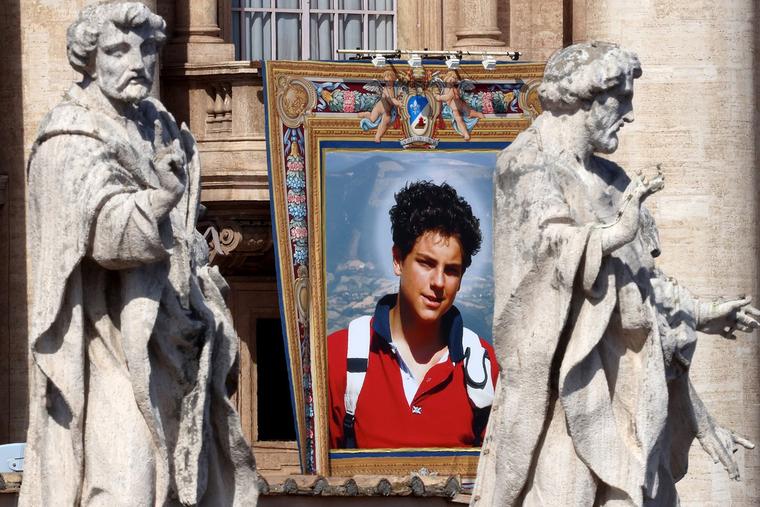
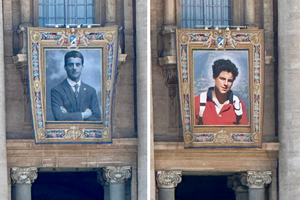
The canonization of Sts. Pier Giorgio Frassati and Carlo Acutis, the first such ceremony for Pope Leo XIV, was helpful in revealing something of the emerging shape of his new pontificate.
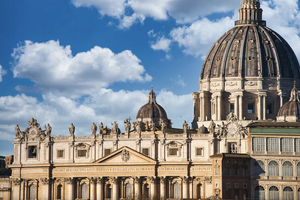
The summertime Jubilee of Youth surprised many with its size, reported to number about 1 million people. Surprising, because numbers at papal events in Rome had been declining for several years; even the canonizations of major figures such as Pope Paul VI, Archbishop Óscar Romero and Cardinal John Henry Newman did not fill St. Peter’s Square. In his approach to the canonization of Pier Giorgio and Carlo, it appears that Pope Leo wants grand events back in Rome.
His enthusiasm was evident in his decision to appear in St. Peter’s Square ahead of the canonization Mass to greet the pilgrims with an impromptu address. It may well be the first time that has ever been done. He was evidently excited and wished to share his excitement.
“Enjoy this celebration! Thank you for being here!” the Holy Father concluded his welcome. Pope Leo wants people to return to Rome for grand events.
The heady days of the massive canonizations under Pope St. John Paul II, when all the streets around St. Peter’s Square were jammed — for Padre Pio in 2002, an overflow congregation of several hundred thousand was assembled simultaneously at St. John Lateran — are not back yet. On Sunday, the crowd filled up the Piazza Pio XII outside of St. Peter’s, but did not extend down the Via della Conciliazione. It may take time, but this canonization reversed the downward trend of the last decade, when canonizations were not treated as great rallying pilgrimages.
That seemed to be the preference of Pope Francis, who spoke very sparingly of the new saints in most of his canonization homilies — on one occasion, he did not even mention their names. When canonizing John Paul II, John XXIII, Junípero Serra and Mother Teresa, Francis mentioned them only in the final paragraphs as examples of other points he wished to make, the same perfunctory treatment he gave in his homily for the funeral of Pope Benedict XVI. It often left pilgrims disappointed, some of whom had traveled a great distance.
Leo went in the opposite direction, extensively preaching on the lives of both saints, quoting them several times and then proposing lessons for the Catholic faithful. While Pope Francis did not even mention the Eucharistic devotion of Mother Teresa, which was the heart of her day, Pope Leo proposed that Pier Giorgio and Carlo’s practice of daily Communion, Eucharistic adoration and frequent confession were “simple acts, available to everyone.”
John Paul and Benedict chose to use canonizations and beatifications as capstone moments, emphasizing key themes of their pontificates: Maximilian Kolbe (1982), Teresa Benedicta of the Cross (1998), Faustina Kowalska (2000), Juan Diego (2002), Mother Teresa (2003), John Henry Newman, Brother André Bessette and Mother Mary MacKillop (all in 2010). Leo XIV may do the same.
Challenge to Youth
One such theme may be challenging young people to live the fullness of the Catholic faith.
Since the dawn of World Youth Day, each pope has benefited from the energy of mass youth gatherings; the current Holy Father was the most recent beneficiary at the Jubilee of Youth in August. It seems that he is intending to forge a connection with youth.
His canonization Mass homily specifically presented the new saints as in continuity with others who were young and wealthy when they first sought God’s call for them — King Solomon, St. Augustine, St. Francis of Assisi.
“Think of St. Francis of Assisi; like Solomon, he too was young and rich, thirsty for glory and fame,” said Pope Leo. “That is why he went to war, hoping to be knighted and adorned with honors. But Jesus appeared to him along the way and asked him to reflect on what he was doing. Coming to his senses, he asked God a simple question: ‘Lord, what do you want me to do?’ From there, he changed his life and began to write a different story: the wonderful story of holiness that we all know.”
“How many similar saints we could recall!” the Holy Father continued. “Sometimes we portray them as great figures, forgetting that for them it all began when, while still young, they said ‘yes’ to God and gave themselves to him completely.”
Coming on the heels of his festive encounter in August, it may be that proposing a “great adventure” to young people is a key theme for Leo. Recall that he spent many years in seminaries and the formation of Augustinian novices and, as bishop of Chiclayo in Peru, his flock was considerably younger than it would have been in Chicago.
Part of the reason for the impromptu greeting before Mass was precisely to salute the young people present: “I wish especially to greet the many young people who have come for this Holy Mass! It is truly a blessing from the Lord to be here together with all of you.”
Benedict XVI as Model
Pope Leo wore a splendid gold chasuble for the canonization Mass — one that had been made for Pope Benedict XVI and which he wore for a canonization in 2011. It seems that his liturgical style is similar to Benedict’s, too — more reserved, more solemn.
Ahead of the Mass, Leo said that “the celebration is very solemn; it is also a day of great joy!” He seemed to reflect that in his deportment. The Mass would be solemn, offered in a reserved manner, but the greetings before and after would be more evidently joyful.
One detail, in particular, stood out. At a canonization, after the canonical formula is pronounced, various people connected to the new saint approach the Holy Father. John Paul, Benedict and Francis would take time to greet each, often embracing them and engaging in brief conversation. Leo did not do that, limiting himself to a nod of the head, smile and blessing, even for St. Carlo’s own parents, though it was the first time in history that the father and mother of a newly canonized saint were present.
In previous pontificates, the photograph of a warm embrace would have been the signature image of the canonization. Not this time; Leo’s liturgical style to date is even more reserved than that of Benedict. Combined with his exuberant greeting before Mass, Leo appears to draw a clear distinction between what is fitting for Holy Mass, and what should be provided for elsewhere.
One additional note, secondary but not unimportant. Pope Leo said that “Carlo, for his part, encountered Jesus in his family, thanks to his parents, Andrea and Antonia.”
That was gracious but addressed only the later years of Carlo’s life. His parents initially had no faith to give their son. Carlo’s mother had been to Mass only three times before he was born — at her First Holy Communion, confirmation and wedding. It was the Acutis family’s Polish nanny who was the first to answer Carlo’s spiritual questions. She taught him the Guardian Angel prayer in her mother tongue — a prayer that little Carlo would recite with great fervor in Polish!
There are many wealthy families where the parents, despite their baptism, live as the Acutis parents did, which Pope Leo described in his first homily as “baptized Christians, who thus end up living in a state of practical atheism.” In many of those families, it is the domestic servants, if any, who will be the first teachers of the faith.
Likely for reasons of delicacy about the parents, that key factor in St. Carlo’s life was overlooked. Those domestic servants might find in St. Carlo a source of inspiration and intercession.
Providence works in mysterious ways. Relying on his parents alone, Carlo likely would not have become a practicing Catholic, let alone a canonized saint.
The nanny was Beata Sperczyńska; she merited a place of honor in Rome on Sunday.