St. Longinus: The Centurion Who Pierced Christ’s Side
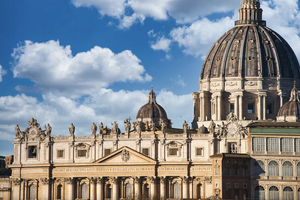
Tradition holds that the soldier who pierced Christ’s side at the Crucifixion came to believe in him and is honored today as St. Longinus, whose monumental statue stands in St. Peter’s Basilica.
At the Crucifixion, two men encountered Christ in a way that changed their lives forever. Both later came to be honored as saints. One was the Good Thief, St. Dismas. Jesus told him, “Truly I tell you, today you will be with me in Paradise” (Luke 23:43). The other was the Roman centurion who pierced the side of Christ with a lance and later came to be known by the name of Longinus.
Because of what happened next, Luke tells us, “When the centurion saw what had taken place, he praised God and said, ‘Certainly this man was innocent’” (Luke 23:47). “Now when the centurion and those with him, who were keeping watch over Jesus, saw the earthquake and what took place, they were terrified and said, ‘Truly this man was God’s Son!’” (Matthew 27:54).
Here was Longinus, a Roman centurion, who at once believed Jesus was the Son of God, converted, became a saint, and today is remembered with an honorable monument not far from the altar in St. Peter’s Basilica in Rome. Part of his lance has a place among the sacred relics of the passion of Our Lord; it is also housed at St. Peter’s.
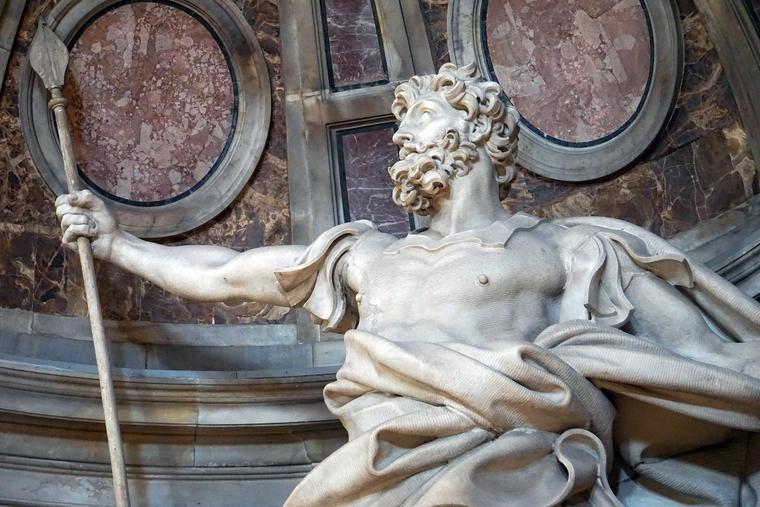
Since the mid-1600s, a monumental marble statue of St. Longinus stands nearly 15 feet tall in a huge niche on the right side of one of the colossal piers holding up the dome above the pontifical altar. No longer dressed as a Roman centurion, the saint’s depiction stands holding a lance and appears to be looking up, as if fixed on the wound in the side of Christ.
In 1643, Gian Lorenzo Bernini, who did so much of the splendid design and art for the basilica, carved this remarkable statue. In the same pier, three other saints in their own niches — Veronica, Helen who discovered the True Cross, and Andrew — join Longinus.
Above them are the Loggias of the Relics, where pieces of the True Cross, the veil of Veronica, and part of the Lance of Longinus that was given to Innocent VIII in 1492 are kept.
Longinus is not named in the Gospels. He is identified only by his place in the Roman legion. That is likely how his name derived. While lancea is the Latin for “lance,” the Greek in which the New Testament was written also makes the connection: It uses the word lónkhē, meaning “lance” or “spear.” At the same time, “Longinus” is also an authentic Roman name used at the time as a “last” or “family” name. Yet this would be the least likely reason for his name. The connection to his place at the Crucifixion and the Greek word used in the New Testament are the most likely reason.
But how did he become a saint? Blessed Jacobus de Voragine (who was beatified in 1816) gives an answer in his multivolume The Golden Legend, written in the 13th century and filled with biographies of the saints. By the 15th century this work was a medieval “bestseller” in every major European language.
The Golden Legend relates how, when Longinus pierced Our Lord’s side with his lance, the Precious Blood and water came down the spear and onto Longinus’ hands. The centurion — tradition tells us that he suffered from very poor eyesight — touched his eyes, “and immediately, he who had previously been blind could now see clearly.”
He left military service, converted to the faith, “abode with the apostles, of whom he was taught and christened, and after,” he went to lead “a holy life in doing alms and in keeping the life of a monk about 38 years in Caesarea and in Cappadocia, and by his words and his example many men converted he to the faith of Christ.”
This conversion displeased Octavian the provost, who tried to get Longinus to sacrifice to idols. Refusing, the former centurion told the provost that if he “become Christian God shall pardon your trespasses.” That angered the Roman official, who ordered some gruesome tortures meant to render Longinus speechless.
Despite the horrible torture, the future saint kept talking, then proceeded to destroy every idol in sight. From them, devils came out and entered the provost and those with him, torturing them. De Voragine described that they admitted: “God is very great to Christian people. Holy man, we ask you not to allow the devils to dwell in this city.”
“Then St. Longinus commanded the devils to leave these people,” he continued, “and in this way the people had great joy and believed in our Lord.”
But shortly after, Octavian reverted to his old ways. The evil provost told St. Longinus that because of his teaching, all the people refused idol worship, adding that would anger “the king,” prompting him to destroy the people and the city. On one occasion, Octavian started torturing a Christian who knew and defended Longinus, and after the prayers of the future saint concerning this atrocity, the provost was struck blind and stricken with great pain.
Longinus told the provost that if he wished to be healed, he should put him, Longinus, to death, stating, “After I die, I shall pray for you to our Lord, that he heal you.” The provost had Longinus beheaded, then wept, confessed his terrible sins, and sincerely repented for returning to idolatry. Longinus’ prayers were answered: The provost’s sight was restored, and his body returned to health.
He buried Longinus honorably, again believed in Jesus Christ and joined the Christian community. The story concludes: “All this happed in Caesarea of Cappadocia to the honor of our Lord God, to whom be given laud and glory in secula seculorum.”
The Lance of Longinus
One of the earliest mentions of the spear of Longinus appeared in the year 570, as The Catholic Encyclopedia chronicles, when St. Antoninus of Piacenza traveled in Jerusalem and saw in the basilica of Mount Zion “the crown of thorns with which Our Lord was crowned and the lance with which he was struck in the side.” At that time, a spear believed to be the one used to pierce our Savior’s heart was venerated in Jerusalem.
Shortly after, in 586, in the Laurentian Library at Florence, a miniature illumination in a Syriac manuscript prominently showed the opening of Christ’s side. Assuming it was not added later, the name Longinus is written in Greek characters (LOGINOS) above the head of the soldier thrusting his lance into Jesus’ side. This helped confirm the legend of the centurion’s name.
A few years later, Bishop Gregory of Tours attested to this relic. But by 615, the relics fell into the hands of Persian pagans who captured Jerusalem. The point of the lance that had been broken off was given to someone who took it to Hagia Sophia in Constantinople. In 1244 the point of the lance, which was by then placed within an icon, was presented to St. Louis, who then enshrined it with the Crown of Thorns in the Sainte-Chapelle in Paris.
Another part of the lance apparently in Constantinople fell into the hands of the Turks. Then in 1492, according to Ludwig von Pastor’s The History of the Popes: From the Close of the Middle Ages, Innocent VIII was given the Constantinople relic of the lance by Sultan Beyazid II as a favor for keeping his brother a prisoner in Rome and agreeing to leave Europe at peace. The relic has been in Rome, and at St. Peter’s, ever since.
Benedict XIV obtained an exact drawing of the point of the lance in Paris, then comparing it with the larger relic in St. Peter’s showed that the two had originally formed one blade. Over the years there have been a few other claimants of part of the lance. But their provenance is uncertain, unlike the relic preserved at St. Peter’s.
The Holy Relic Today
During Lent, canons bring the three relics of the Passion for public veneration. One canon wearing red gloves carries the relic of the lance of St. Longinus and proceeds to give a blessing with it. The faithful are urged to meditate upon that moment when St. Longinus pierced Christ’s side and Jesus shed his last drops of blood and water for all humanity.
The event is remembered after a Lenten Mass, as an EWTN News article explains, adding that “ministers and servers process around the High Altar as the choir sings the Stabat Mater with an antiphon also sung in Latin: Unus militum lancea latus eius aperuit et continuo exivit sanguis et aqua: ‘One of the soldiers opened his side with a spear, and immediately there flowed out blood and water.’”
Historically, the feast of St. Longinus was celebrated on March 15. However, the Roman Martyrology mentions him on Oct. 16. Remembering the saint amid the events of Lent, the faithful can prayerfully ponder the Passion.
As the EWTN article affirms, “The Holy Lance continues to captivate hearts and minds, inviting believers to contemplate the profound significance of Christ’s sacrifice on the cross and to say with St. Longinus: ‘Truly, this man was the Son of God.’”