8 Ways St. John Henry Newman Is the Doctor of the Church We Need Now
COMMENTARY: Pope Leo XIV’s first selection for doctor of the Church offers a model of courage and clarity in our time of confusion.

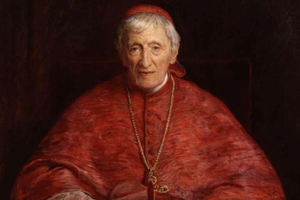
Elected to the papacy in 1878 after the long, defensive years of Blessed Pius IX, Pope Leo XIII advised paying close attention to his first cardinals. Included among them would be St. John Henry Newman, the towering intellectual convert who, while accepting the truth of Vatican I’s declaration of papal infallibility, thought it was not opportune to do so.
Cardinal Newman preferred engagement with modernity rather than estrangement from it. No other figure better represented the new approach of Leo XIII, a turn away from the defensive posture of Tridentine Catholicism toward evangelization of the new liberal order.
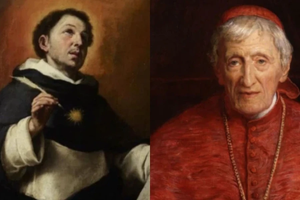
Now, Pope Leo XIV has made St. John Henry Newman his first doctor of the Church — a title granted to saints whose theological teaching is considered of the highest caliber. There have only been 38 saints (including Newman) who have been declared doctors of the Church, including Augustine of Hippo, Leo the Great, Gregory the Great, Thomas Aquinas and Bonaventure.
The Holy Father granted the title to Newman on July 31, the feast of St. Ignatius of Loyola, which falls between the feast days of two doctors of the Church: Peter Chrysologus (July 30) and Alphonsus Liguori (Aug. 1). Ignatius is not a doctor of the Church.
St. John Henry Newman, upon whom the title of “Doctor of the Church” will be conferred “soon” according to the Vatican announcement, is particularly apt now, as apt as he was in 1879 when created a cardinal. There are at least eight ways in which Newman is the doctor of the Church we need now.
Doctor of the Intellect
Newman’s life was devoted entirely to moving “from the shadows … into the truth” — the epitaph he composed for his tombstone. Assent to the truth is an act of the intellect, though Newman was sufficiently subtle and attentive to experience to recognize that other factors — our emotions, intuitions, relationships — can move us toward the ultimate Truth. Yet in a time when emotions reign supreme, and even faithful Christians try to discern God’s will in the sphere of subjective experience, Newman’s emphasis on the intellect as our faculty for knowing the truth is most welcome.
Newman’s conversion in 1845 was a cultural and ecclesial earthquake in England precisely because he was the most gifted religious intellect in the land. He may have been the most learned Englishman in a time when learning was highly esteemed.
In his homily at the Holy Mass with the cardinals the day after his election, Pope Leo XIV acknowledged that, “even today, there are many settings in which the Christian faith is considered absurd, meant for the weak and unintelligent.”
There are plenty of Christians who are absurd, weak and unintelligent, so that worldly judgment is partially understandable, but the Christian faith emphatically is not. Christians should aspire not to be weak and or unintelligent. Cardinal Newman was the exact opposite and thus a fitting model for today.
Doctor of Courage
The late Cardinal George Pell — he would have delighted in Newman’s elevation, and please God is doing so in heaven — often noted that courage was the virtue most needed now in ecclesial, cultural and political life. Courage has never been superabundant in the Church — see Holy Thursday — but Newman was courageous. Courage is not an intellectual virtue, and it is possible to be a skilled teacher and a coward.
Newman understood that the truth, once grasped, demanded consequences. It was not only a matter of intellectual assent but conversion of life. Thus he left his beloved Oxford life behind to become Catholic — a move at the time of considerable downward social standing.
After he became Catholic, he was viewed by some of the leading Catholic authorities in England as suspiciously liberal. Reactionary conservatism reigned in Rome. He bore doubts, criticisms and insults with equanimity, even as his private correspondence revealed that they inflicted a toll upon him. It took courage to continue his enquiry, to make his arguments, to engage in public controversy, having lost his former coreligionists and enduring suspicion from his new ones.
Doctor of Moderation
When Pope Benedict XVI went to Britain for the beatification of John Henry Newman in 2010 — the only beatification he traveled to preside over — he gave a landmark address at Westminster. He praised there Britain’s political institutions, which he said owe “much to the national instinct for moderation.”
Newman exemplified that instinct for moderation. He could be relentless in theological research, and insistent in the defense of truth, but he sought grounds for engagement. He first courted controversy while still an Anglican, arguing for an interpretation of Anglican teaching that was more sympathetic to Catholic claims. And when Catholic, he sought to find in 19th-century liberalism that which could be affirmed without compromising the faith.
In a digital environment that rewards extreme positions and sharpens disagreements, Newman’s moderation has much to teach today.
Doctor of Conviviality
When Newman converted to Catholicism in 1845 and prepared for priestly ordination thereafter, he discovered in the Oratory of St. Philip Neri the community he was looking for and introduced it to England. Newman lived as an Oratorian in Birmingham until his death in 1890, and his relics are venerated there.
In choosing St. Philip Neri as his model, Cardinal Newman chose the convivial approach over the combative one. In 16th-century Rome, with the post-Reformation challenges for the Church at their height, two saints offered contrasting, but not contradictory, approaches. Philip Neri was the “saint of gentleness and kindness” as Newman would write, while Ignatius of Loyola was the man of martial combat. Ignatius viewed Philip’s approach as too soft, unequal to the moment.
Both are needed, but Newman chose Philip Neri. It is therefore amusing that Leo chose the feast day of Ignatius to confer the title of “Doctor of the Church” on a son of St. Philip Neri.
Ignatius preached the importance of sentire cum Ecclesia (“thinking with the Church”) — and no one did it better than John Henry Newman. To think with the Church does not mean simply repeating with the Church. Thinking with the Church begins with thinking, and the convivial atmosphere of conversation, not combat, is conducive to working out one’s thoughts.
When setting out to found a Catholic university in Ireland, Newman set down his thoughts on the character of the men he wished to form. In his Definition of a Gentleman, Newman laid out what might be considered a thoroughgoing rebuke to the internet “manosphere” and its Catholic accomplices:
“[A gentleman] is never mean or little in his disputes, never takes unfair advantage, never mistakes personalities or sharp sayings for arguments, or insinuates evil which he dare not say out. From a long-sighted prudence, he observes the maxim of the ancient sage, that we should ever conduct ourselves towards our enemy as if he were one day to be our friend.”
Doctor of Conscience
Of all his teachings, it may be that Newman on conscience is most relevant today. When anti-authoritarian impulses animate both the Catholic left and right, conscience is often invoked to justify elevating private judgment over the authoritative teaching of the Church. Newman’s view was different, that conscience — the “aboriginal vicar of Christ” he called it — was the faculty by which we recognize and apply objective truths to our particular situations. Some of those truths have been taught by the magisterium. To oppose conscience and magisterium is thus something of a contradiction in terms, properly understood.
There cannot be any Catholic moral theology without a proper sense of the centrality of conscience. Newman is the most reliable teacher of such for our time.
Doctor of Prose and Poetry
I recall a conversation with the historian Conrad Black, himself a man of letters, about the perfectors of the English language. We agreed that Shakespeare claimed the title of the leading poet and playwright, but differed on prose. Black argued for Abraham Lincoln, perhaps betraying his interest in political history, and I argued for Cardinal Newman, certainly the consequence of my work as a Newman House chaplain on campus. On my side of the argument is the Irish literary giant James Joyce, who considered Newman the greatest writer of English prose.
Christianity is a faith of the Word. Words are of the highest importance. The quality of our words matters a great deal, and therefore they should be beautiful. Newman’s writings are beautiful, even musical. A more mundane manner of writing grows frustrated with his subordinate clauses, piled one gloriously upon another, and his adornment of subjects from a half-dozen different angles in the same sentence, like a light refracted through a diamond. If a reader does not treasure the beauty of Newman, the problem is with the reader, not Newman.
Some of his writing has been set to music. His poetry was not as vast as his other writings, but some of them come down to us as hymns: Lead Kindly Light, Firmly I Believe and Truly, Praise to the Holiest in the Height.
Doctor of Preaching
Newman was not an academic theologian insofar as he argued in scholarly books and journals. He, like the Fathers of the Church, was primarily a preacher — which may well explain his appeal to both Benedict XVI and Leo XIV, as patristics is of particular importance to both of them.
Newman was the preacher par excellence of this time, invited in 1850 — just five years after becoming Catholic — to preach on the occasion of the restoration of the hierarchy in England, the emancipation of the Catholic Church after three centuries of persecution.
Perhaps nobody can preach like Newman today, but when seminarians and young priests ask for homiletic advice, I always tell them: Pray less; read more. There are many worth reading to be sure, but Newman belongs near the top of any list.
Doctor of Unity
When Pope Francis declared St. Irenaeus of Lyon a doctor of the Church in 2022, he gave him the title of Doctor Unitatis (“Doctor of Unity”).
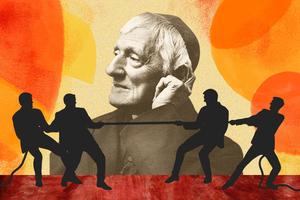
There is something of that in Newman, too. Liberals claim Newman for demurring from the reactionary conservatism of his time. Conservatives claim Newman for his declaration that he had devoted his whole life to fighting “against liberalism in religion.” Scripture scholars find in him a model of biblical theology. His devotion to the Church Fathers was not a matter of ossified traditionalism, but employing ancient sources — ressourcement — in creative new ways. He has often been called the “hidden father” of the Second Vatican Council, and therefore a formator of the formative council of our time.
In 2023, when the U.S. bishops decided to give their support to a petition to name Newman a doctor of the Church, Bishop Robert Barron said, “It might help to heal some of the divisions in our Church.”
The breadth of Newman’s teaching means that he cannot be enlisted for one faction over another. His teaching is truly ecclesial, speaking to the whole of Tradition, in a manner strikingly sympathetic to the challenges of our time.