God’s Sunflower: How the Bright Bloom Became a Catholic Symbol of Faith and Devotion
The fierce flower that always faces the sun can teach us all a great deal about human life.
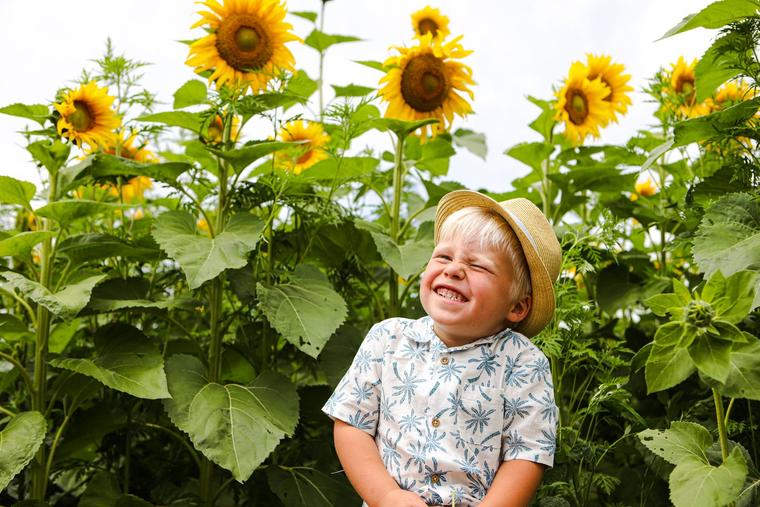
The sunflower is a bloom like no other: photogenic, massive and high in protein and vitamin E, as well as delicious, and full of Catholic symbolism. The gold and orange giants grow fast and tall, with roots planted deep, and — always — they face the sun. Even before they start blooming, they bend from east to west during the day and bend back again at night, ready to follow the sun again when it rises the next day. For that reason, several saints and the Blessed Mother have been associated with the bright and cheerful sunflower, symbolizing faith and devotion.
Our Lady of Charity, a Cuban devotion, is associated with sunflowers. During times of persecution in Cuba, sunflowers were placed on windows to represent Our Lady of Charity — mirroring the Virgin Mary’s constant focus on her Son Jesus just as the sunflower stays focused on the sun.
Some of the saints were attracted to the sunflower. St. Julie Billiart, foundress of the Sisters of Notre Dame, used the sunflower to remind people to keep their eyes fixed on God just as the flower always turns to the sun. It remains a symbol associated with the Sisters of Notre Dame. In a prayer, she wrote:
To be simple
Is to be like a sunflower
Which follows
All the movements
Of the sun and
Ever turns towards it.
St. Josephine Bakhita, an African saint freed from slavery who became a Canossian Daughter of Charity sister in Italy, is sometimes depicted with sunflowers, symbolizing her sunny disposition and joy despite past suffering. St. Mary Euphrasia, founder of the Sisters of the Good Shepherd, was captivated by sunflowers. She wrote:
“Like sunflowers that look towards the sun and as a compass needle seeks the pole, so your minds should always turn to our Lord, to Rome, to the Congregation.”
And St. (Padre) Pio, the 20th-century mystic and stigmatist, has been referred to as “God’s Sunflower” in Catholic writings, representing his loyal devotion entirely toward the Creator.
North Dakota, Sunflower Capital
God speaks to us through nature, and the joy that sunflowers bring naturally lifts hearts and souls to our Creator. In North Dakota, which leads the nation in sunflower production, every summer the blooming fields of the divine artistry turn the state’s highways and byways into living canvases. They draw visitors to the golden spectacle so that the North Dakota Tourism Department publishes an annual sunflower-bloom map in July and August.
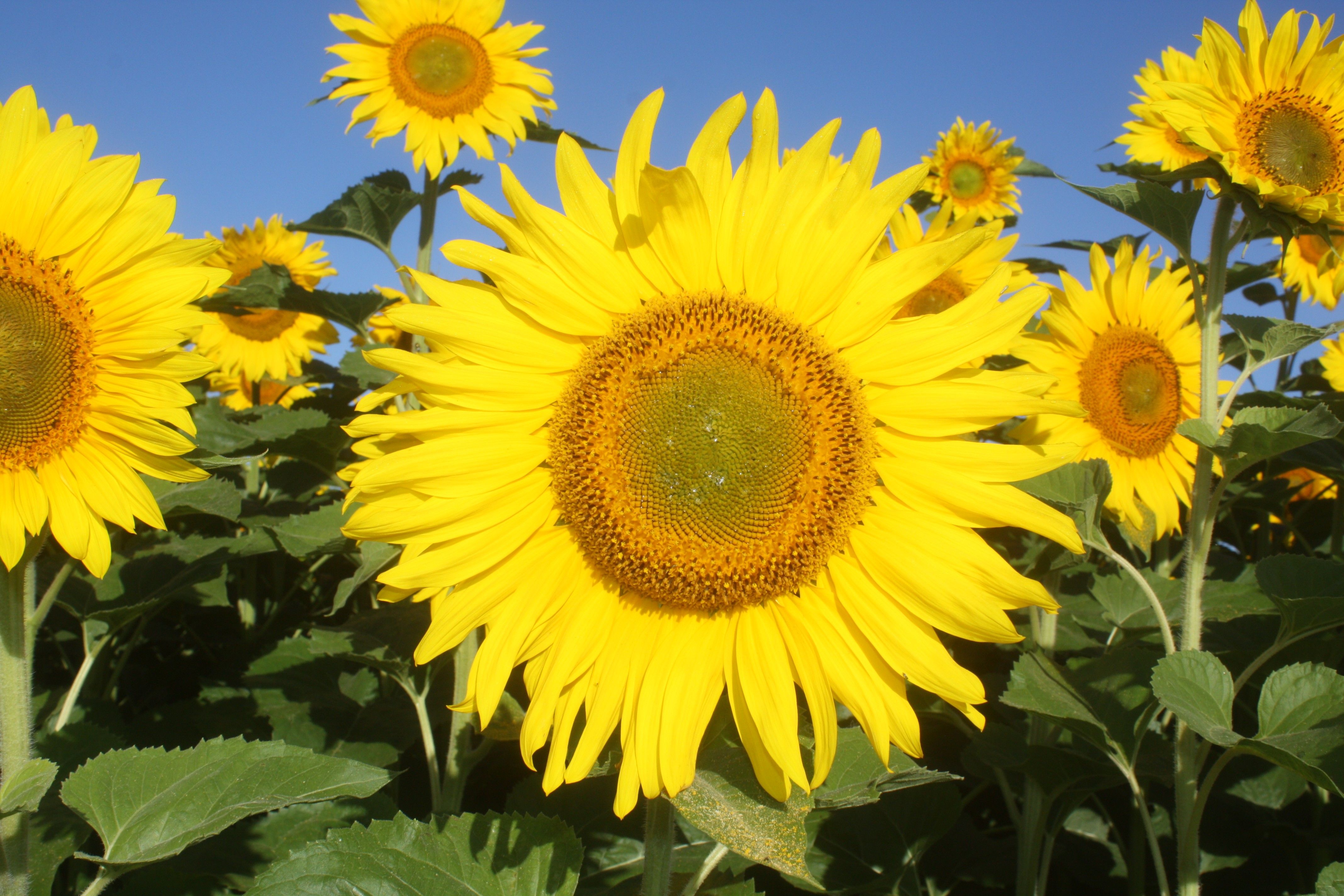
Last year’s sunflower output in North Dakota was 1.1 billion pounds, followed by South Dakota, with 817.2 million pounds. Minnesota and Texas had respective outputs of 132 million pounds and 61.3 million pounds; and Nebraska, California, Kansas, and Colorado contributed millions of more pounds collectively.
However, despite the flowers’ beauty and profitability, Ron Aberle, a sunflower grower in Menoken, North Dakota, told the Register that growing sunflowers is not for the faint of heart. He began growing them in 1978 with his own father when he was still in high school. While his wife Dawn runs the campground on their property, he, along with two brothers and one of his four children, farm together.
“Around 42%-45% of each seed is sunflower oil,” Aberle, a Catholic who attends the Church of St. Hildegard in Menoken, explained. “Crushing the plants extracts the oil; then the remaining sunflower meal has protein for cattle feed. I raise confection sunflowers too.” The sunflowers grown for eating have bigger but fewer seeds on their heads.
He credits sunflowers with helping to build their farm but points out that it carries some challenges too. For instance, too much moisture in middle to late summer can cause head rot. During harvest, which begins in early October, he hopes for drier weather. Excessive moisture during harvest — September has been very wet this year — saturates the ground so strong winds can knock down the large plants, making combining difficult. Just prior to harvest while the sunflowers need to dry out, there are massive flocks of blackbirds to be concerned about. They will sweep the fields, eating seeds as they go.
Noise-making strategies can scare them away, but Aberle said that the hundreds of thousands of birds just end up going from one field to another. Research into other pest control methods is ongoing. “One year, I had three-quarters of the sunflowers eaten by blackbirds,” he admitted.
If the sunflowers make it to harvest time, there’s another risk: fire. “When combining, the sunflowers have to be dry — 10% or less moisture,” he said. “But that makes them very flammable. There’s so many moving parts in the combine that static electricity is generated. We have to keep it clean to keep the fire danger low. Anyone raising sunflowers has had a fire in their combine, so we have a small firetruck that follows our combine. If we see smoke, we get out and check on it right away.”
Despite the many risks, Aberle says sunflowers have been good to him. “We have a beautiful sunflower crop right now,” he said, knowing that weather and the birds could change that.
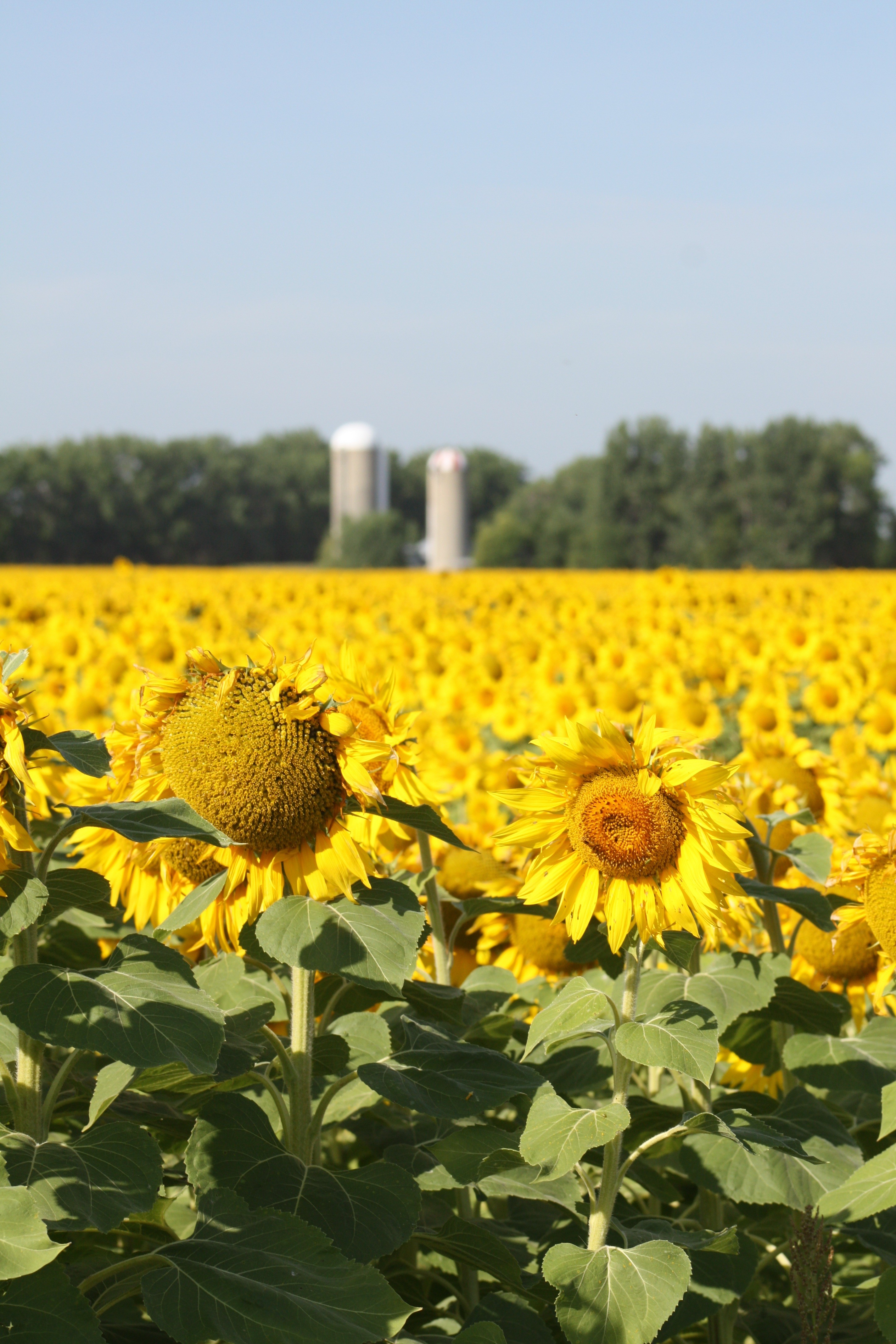
“You have to have faith in God to do what we do,” Aberle added. “We can only control a certain percent, and then the rest is up to the Lord. To farm, you need a thick stomach lining and faith in God. You have loss in life, but you don’t lose your faith over it — you lean on it all the more.”
Being so close to nature enhances his faith, he explained. “Watching nature in the course of the changing seasons helps keep me in touch with God and see that he is present in everything we do. It’s awesome.”
The Humanness of the Sunflower
Don Lilleboe has been writing about and photographing sunflowers for 46 years for the National Sunflower Association’s The Sunflower magazine. He has covered everything from farming and marketing to research and once hopped into a semitruck dubbed the “Sunflower Express” to report on seeds going to market around the world on ships in Lake Superior.
Lilleboe began covering the industry just as it began booming. “The nation’s sunflower acreage had doubled in just two years, going from 1.2 million harvested acres in 1975 to almost 2.4 million in 1977,” he wrote. “Acreage jumped again the following year, and then exploded in 1979 with an all-time peak of 5.4 million harvested acres in the four states being surveyed by USDA at that time: Minnesota, North Dakota, South Dakota and Texas. Total sunflower production that year was a whopping 7.3 billion lbs — nearly twice the size of the 1978 crop.”
He noted that, even after all these years, “I still enjoy going out to a field of sunflowers to take photographs. When they are in full bloom, they are gorgeous.”
“The sunflower reminds me of human life,” he explained further. “They germinate and are born and begin growing. They blossom like in adolescence and then become adults in full bloom. And then, by harvest, when they are old and at the end of their growing stage, they are no longer a beautiful sight, but that is when they are their most valuable.”
Photogenic Beauty
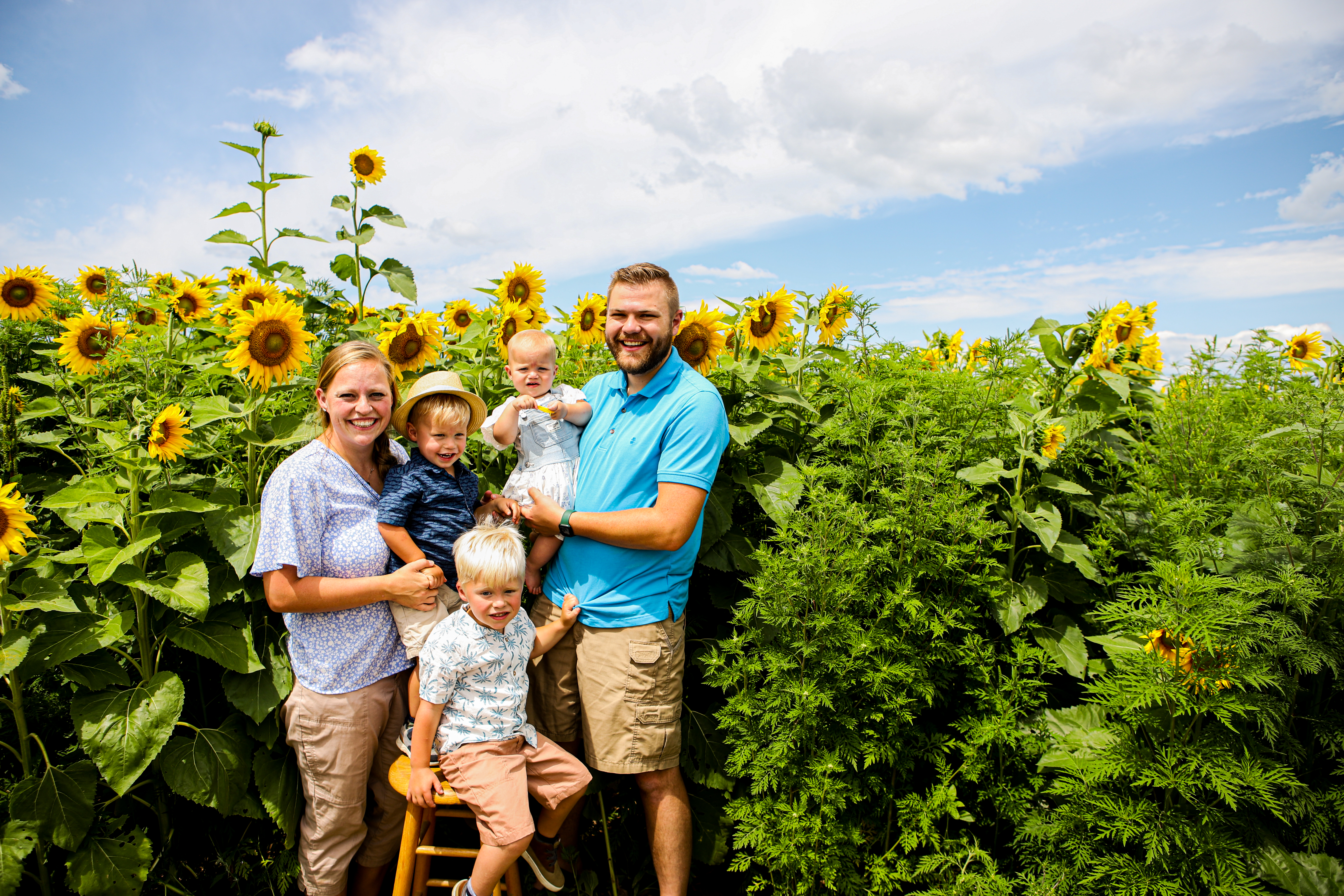
Emma Follet, a mother of four who lives in Wisconsin, annually photographs her family in front of a sunflower field on their way to a nearby Sunflower Festival.
“We’ve watched our family grow in front of the sunflower field,” she said. “Our family portraits started there when I was big and pregnant with our first. As our family and the kids get bigger, we take photos in front of the same sunflower field — it’s such a bright and cheerful place.”
“I’ve always loved what a cheerful, bright flower they are,” Follet said. She shared that they are part of some of her favorite memories, watching them grow in the backyard as a young girl and seeing their hardy resilience of repopulating and, as a young adult, picking wild ones along the road with her sister on road trips.
“It’s so powerful to see entire fields of sunflowers, growing together and moving toward the light in unison,” she added. “Our Creator has a plan for all of us, and it’s pretty incredible to see it reflected in the sunflower.”
BONUS
Thirteen more reasons to love the sunflower.
- Keywords:
- flowers

Patti Maguire Armstrong Patti (Maguire) Armstrong is an award-winning journalist and was managing editor and co-author of the bestselling Amazing Grace Series. Her latest books are the humorous and inspirational second-edition Dear God, I Don't Get It, Dear God, You Can't Be Serious!, What Would Monica Do?, Holy Hacks and Michelle Duppong: Hope in the Depths of Suffering. Patti worked in social work and public administration before staying home as a freelance writer while she and Mark raised their 10 children in North Dakota. Follow her on Twitter at @PattiArmstrong and read her blog at PattiMaguireArmstrong.com.